01 / Morfologi

Ciri dan struktur

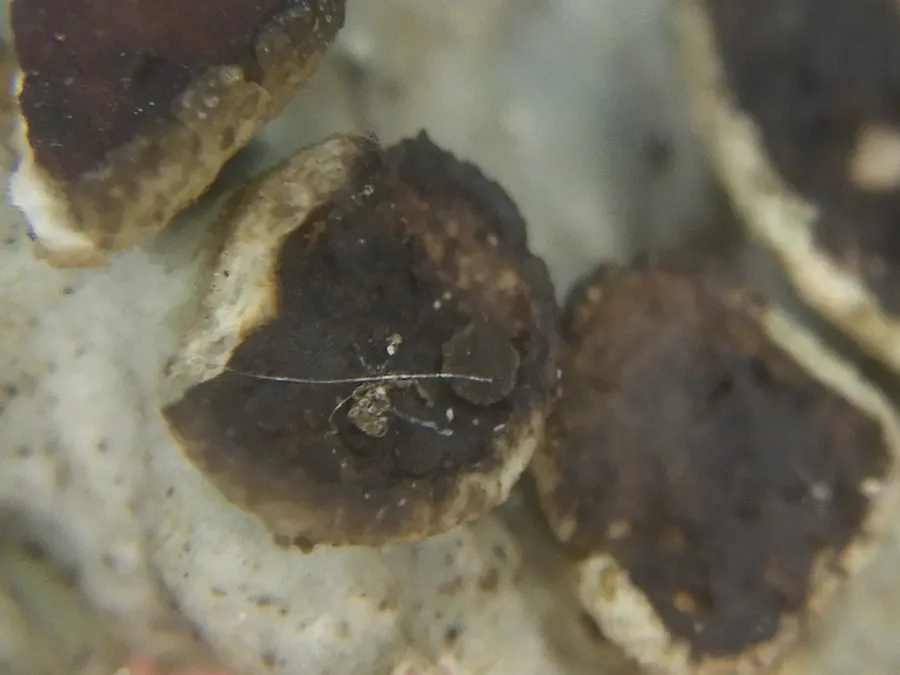
Abrothallus halei forms minute, dome-shaped fruiting bodies (apothecia) that erupt through the surface of its Lobaria host, most often on the lichen's own apothecia. Each measures roughly 0.2–0.55 mm across and about 0.15 mm tall and is frequently pinched in at the base so older examples look faintly stalked. When young the outer surface is cloaked in a vivid olive-green, powdery coating () that can be lost with age, exposing an underlying black wall. In vertical section the cup lacks a distinct rim, its wall being made of radiating fungal threads that surround a pale-brown supportive layer (). Above this sits the hymenium, a spore-producing tissue about 50 micrometres (μm) tall that is clear below but infused with olive-green pigment granules in the upper part; these granules dissolve in potassium hydroxide solution, a routine diagnostic test. Between the spore sacs run very slender, forked sterile filaments (paraphyses) barely 2 μm thick at the tip. The sacs themselves (asci) are double-walled and , meaning the two walls separate like a telescope when the spores are released. They are club-shaped, 40–60 μm long by 9–12 μm wide and usually hold eight spores. The brown, ellipsoid spores are initially two-celled but mature into four-celled bodies only 9–14 μm long and 3–5 μm wide. A deep waist at the middle septum allows each mature spore to break neatly into a pair of identical two-celled "part-spores" even while still inside the ascus, a feature unique within the genus. Viewed at high magnification the spore wall is dotted with minute "warts", and no asexual reproductive stage had yet been observed.

Sebagian uraian ditampilkan dalam bahasa sumber; terjemahannya belum tersedia atau belum lolos pemeriksaan.

Rujukan: [1]

Pengukuran mengikuti objek, spesimen atau kultur, dan metode yang disebutkan sumber. Baca uraian asli untuk konteks lengkap.

02 / Kehidupan

Habitat dan peran ekologis

Abrothallus halei is a species of lichenicolous (lichen-dwelling) fungus in the family Abrothallaceae. It was formally described as a new species in 2010 by the lichenologists Sergio Pérez-Ortega, Ave Suija, David Leslie Hawksworth, and Rolf Santesson. The type specimen was collected by Cliff Wetmore east of Hare Lake (Superior National Forest, Minnesota) at an elevation of 550 m; there it was found on the foliose lichen Lobaria quercizans, which itself was growing on the bark of Acer saccharum. The fungus has also been collected in West Virginia, Maine, as well as in Norway. The species epithet honours American lichenologist Mason Hale.

Sebagian uraian ditampilkan dalam bahasa sumber; terjemahannya belum tersedia atau belum lolos pemeriksaan.

Rujukan: [1]

Habitat atau konteks temuan
hutan
Substrat
Informasi belum tersedia pada sumber rilis ini.
Peran atau konteks
Pembentuk liken
Temukan hubungan serupa
03 / Siklus hidup

Reproduksi

In vertical section the cup lacks a distinct rim, its wall being made of radiating fungal threads that surround a pale-brown supportive layer (). Above this sits the hymenium, a spore-producing tissue about 50 micrometres (μm) tall that is clear below but infused with olive-green pigment granules in the upper part; these granules dissolve in potassium hydroxide solution, a routine diagnostic test. Between the spore sacs run very slender, forked sterile filaments (paraphyses) barely 2 μm thick at the tip. The sacs themselves (asci) are double-walled and , meaning the two walls separate like a telescope when the spores are released. They are club-shaped, 40–60 μm long by 9–12 μm wide and usually hold eight spores.

Sebagian uraian ditampilkan dalam bahasa sumber; terjemahannya belum tersedia atau belum lolos pemeriksaan.

Rujukan: [1]

04 / Batas informasi

Catatan identitas dan cakupan

  • Nama diterima mengikuti Catalogue of Life Base2026-09-11; uraian mempertahankan konsep dan nama sumber aslinya.
  • Original geographic, specimen and life-cycle scope retained; source import awaits individual editorial review.
  • Impor dan terjemahan otomatis belum diperiksa editorial per profil. Struktur reproduktif yang disebutkan tidak membuktikan seluruh siklus hidup diketahui.
  • Pengukuran pada uraian mengikuti spesimen, kultur, dan metode sumber; angka tidak diperluas ke semua populasi.

Catatan distribusi dalam narasi mengikuti sumbernya. Dokumentasi spesimen atau foto mengikuti catatan sumber. Bukti wilayah Indonesia dan penilaian konservasi tidak disimpulkan dari gambar.

05 / Dokumentasi

Melihat dengan konteks

Dokumentasi Abrothallus halei menurut asosiasi foto pada record takson iNaturalist. Kredit: Fotografer tidak dicantumkan. Sumber observasi iNaturalist; pengunggah: Jonny Tostenson. Identitas mengikuti sumber; bukan penentuan spesimen independen.

Jenis
Fotografi
Kredit
Fotografer tidak dicantumkan. Sumber observasi iNaturalist; pengunggah: Jonny Tostenson
Lisensi
CC0 1.0
Sumber media
Buka entri sumber

Gambar menunjukkan objek menurut identifikasi sumber, bukan verifikasi independen spesimen oleh Fungi. Tidak ada skala baru yang ditambahkan.

06 / Rujukan

Sumber profil

  1. [1] Abrothallus halei — Wikipedia (en)Bagian sumber: Frozen revision 1294116508
    Tanggal penghimpunan sumber: 2026-10-12
    Teks sumber: CC BY-SA4.0 · Wikipedia contributors
  2. [2] Catalogue of Life Base2026-09-11 — Abrothallus haleiBagian sumber: ColDP NameUsage.tsv ID 8MDS; accepted species; source 2073
    Tanggal penghimpunan sumber: 2026-10-12
  3. [3] Dokumentasi visual — Abrothallus haleiBagian sumber: Individual media record; identification follows the source, not independent determination
    Tanggal penghimpunan sumber: 2026-10-12
    Media sumber: CC0 1.0 · Fotografer tidak dicantumkan. Sumber observasi iNaturalist; pengunggah: Jonny Tostenson

Adaptasi teks: CC BY-SA 4.0. Wikipedia contributors — Abrothallus halei — Wikipedia (en)

Uraian asli dan riwayat sumber

Riwayat atau halaman sumber

Ringkasan sumber

Abrothallus halei is a species of lichenicolous (lichen-dwelling) fungus in the family Abrothallaceae. It was formally described as a new species in 2010 by the lichenologists Sergio Pérez-Ortega, Ave Suija, David Leslie Hawksworth, and Rolf Santesson. The type specimen was collected by Cliff Wetmore east of Hare Lake (Superior National Forest, Minnesota) at an elevation of 550 m; there it was found on the foliose lichen Lobaria quercizans, which itself was growing on the bark of Acer saccharum.

Revisi sumber

Morfologi sumber

Abrothallus halei forms minute, dome-shaped fruiting bodies (apothecia) that erupt through the surface of its Lobaria host, most often on the lichen's own apothecia. Each measures roughly 0.2–0.55 mm across and about 0.15 mm tall and is frequently pinched in at the base so older examples look faintly stalked. When young the outer surface is cloaked in a vivid olive-green, powdery coating () that can be lost with age, exposing an underlying black wall. In vertical section the cup lacks a distinct rim, its wall being made of radiating fungal threads that surround a pale-brown supportive layer (). Above this sits the hymenium, a spore-producing tissue about 50 micrometres (μm) tall that is clear below but infused with olive-green pigment granules in the upper part; these granules dissolve in potassium hydroxide solution, a routine diagnostic test. Between the spore sacs run very slender, forked sterile filaments (paraphyses) barely 2 μm thick at the tip. The sacs themselves (asci) are double-walled and , meaning the two walls separate like a telescope when the spores are released. They are club-shaped, 40–60 μm long by 9–12 μm wide and usually hold eight spores. The brown, ellipsoid spores are initially two-celled but mature into four-celled bodies only 9–14 μm long and 3–5 μm wide. A deep waist at the middle septum allows each mature spore to break neatly into a pair of identical two-celled "part-spores" even while still inside the ascus, a feature unique within the genus. Viewed at high magnification the spore wall is dotted with minute "warts", and no asexual reproductive stage had yet been observed.

Revisi sumber

Ekologi sumber

Abrothallus halei is a species of lichenicolous (lichen-dwelling) fungus in the family Abrothallaceae. It was formally described as a new species in 2010 by the lichenologists Sergio Pérez-Ortega, Ave Suija, David Leslie Hawksworth, and Rolf Santesson. The type specimen was collected by Cliff Wetmore east of Hare Lake (Superior National Forest, Minnesota) at an elevation of 550 m; there it was found on the foliose lichen Lobaria quercizans, which itself was growing on the bark of Acer saccharum. The fungus has also been collected in West Virginia, Maine, as well as in Norway. The species epithet honours American lichenologist Mason Hale.

Revisi sumber

Struktur reproduksi sumber

In vertical section the cup lacks a distinct rim, its wall being made of radiating fungal threads that surround a pale-brown supportive layer (). Above this sits the hymenium, a spore-producing tissue about 50 micrometres (μm) tall that is clear below but infused with olive-green pigment granules in the upper part; these granules dissolve in potassium hydroxide solution, a routine diagnostic test. Between the spore sacs run very slender, forked sterile filaments (paraphyses) barely 2 μm thick at the tip. The sacs themselves (asci) are double-walled and , meaning the two walls separate like a telescope when the spores are released. They are club-shaped, 40–60 μm long by 9–12 μm wide and usually hold eight spores.

Revisi sumber

Rujukan halaman ini

Fungi. Abrothallus halei. Rilis data fungi-2026-10-12-expansion-2. https://fungi-atlas.mgadib.chatgpt.site/jamur/abrothallus-halei/.

Status: impor sumber; pemeriksaan editorial per profil belum selesai. Untuk klaim biologis, gunakan rujukan pada bagian terkait dan periksa konteks sumber aslinya.
