Ciri dan struktur
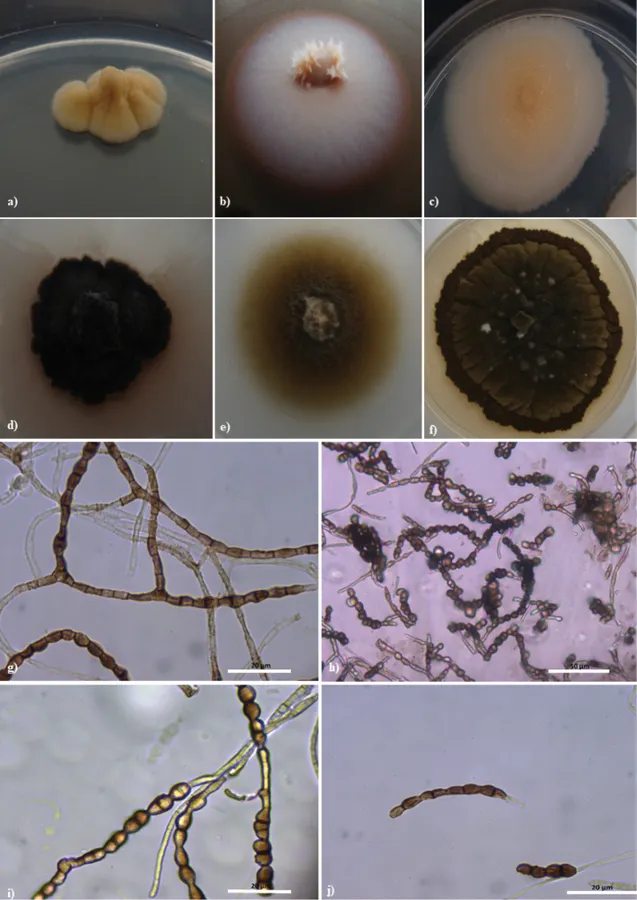
Phylogenetic analysis based on the concatenated ITS rDNA, LSU and rpb2 dataset considered in the present study clustered the retrieved strains in a monophyletic separate lineage related to the families Neodevriesiaceae and Extremaceae. Therefore, a new family Aeminiaceae fam. nov, a new genus Aeminium gen. nov., and a new species Aeminium ludgeri sp. nov. in the order Capnodiales are here proposed. Mycelium initially consisting of branched, septate, smooth, subhyaline to pale green, 2–3 μm wide hyphae. Hyphae moniliform, gradually becoming widen, thick-walled, darker and developing into meristematic conidial chains. Conidiophores micronematous. Arthroconidia dark brown, thick-walled, smooth, sometimes rugose, globose, measuring 3.5–6 × 4.5–6 μm, single central septa, resulting from the differentiation of intercalary or terminal toruloid-like hyphal cells. Sexual morph unknown. On 6 weeks old PDA plates, colonies growing slowly, to 8 mm in diameter, cerebriform, irregular, raised centrally, often moist, deeply immersed into agar, pale pink, with scarce velvety, pale pink-hyaline, aerial, short hyphae and well-defined, small, white, and glossy margin; pale pink on reverse. After at least 2 months, colonies become fully mature and melanized, olivaceous brown-black on top and on reverse. On 6 weeks old MEA +10% NaCl plates, colonies growing slowly, to 25 mm in diameter, flat, circular, moist, pale pink, with prominent velvety pale pink-hyaline aerial short hyphae and with undulate margin; pale pink in reverse. After at least 2 months, colonies become fully mature and melanized, with velvety grey-white aerial short hyphae, filiform margin, olivaceous brown on top and in reverse.
Habitat dan peran ekologis
Portugal, Coimbra (40°12'32"N, 8°25'38"W), isolated from a biodeteriorated limestone art piece in the Old Cathedral of Coimbra, 22 November 2016, Igor Tiago, (holotype: permanently preserved in metabolically inactive state DSM 106916). Portugal, Coimbra (40°12'32"N, 8°25'38"W), isolated from a biodeteriorated limestone art piece in the Old Cathedral of Coimbra, I. Tiago, living culture E8, ibid. living culture E11, ibid. living culture E12, ibid. living culture E13, ibid. living culture E14, ibid. living culture E15, ibid. living culture E16, ibid. living culture E17, ibid. living culture E18; ibid. living culture E19.
- Habitat atau konteks temuan
- kultur yang didokumentasikan
- Substrat
- Informasi belum tersedia pada sumber rilis ini.
- Peran atau konteks
- Belum dikategorikan pada rilis ini.
Reproduksi
Mycelium initially consisting of branched, septate, smooth, subhyaline to pale green, 2–3 μm wide hyphae. Hyphae moniliform, gradually becoming widen, thick-walled, darker and developing into meristematic conidial chains. Conidiophores micronematous. Arthroconidia dark brown, thick-walled, smooth, sometimes rugose, globose, measuring 3.5–6 × 4.5–6 μm, single central septa, resulting from the differentiation of intercalary or terminal toruloid-like hyphal cells. Sexual morph unknown.
Catatan identitas dan cakupan
- Nama diterima mengikuti Catalogue of Life Base2026-09-11; uraian mempertahankan konsep dan nama sumber aslinya.
- Preserve original treatment localities, hosts and substrate scope. Materials examined describe documented specimens, not the full global range.
- Impor dan terjemahan otomatis belum diperiksa editorial per profil. Struktur reproduktif yang disebutkan tidak membuktikan seluruh siklus hidup diketahui.
- Pengukuran pada uraian mengikuti spesimen, kultur, dan metode sumber; angka tidak diperluas ke semua populasi.
Catatan distribusi dalam narasi mengikuti sumbernya. Dokumentasi spesimen atau foto mengikuti catatan sumber. Bukti wilayah Indonesia dan penilaian konservasi tidak disimpulkan dari gambar.
Melihat dengan konteks
Aeminium ludgeri a Colony appearance on PDA b Colony appearance on MEA +10% NaCl (w/v) c Colony appearance on DG-18 d Colony appearance on PDA after maturation e Colony appearance on MEA +10% NaCl (w/v) after maturation f Colony appearance on DG-18 after maturation g Initial simple, branched, septate hyphae becoming toruloid-like (scale 20 μm) h Differentiated, toruloid-like hyphae and mature chains of arthroconidia (scale 50 μm) i Intercalary and terminal conidial chains (scale 20 μm); j typical aspect of arthroconidia (scale 20 μm)
- Jenis
- Pelat ilmiah
- Kredit
- João rovão, Igor Tiago, Fabiana Soares, Diana Sofia Paiva, Nuno Mesquita, Catarina Coelho, Lídia atarino, Francisco Gil, António ortugal
- Lisensi
- CC BY 4.0
- Sumber media
- Buka entri sumber
Sumber profil
- [1] Description of Aeminiaceae fam. nov., Aeminium gen. nov. and Aeminium ludgeri sp. nov. (Capnodiales), isolated from a biodeteriorated art-piece in the Old Cathedral of Coimbra, Portugal — Aeminium ludgeri
- [2] Catalogue of Life Base2026-09-11 — Aeminium ludgeri
- [3] Dokumentasi visual — Aeminium ludgeri
Rujukan halaman ini
Fungi. Aeminium ludgeri. Rilis data fungi-2026-10-12-expansion-2. https://fungi-atlas.mgadib.chatgpt.site/jamur/aeminium-ludgeri/.
Status: impor sumber; pemeriksaan editorial per profil belum selesai. Untuk klaim biologis, gunakan rujukan pada bagian terkait dan periksa konteks sumber aslinya.