01 / Morfologi

Ciri dan struktur

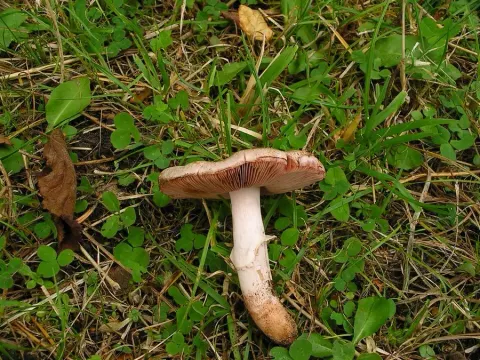
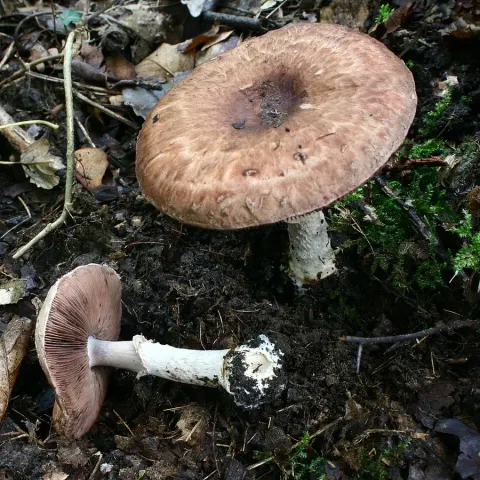
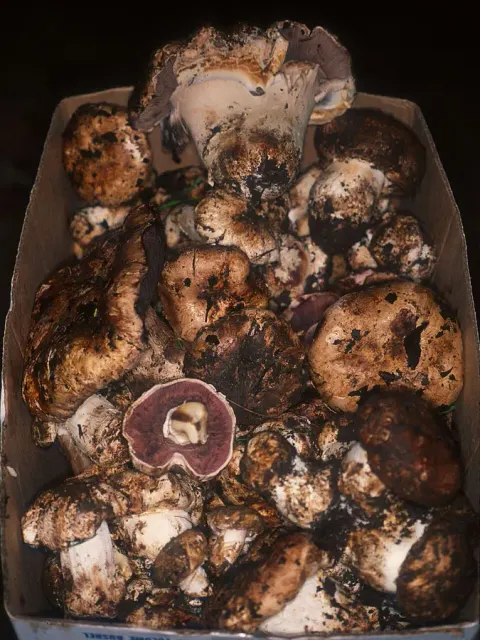
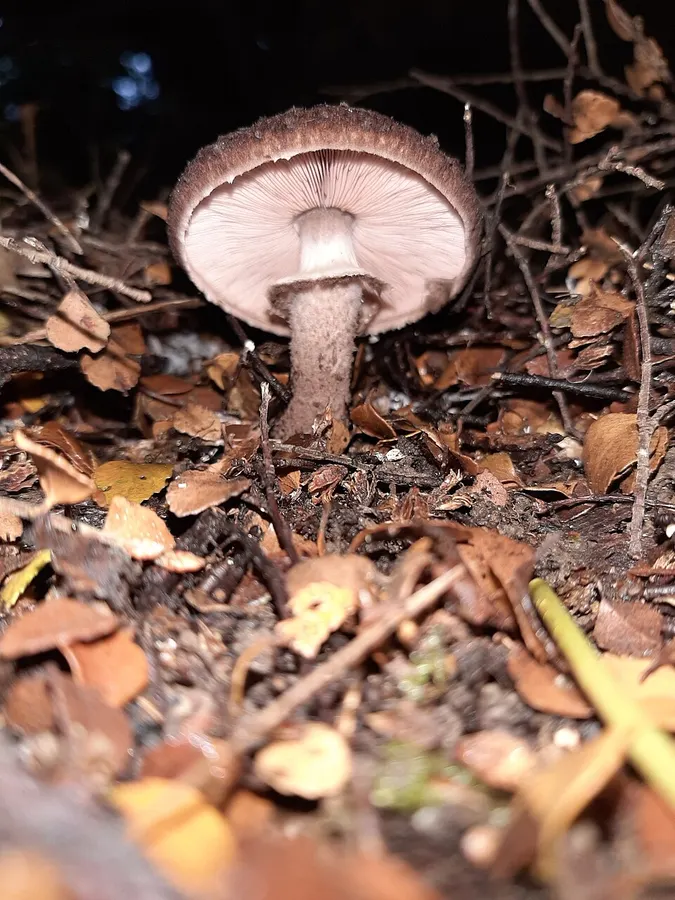
The pileus (cap) can vary from a spherical to a convex shape. Smaller specimens tend to have more spherical pileus, while larger are more flattened convex shape, although both have round shape when viewed from above. The dark brown, feltlike cap can be up to 12 cm wide. The gills consist of thin pink filaments, stemming from the underside of the pileus without touching the stem. This forms a small ring around the stem less than 1 mm long. About a third of the length of the stem is a 1-mm thick skirt. This extends 10 mm out from the stem. Above the skirt, the stem is tan or pale colour. While underneath, the colour transitions from light brown to dark brown or black like the cap's colour. The spores are opaque chocolate brown, ellipsoid and 5.3–6.0 (6.5) X 3.4–3.7 μm in size. The basidia are 18–24 X 6.5–7.2 μm, transparent and have 4 spores each. The gills have abundant transparent cheilocystidia which are pear to club shaped and 20–25 X 7–12 μm. The stem is 3 to 5 cm long and 12–14 mm thick, generally wider toward the base. Inside the stem is a white, hollow column beginning at gill level but sealed at the bottom. Beneath the ground, the bulbous shape has many small root-like filaments. The stem's insides are white with a hollow center.

Sebagian uraian ditampilkan dalam bahasa sumber; terjemahannya belum tersedia atau belum lolos pemeriksaan.

Rujukan: [1]

Pengukuran mengikuti objek, spesimen atau kultur, dan metode yang disebutkan sumber. Baca uraian asli untuk konteks lengkap.

02 / Kehidupan

Habitat dan peran ekologis

Agaricus lanatoniger has been found in nine different terrestrial locations, primarily in New Zealand. The mean annual temperature for all locations ranges from 6.98–15.10 C. Due to New Zealand's temperate climate, this fluctuates throughout its four distinct seasons. Most samples show the species in the ground of forests, but the type of forest has not been noted.

Sebagian uraian ditampilkan dalam bahasa sumber; terjemahannya belum tersedia atau belum lolos pemeriksaan.

Rujukan: [1]

Habitat atau konteks temuan
Informasi belum tersedia pada sumber rilis ini.
Substrat
Informasi belum tersedia pada sumber rilis ini.
Peran atau konteks
Belum dikategorikan pada rilis ini.
Temukan hubungan serupa
03 / Siklus hidup

Reproduksi

The spores are opaque chocolate brown, ellipsoid and 5.3–6.0 (6.5) X 3.4–3.7 μm in size. The basidia are 18–24 X 6.5–7.2 μm, transparent and have 4 spores each. The gills have abundant transparent cheilocystidia which are pear to club shaped and 20–25 X 7–12 μm.

Sebagian uraian ditampilkan dalam bahasa sumber; terjemahannya belum tersedia atau belum lolos pemeriksaan.

Rujukan: [1]

04 / Batas informasi

Catatan identitas dan cakupan

  • Nama diterima mengikuti Catalogue of Life Base2026-09-11; uraian mempertahankan konsep dan nama sumber aslinya.
  • Original geographic, specimen and life-cycle scope retained; source import awaits individual editorial review.
  • Impor dan terjemahan otomatis belum diperiksa editorial per profil. Struktur reproduktif yang disebutkan tidak membuktikan seluruh siklus hidup diketahui.
  • Pengukuran pada uraian mengikuti spesimen, kultur, dan metode sumber; angka tidak diperluas ke semua populasi.

Catatan distribusi dalam narasi mengikuti sumbernya. Dokumentasi spesimen atau foto mengikuti catatan sumber. Bukti wilayah Indonesia dan penilaian konservasi tidak disimpulkan dari gambar.

05 / Dokumentasi

Melihat dengan konteks

Dokumentasi Agaricus lanatoniger dari Wikimedia Commons. Photo of Agaricus lanatoniger uploaded from iNaturalist . Identifikasi mengikuti record berkas sumber.

Jenis
Fotografi
Kredit
(c) J. Brand, some rights reserved (CC BY)
Lisensi
CC BY 4.0
Sumber media
Buka entri sumber

Gambar menunjukkan objek menurut identifikasi sumber, bukan verifikasi independen spesimen oleh Fungi. Tidak ada skala baru yang ditambahkan.

06 / Rujukan

Sumber profil

  1. [1] Agaricus lanatoniger — Wikipedia (en)Bagian sumber: Frozen revision 1331437114
    Tanggal penghimpunan sumber: 2026-10-12
    Teks sumber: CC BY-SA4.0 · Wikipedia contributors
  2. [2] Catalogue of Life Base2026-09-11 — Agaricus lanatonigerBagian sumber: ColDP NameUsage.tsv ID 5TN54; accepted species; source 2073
    Tanggal penghimpunan sumber: 2026-10-12
  3. [3] Dokumentasi visual — Agaricus lanatonigerBagian sumber: Individual media record; identification follows the source, not independent determination
    Tanggal penghimpunan sumber: 2026-10-12
    Media sumber: CC BY 4.0 · (c) J. Brand, some rights reserved (CC BY)

Adaptasi teks: CC BY-SA 4.0. Wikipedia contributors — Agaricus lanatoniger — Wikipedia (en)

Uraian asli dan riwayat sumber

Riwayat atau halaman sumber

Ringkasan sumber

The pileus (cap) can vary from a spherical to a convex shape. Smaller specimens tend to have more spherical pileus, while larger are more flattened convex shape, although both have round shape when viewed from above. The dark brown, feltlike cap can be up to 12 cm wide. The gills consist of thin pink filaments, stemming from the underside of the pileus without touching the stem. This forms a small ring around the stem less than 1 mm long. About a third of the length of the stem is a 1-mm thick skirt.

Revisi sumber

Morfologi sumber

The pileus (cap) can vary from a spherical to a convex shape. Smaller specimens tend to have more spherical pileus, while larger are more flattened convex shape, although both have round shape when viewed from above. The dark brown, feltlike cap can be up to 12 cm wide. The gills consist of thin pink filaments, stemming from the underside of the pileus without touching the stem. This forms a small ring around the stem less than 1 mm long. About a third of the length of the stem is a 1-mm thick skirt. This extends 10 mm out from the stem. Above the skirt, the stem is tan or pale colour. While underneath, the colour transitions from light brown to dark brown or black like the cap's colour. The spores are opaque chocolate brown, ellipsoid and 5.3–6.0 (6.5) X 3.4–3.7 μm in size. The basidia are 18–24 X 6.5–7.2 μm, transparent and have 4 spores each. The gills have abundant transparent cheilocystidia which are pear to club shaped and 20–25 X 7–12 μm. The stem is 3 to 5 cm long and 12–14 mm thick, generally wider toward the base. Inside the stem is a white, hollow column beginning at gill level but sealed at the bottom. Beneath the ground, the bulbous shape has many small root-like filaments. The stem's insides are white with a hollow center.

Revisi sumber

Ekologi sumber

Agaricus lanatoniger has been found in nine different terrestrial locations, primarily in New Zealand. The mean annual temperature for all locations ranges from 6.98–15.10 C. Due to New Zealand's temperate climate, this fluctuates throughout its four distinct seasons. Most samples show the species in the ground of forests, but the type of forest has not been noted.

Revisi sumber

Struktur reproduksi sumber

The spores are opaque chocolate brown, ellipsoid and 5.3–6.0 (6.5) X 3.4–3.7 μm in size. The basidia are 18–24 X 6.5–7.2 μm, transparent and have 4 spores each. The gills have abundant transparent cheilocystidia which are pear to club shaped and 20–25 X 7–12 μm.

Revisi sumber

Rujukan halaman ini

Fungi. Agaricus lanatoniger. Rilis data fungi-2026-10-12-expansion-2. https://fungi-atlas.mgadib.chatgpt.site/jamur/agaricus-lanatoniger/.

Status: impor sumber; pemeriksaan editorial per profil belum selesai. Untuk klaim biologis, gunakan rujukan pada bagian terkait dan periksa konteks sumber aslinya.