Ciri dan struktur
The species is distinct by having corticioid basidiomata, a compact texture, simple-septate generative hyphae, abundant acanthophyses, basidia with an acanthophysoid appendage and smooth basidiospores 7–10 × 4–6 μm and growing on bamboo. Hyphal system monomitic; generative hyphae simple-septate, colourless, thin- to thick-walled, scattered near the substrate, 2–4 μm in diam. Subiculum thin to indistinct. Subhymenium thick, with compact texture, composed of acanthophyses and gloeocystidia. Acanthophyses abundant, hyphoid or distinctly swollen in the middle part, colourless, thin-walled, with abundant spines in apex, 30–40 × 3–12 μm. Gloeocystidia abundant, flexuous or slightly moniliform with one to several constrictions, slightly thick-walled, negative in sulphobenzaldehyde, 30–55 × 8–13 μm. Basidia subclavate to subcylindrical, colourless, slightly thick-walled, usually with a lateral acanthophysoid appendage, with four sterigmata and a basal simple septum, 25–35 × 7–9 μm. Basidiospores ellipsoid to broadly ellipsoid, bearing a distinct apiculus, colourless, thin-walled, smooth, amyloid, 7–10 × 4–6 μm, L = 8.7 μm, W = 4.9 μm, Q = 1.6–1.9 (n = 90/3).
Habitat dan peran ekologis
Aleurodiscus bambusinus is morphologically similar and phylogenetically close to A. dextrinoideophyses S.H. He and A. tropicus L.D. Dai & S.H. He that also grow on bamboo in East Asia (Dai et al. 2017a, b). Aleurodiscus dextrinoideophyses differs from A. bambusinus by having apparently dextrinoid acanthophyses and smaller basidiospores (5–7 × 3–4 μm, Dai et al. 2017b). Aleurodiscus tropicus differs from A. bambusinus by having a looser texture and slightly larger basidiospores (9–12 × 5–7.5 μm, Dai et al. 2017a). The ITS similarity between A. bambusinus (He 4261) and A. dextrinoideophyses (He 4105) is 95.6% of 434 base pairs and, between A. bambusinus (He 4261) and A. tropicus (He 3830), is 97.3% of 582 base pairs. Aleurodiscus aberrans G. Cunn. and A. rimulosus Núñez & Ryvarden are also similar to A. bambusinus, but they differ from this new species by having smooth basidia and growing on angiosperm wood outside of Asia (Núñez and Ryvarden 1997).
- Habitat atau konteks temuan
- Informasi belum tersedia pada sumber rilis ini.
- Substrat
- Informasi belum tersedia pada sumber rilis ini.
- Peran atau konteks
- Belum dikategorikan pada rilis ini.
Reproduksi
The species is distinct by having corticioid basidiomata, a compact texture, simple-septate generative hyphae, abundant acanthophyses, basidia with an acanthophysoid appendage and smooth basidiospores 7–10 × 4–6 μm and growing on bamboo. Hyphal system monomitic; generative hyphae simple-septate, colourless, thin- to thick-walled, scattered near the substrate, 2–4 μm in diam. Subiculum thin to indistinct. Subhymenium thick, with compact texture, composed of acanthophyses and gloeocystidia. Acanthophyses abundant, hyphoid or distinctly swollen in the middle part, colourless, thin-walled, with abundant spines in apex, 30–40 × 3–12 μm. Gloeocystidia abundant, flexuous or slightly moniliform with one to several constrictions, slightly thick-walled, negative in sulphobenzaldehyde, 30–55 × 8–13 μm.
Catatan identitas dan cakupan
- Nama diterima mengikuti Catalogue of Life Base2026-09-11; uraian mempertahankan konsep dan nama sumber aslinya.
- Preserve original treatment localities, hosts and substrate scope. Materials examined describe documented specimens, not the full global range.
- Impor dan terjemahan otomatis belum diperiksa editorial per profil. Struktur reproduktif yang disebutkan tidak membuktikan seluruh siklus hidup diketahui.
- Pengukuran pada uraian mengikuti spesimen, kultur, dan metode sumber; angka tidak diperluas ke semua populasi.
Catatan distribusi dalam narasi mengikuti sumbernya. Dokumentasi spesimen atau foto mengikuti catatan sumber. Bukti wilayah Indonesia dan penilaian konservasi tidak disimpulkan dari gambar.
Melihat dengan konteks
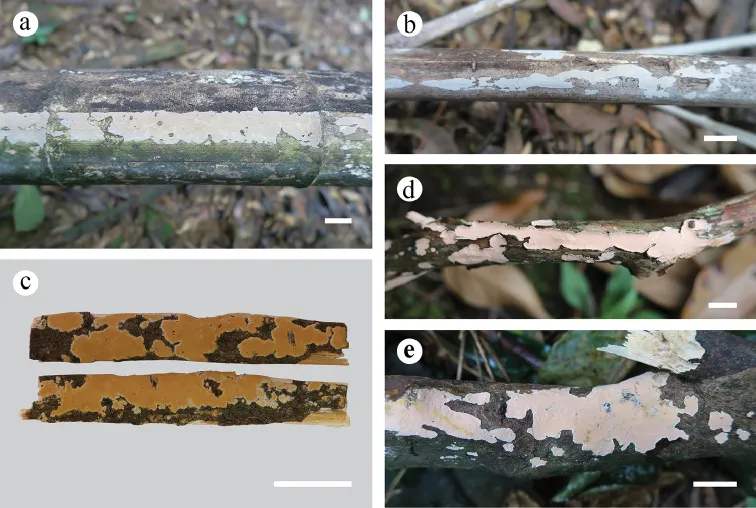
Basidiomata. a–b Aleurodiscus bambusinus (a He 4250 b holotype, He 4261) c A. isabellinus (holotype, KKN-2017-19) d–e A. subroseus (d He 5571 e He 4895). Scale bars: 1 cm.
- Jenis
- Pelat ilmiah
- Kredit
- Yan Tian, Masoomeh Ghobad-Nejhad, Shuang-Hui He, Yu-Cheng Dai
- Lisensi
- CC BY 4.0
- Sumber media
- Buka entri sumber
Dokumentasi tambahan
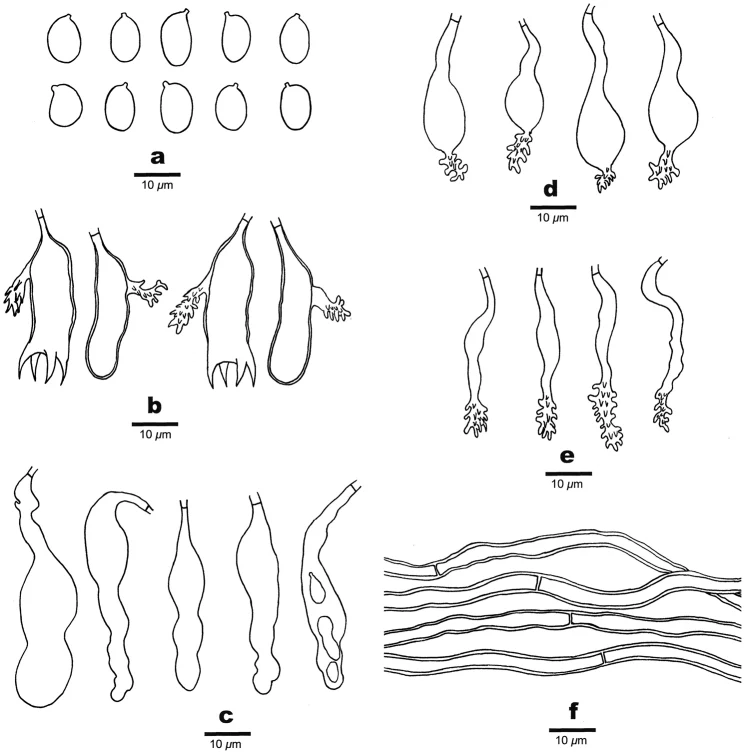
Microscopic structures of Aleurodiscus bambusinus (drawn from the holotype). a Basidiospores; b Basidia c Gloeocystidia d–e Acanthophyses f Generative hyphae.
Kredit dan penggunaan
Yan Tian, Masoomeh Ghobad-Nejhad, Shuang-Hui He, Yu-Cheng Dai
Ukuran dan format gambar disesuaikan tanpa pemotongan, retus, atau penambahan skala. Lisensi sumber dipertahankan.
Sumber profil
- [1] Three new species of Aleurodiscus s.l. (Russulales, Basidiomycota) from southern China — Aleurodiscus bambusinus
- [2] Catalogue of Life Base2026-09-11 — Aleurodiscus bambusinus
- [3] Dokumentasi visual — Aleurodiscus bambusinus
- [4] Dokumentasi visual — Aleurodiscus bambusinus
Rujukan halaman ini
Fungi. Aleurodiscus bambusinus. Rilis data fungi-2026-10-12-expansion-2. https://fungi-atlas.mgadib.chatgpt.site/jamur/aleurodiscus-bambusinus/.
Status: impor sumber; pemeriksaan editorial per profil belum selesai. Untuk klaim biologis, gunakan rujukan pada bagian terkait dan periksa konteks sumber aslinya.