01 / Morfologi

Ciri dan struktur

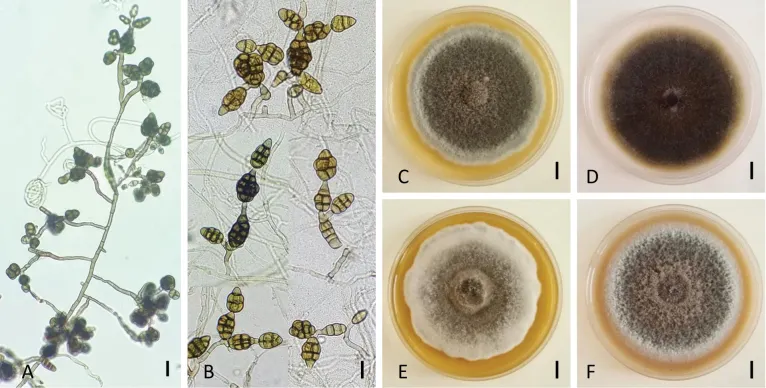
Colonies on PCA velvety, approximately 70 mm in diameter, with three discrete concentric rings of growth after 7 days. Aerial axes abundant and reaching a size length of 113–387 µm, with 5 to 10 lateral conidiogenous branches and tips in light-exposed zones of young parts of the colony (Fig. 3A). These branches most frequently on the upper portions of aerial conidiogenous elements, forming an arachnoid layer of branching hyphae. Primary conidiophores formed outside the center of the colony, simple, rarely branched, produced at the substrate surface, conspicuous, straight, or geniculate, up to 30–110(–352) × 3.8–5 µm, often developing through geniculate extensions. Each conidiophore bearing 1–3 conidia, sometimes with additional short chains of 2–3 conidia through secondary conidiophores formed mainly from distal terminal conidial cells (Fig. 3B). Secondary conidiophores short, 20–52(–105) × 3–5 µm, with one or two conidiogenous sites. A high percentage of conidia of any age remaining solitary. The sporulation patterns in small clumps on elongate-branched sporulating hyphae forming a brown layer at the center of the colony. Conidia medium brown to brown, short ellipsoid, ovoid, muriform, mainly beakless or with a rounded apex (Fig. 3B). Dominant size range: 22–37(–40) µm long × 13–20 μm width with 2–4(–5) transverse septa and 0–2(–3) longitudinal septa in each of the transverse segments. In the center of the colony, a high percentage of dark pigmented conidia mature of smaller size, 17.5–25 × 12–17.5 µm, initiating chain development. All maturing conidia distinctly constricted at their transverse septa, developing thick and dark-brown pigmented outer walls and sometimes with a punctate surface.

Sebagian uraian ditampilkan dalam bahasa sumber; terjemahannya belum tersedia atau belum lolos pemeriksaan.

Rujukan: [1]

Pengukuran mengikuti objek, spesimen atau kultur, dan metode yang disebutkan sumber. Baca uraian asli untuk konteks lengkap.

02 / Kehidupan

Habitat dan peran ekologis

Colonies on PCA velvety, approximately 70 mm in diameter, with three discrete concentric rings of growth after 7 days. Aerial axes abundant and reaching a size length of 113–387 µm, with 5 to 10 lateral conidiogenous branches and tips in light-exposed zones of young parts of the colony (Fig. 3A). These branches most frequently on the upper portions of aerial conidiogenous elements, forming an arachnoid layer of branching hyphae. Primary conidiophores formed outside the center of the colony, simple, rarely branched, produced at the substrate surface, conspicuous, straight, or geniculate, up to 30–110(–352) × 3.8–5 µm, often developing through geniculate extensions. Each conidiophore bearing 1–3 conidia, sometimes with additional short chains of 2–3 conidia through secondary conidiophores formed mainly from distal terminal conidial cells (Fig. 3B). Secondary conidiophores short, 20–52(–105) × 3–5 µm, with one or two conidiogenous sites. A high percentage of conidia of any age remaining solitary. The sporulation patterns in small clumps on elongate-branched sporulating hyphae forming a brown layer at the center of the colony. Conidia medium brown to brown, short ellipsoid, ovoid, muriform, mainly beakless or with a rounded apex (Fig. 3B).

Sebagian uraian ditampilkan dalam bahasa sumber; terjemahannya belum tersedia atau belum lolos pemeriksaan.

Rujukan: [1]

Habitat atau konteks temuan
Informasi belum tersedia pada sumber rilis ini.
Substrat
Informasi belum tersedia pada sumber rilis ini.
Peran atau konteks
Belum dikategorikan pada rilis ini.
Temukan hubungan serupa
03 / Siklus hidup

Reproduksi

Colonies on PCA velvety, approximately 70 mm in diameter, with three discrete concentric rings of growth after 7 days. Aerial axes abundant and reaching a size length of 113–387 µm, with 5 to 10 lateral conidiogenous branches and tips in light-exposed zones of young parts of the colony (Fig. 3A). These branches most frequently on the upper portions of aerial conidiogenous elements, forming an arachnoid layer of branching hyphae. Primary conidiophores formed outside the center of the colony, simple, rarely branched, produced at the substrate surface, conspicuous, straight, or geniculate, up to 30–110(–352) × 3.8–5 µm, often developing through geniculate extensions. Each conidiophore bearing 1–3 conidia, sometimes with additional short chains of 2–3 conidia through secondary conidiophores formed mainly from distal terminal conidial cells (Fig. 3B).

Sebagian uraian ditampilkan dalam bahasa sumber; terjemahannya belum tersedia atau belum lolos pemeriksaan.

Rujukan: [1]

04 / Batas informasi

Catatan identitas dan cakupan

  • Nama diterima mengikuti Catalogue of Life Base2026-09-11; uraian mempertahankan konsep dan nama sumber aslinya.
  • Preserve original treatment localities, hosts and substrate scope. Materials examined describe documented specimens, not the full global range.
  • Impor dan terjemahan otomatis belum diperiksa editorial per profil. Struktur reproduktif yang disebutkan tidak membuktikan seluruh siklus hidup diketahui.
  • Pengukuran pada uraian mengikuti spesimen, kultur, dan metode sumber; angka tidak diperluas ke semua populasi.

Catatan distribusi dalam narasi mengikuti sumbernya. Dokumentasi spesimen atau foto mengikuti catatan sumber. Bukti wilayah Indonesia dan penilaian konservasi tidak disimpulkan dari gambar.

05 / Dokumentasi

Melihat dengan konteks

Morphology of Alternaria hungarica (strain: NB803). Sporulation patterns on PCA for 14 days at 22 °C (A); Conidiophores and conidia on PCA for 7 days at 22 °C (B); Colony phenotypes on PDA (C), PCA (D), MEA (E), and OA (F) for 7 days at 25 °C. Scale bar: 25 µm (A, B); 10 mm (C–F).

Jenis
Pelat ilmiah
Kredit
Nabahat Bessadat, Nelly Bataillé-Simoneau, Justine Colou, Bruno Hamon, Kihal Mabrouk, Philippe Simoneau
Lisensi
CC BY 4.0
Sumber media
Buka entri sumber

Gambar menunjukkan objek menurut identifikasi sumber, bukan verifikasi independen spesimen oleh Fungi. Tidak ada skala baru yang ditambahkan.

06 / Rujukan

Sumber profil

  1. [1] New members of Alternaria (Pleosporales, Pleosporaceae) collected from Apiaceae in Algeria — Alternaria hungaricaBagian sumber: PMC11815330_section_15
    Tanggal penghimpunan sumber: 2026-10-12
    Teks sumber: CC BY 4.0 · Bessadat N, Bataillé-Simoneau N, Colou J, Hamon B, Mabrouk K, Simoneau P.
  2. [2] Catalogue of Life Base2026-09-11 — Alternaria hungaricaBagian sumber: ColDP NameUsage.tsv ID C9W3; accepted species; source 2073
    Tanggal penghimpunan sumber: 2026-10-12
  3. [3] Dokumentasi visual — Alternaria hungaricaBagian sumber: Individual media record; identification follows the source, not independent determination
    Tanggal penghimpunan sumber: 2026-10-12
    Media sumber: CC BY 4.0 · Nabahat Bessadat, Nelly Bataillé-Simoneau, Justine Colou, Bruno Hamon, Kihal Mabrouk, Philippe Simoneau

Adaptasi teks: CC BY 4.0. Bessadat N, Bataillé-Simoneau N, Colou J, Hamon B, Mabrouk K, Simoneau P. — New members of Alternaria (Pleosporales, Pleosporaceae) collected from Apiaceae in Algeria — Alternaria hungarica

Uraian asli dan riwayat sumber

Riwayat atau halaman sumber

Ringkasan sumber

Colonies on PCA velvety, approximately 70 mm in diameter, with three discrete concentric rings of growth after 7 days. Aerial axes abundant and reaching a size length of 113–387 µm, with 5 to 10 lateral conidiogenous branches and tips in light-exposed zones of young parts of the colony (Fig. 3A). These branches most frequently on the upper portions of aerial conidiogenous elements, forming an arachnoid layer of branching hyphae. Primary conidiophores formed outside the center of the colony, simple, rarely branched, produced at the substrate surface, conspicuous, straight, or geniculate, up to 30–110(–352) × 3.8–5 µm, often developing through geniculate extensions.

Revisi sumber

Morfologi sumber

Colonies on PCA velvety, approximately 70 mm in diameter, with three discrete concentric rings of growth after 7 days. Aerial axes abundant and reaching a size length of 113–387 µm, with 5 to 10 lateral conidiogenous branches and tips in light-exposed zones of young parts of the colony (Fig. 3A). These branches most frequently on the upper portions of aerial conidiogenous elements, forming an arachnoid layer of branching hyphae. Primary conidiophores formed outside the center of the colony, simple, rarely branched, produced at the substrate surface, conspicuous, straight, or geniculate, up to 30–110(–352) × 3.8–5 µm, often developing through geniculate extensions. Each conidiophore bearing 1–3 conidia, sometimes with additional short chains of 2–3 conidia through secondary conidiophores formed mainly from distal terminal conidial cells (Fig. 3B). Secondary conidiophores short, 20–52(–105) × 3–5 µm, with one or two conidiogenous sites. A high percentage of conidia of any age remaining solitary. The sporulation patterns in small clumps on elongate-branched sporulating hyphae forming a brown layer at the center of the colony. Conidia medium brown to brown, short ellipsoid, ovoid, muriform, mainly beakless or with a rounded apex (Fig. 3B). Dominant size range: 22–37(–40) µm long × 13–20 μm width with 2–4(–5) transverse septa and 0–2(–3) longitudinal septa in each of the transverse segments. In the center of the colony, a high percentage of dark pigmented conidia mature of smaller size, 17.5–25 × 12–17.5 µm, initiating chain development. All maturing conidia distinctly constricted at their transverse septa, developing thick and dark-brown pigmented outer walls and sometimes with a punctate surface.

Revisi sumber

Ekologi sumber

Colonies on PCA velvety, approximately 70 mm in diameter, with three discrete concentric rings of growth after 7 days. Aerial axes abundant and reaching a size length of 113–387 µm, with 5 to 10 lateral conidiogenous branches and tips in light-exposed zones of young parts of the colony (Fig. 3A). These branches most frequently on the upper portions of aerial conidiogenous elements, forming an arachnoid layer of branching hyphae. Primary conidiophores formed outside the center of the colony, simple, rarely branched, produced at the substrate surface, conspicuous, straight, or geniculate, up to 30–110(–352) × 3.8–5 µm, often developing through geniculate extensions. Each conidiophore bearing 1–3 conidia, sometimes with additional short chains of 2–3 conidia through secondary conidiophores formed mainly from distal terminal conidial cells (Fig. 3B). Secondary conidiophores short, 20–52(–105) × 3–5 µm, with one or two conidiogenous sites. A high percentage of conidia of any age remaining solitary. The sporulation patterns in small clumps on elongate-branched sporulating hyphae forming a brown layer at the center of the colony. Conidia medium brown to brown, short ellipsoid, ovoid, muriform, mainly beakless or with a rounded apex (Fig. 3B).

Revisi sumber

Struktur reproduksi sumber

Colonies on PCA velvety, approximately 70 mm in diameter, with three discrete concentric rings of growth after 7 days. Aerial axes abundant and reaching a size length of 113–387 µm, with 5 to 10 lateral conidiogenous branches and tips in light-exposed zones of young parts of the colony (Fig. 3A). These branches most frequently on the upper portions of aerial conidiogenous elements, forming an arachnoid layer of branching hyphae. Primary conidiophores formed outside the center of the colony, simple, rarely branched, produced at the substrate surface, conspicuous, straight, or geniculate, up to 30–110(–352) × 3.8–5 µm, often developing through geniculate extensions. Each conidiophore bearing 1–3 conidia, sometimes with additional short chains of 2–3 conidia through secondary conidiophores formed mainly from distal terminal conidial cells (Fig. 3B).

Revisi sumber

Rujukan halaman ini

Fungi. Alternaria hungarica. Rilis data fungi-2026-10-12-expansion-2. https://fungi-atlas.mgadib.chatgpt.site/jamur/alternaria-hungarica/.

Status: impor sumber; pemeriksaan editorial per profil belum selesai. Untuk klaim biologis, gunakan rujukan pada bagian terkait dan periksa konteks sumber aslinya.