01 / Morfologi

Ciri dan struktur

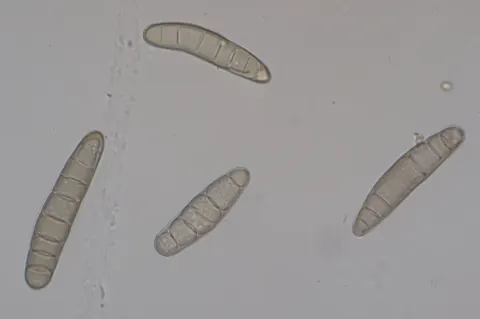
Leaf blight of sunflowers is one of the most devastating diseases for sunflowers and is caused by Alternaria helianthi (Hansford) Tubaki and Nishihara, a seed-borne pathogenic fungus. It was recorded in Japan and was the same as a fungus collected earlier on sunflower in Argentina, India, Tanzania, Uganda and Zambia. Transportation of infected sunflowers and agricultural practices spread the pathogen worldwide and cause disasters in places, like India, where sunflowers are a main source of oil production. This pathogen produces simple, meaning rarely branched conidiophores, that bear solitary conidia. These conidia are light brown colored, ellipsoid or broadly ovoid, and rarely form longitudinal septa. This pathogen overwinters on infected plant residues, but wild sunflowers may also serve as reservoirs. All species, including Alternaria helianthi, may also be seedborne. Alternaria spp. have no sexual or perfect stage. They multiply asexually through the method of sporulation. By producing one or more germ tubes, the conidia are germinated. Disease progression heavily relies on the duration of leaf wetness following initial infection, as the germination of new spores can occur within days. Germination occurs best at temperatures less than 26 degrees C and require a minimum of 4 hours of leaf wetness for sporulation. The conidia will emerge through the stomata and trichomes. At this stage, the conidia produced will cause secondary infection and spread to other healthy plants. Under certain conditions, micro-cyclic conidia can be produced directly from the parent conidia.

Sebagian uraian ditampilkan dalam bahasa sumber; terjemahannya belum tersedia atau belum lolos pemeriksaan.

Rujukan: [1]

Pengukuran mengikuti objek, spesimen atau kultur, dan metode yang disebutkan sumber. Baca uraian asli untuk konteks lengkap.

02 / Kehidupan

Habitat dan peran ekologis

Ada delapan spesies yang berbeda yang menyebabkan hilangnya hasil bunga matahari; namun, Alternaria helianthi adalah agen penyebab utama dan paling luas. Tuan rumah utama adalah bunga matahari (Helianthus annuus); Namun, telah terbukti bahwa safflower (Carthamus tinctorius), noogoora burr (Xanthium pungens), cocklebur (Xanthium strumarium), dan Bathurst burr (Xanthium spinosum) dapat berfungsi sebagai tuan rumah alternatif untuk patogen.

Rujukan: [1]

Habitat atau konteks temuan
Informasi belum tersedia pada sumber rilis ini.
Substrat
Informasi belum tersedia pada sumber rilis ini.
Peran atau konteks
Belum dikategorikan pada rilis ini.
Temukan hubungan serupa
03 / Siklus hidup

Reproduksi

Leaf blight of sunflowers is one of the most devastating diseases for sunflowers and is caused by Alternaria helianthi (Hansford) Tubaki and Nishihara, a seed-borne pathogenic fungus. It was recorded in Japan and was the same as a fungus collected earlier on sunflower in Argentina, India, Tanzania, Uganda and Zambia. Transportation of infected sunflowers and agricultural practices spread the pathogen worldwide and cause disasters in places, like India, where sunflowers are a main source of oil production. This pathogen produces simple, meaning rarely branched conidiophores, that bear solitary conidia. These conidia are light brown colored, ellipsoid or broadly ovoid, and rarely form longitudinal septa.

Sebagian uraian ditampilkan dalam bahasa sumber; terjemahannya belum tersedia atau belum lolos pemeriksaan.

Rujukan: [1]

Sinonim menurut acuan taksonomi rilis: Alternaria helianthi; Helminthosporium helianthi
04 / Batas informasi

Catatan identitas dan cakupan

  • Nama diterima mengikuti Catalogue of Life Base2026-09-11; uraian mempertahankan konsep dan nama sumber aslinya.
  • Original geographic, specimen and life-cycle scope retained; source import awaits individual editorial review.
  • Impor dan terjemahan otomatis belum diperiksa editorial per profil. Struktur reproduktif yang disebutkan tidak membuktikan seluruh siklus hidup diketahui.
  • Pengukuran pada uraian mengikuti spesimen, kultur, dan metode sumber; angka tidak diperluas ke semua populasi.

Catatan distribusi dalam narasi mengikuti sumbernya. Dokumentasi spesimen atau foto mengikuti catatan sumber. Bukti wilayah Indonesia dan penilaian konservasi tidak disimpulkan dari gambar.

05 / Dokumentasi

Melihat dengan konteks

Dokumentasi visual yang memenuhi pemeriksaan subjek dan hak penggunaan belum tersedia. Foto gejala, label, dan gambar yang meragukan tidak dihitung.

06 / Rujukan

Sumber profil

  1. [1] Alternaria helianthi — Wikipedia (en)Bagian sumber: Frozen revision 1360609778
    Tanggal penghimpunan sumber: 2026-10-12
    Teks sumber: CC BY-SA4.0 · Wikipedia contributors
  2. [2] Catalogue of Life Base2026-09-11 — Alternariaster helianthiBagian sumber: ColDP NameUsage.tsv ID 5TXR3; accepted species; source 2073
    Tanggal penghimpunan sumber: 2026-10-12

Adaptasi teks: CC BY-SA 4.0. Wikipedia contributors — Alternaria helianthi — Wikipedia (en)

Uraian asli dan riwayat sumber

Riwayat atau halaman sumber

Ringkasan sumber

Leaf blight of sunflowers is one of the most devastating diseases for sunflowers and is caused by Alternaria helianthi (Hansford) Tubaki and Nishihara, a seed-borne pathogenic fungus. It was recorded in Japan and was the same as a fungus collected earlier on sunflower in Argentina, India, Tanzania, Uganda and Zambia. Transportation of infected sunflowers and agricultural practices spread the pathogen worldwide and cause disasters in places, like India, where sunflowers are a main source of oil production.

Revisi sumber

Morfologi sumber

Leaf blight of sunflowers is one of the most devastating diseases for sunflowers and is caused by Alternaria helianthi (Hansford) Tubaki and Nishihara, a seed-borne pathogenic fungus. It was recorded in Japan and was the same as a fungus collected earlier on sunflower in Argentina, India, Tanzania, Uganda and Zambia. Transportation of infected sunflowers and agricultural practices spread the pathogen worldwide and cause disasters in places, like India, where sunflowers are a main source of oil production. This pathogen produces simple, meaning rarely branched conidiophores, that bear solitary conidia. These conidia are light brown colored, ellipsoid or broadly ovoid, and rarely form longitudinal septa. This pathogen overwinters on infected plant residues, but wild sunflowers may also serve as reservoirs. All species, including Alternaria helianthi, may also be seedborne. Alternaria spp. have no sexual or perfect stage. They multiply asexually through the method of sporulation. By producing one or more germ tubes, the conidia are germinated. Disease progression heavily relies on the duration of leaf wetness following initial infection, as the germination of new spores can occur within days. Germination occurs best at temperatures less than 26 degrees C and require a minimum of 4 hours of leaf wetness for sporulation. The conidia will emerge through the stomata and trichomes. At this stage, the conidia produced will cause secondary infection and spread to other healthy plants. Under certain conditions, micro-cyclic conidia can be produced directly from the parent conidia.

Revisi sumber

Ekologi sumber

There are eight different species that cause yield loss of sunflowers; however, Alternaria helianthi is the primary causal agent and most widespread. The main hosts are sunflowers (Helianthus annuus); however, it has been proven that safflower (Carthamus tinctorius), noogoora burr (Xanthium pungens), cocklebur (Xanthium strumarium), and Bathurst burr (Xanthium spinosum) can serve as alternative hosts for the pathogen.

Revisi sumber

Struktur reproduksi sumber

Leaf blight of sunflowers is one of the most devastating diseases for sunflowers and is caused by Alternaria helianthi (Hansford) Tubaki and Nishihara, a seed-borne pathogenic fungus. It was recorded in Japan and was the same as a fungus collected earlier on sunflower in Argentina, India, Tanzania, Uganda and Zambia. Transportation of infected sunflowers and agricultural practices spread the pathogen worldwide and cause disasters in places, like India, where sunflowers are a main source of oil production. This pathogen produces simple, meaning rarely branched conidiophores, that bear solitary conidia. These conidia are light brown colored, ellipsoid or broadly ovoid, and rarely form longitudinal septa.

Revisi sumber

Rujukan halaman ini

Fungi. Alternariaster helianthi. Rilis data fungi-2026-10-12-expansion-2. https://fungi-atlas.mgadib.chatgpt.site/jamur/alternariaster-helianthi/.

Status: impor sumber; pemeriksaan editorial per profil belum selesai. Untuk klaim biologis, gunakan rujukan pada bagian terkait dan periksa konteks sumber aslinya.