Ciri dan struktur
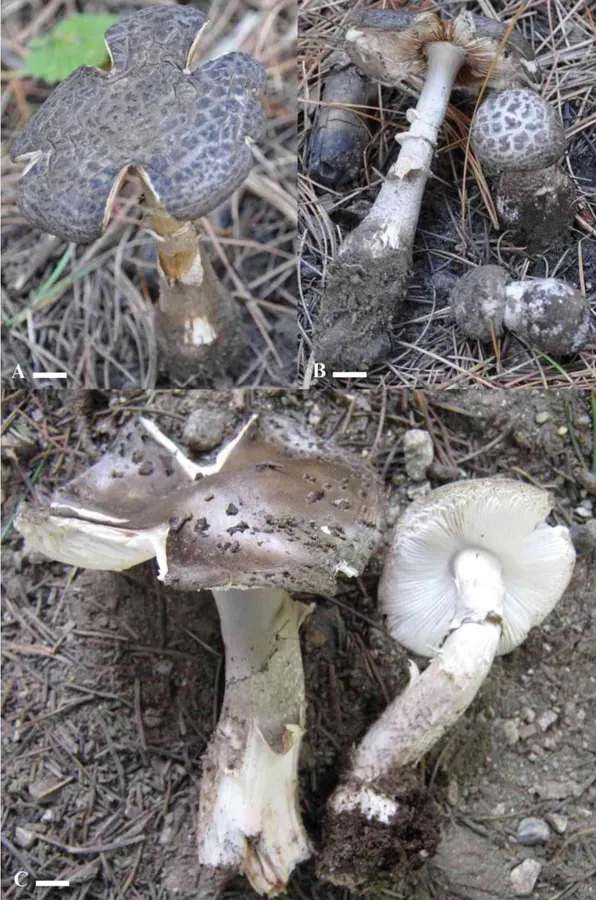
Small to medium-sized basidiomata, grayish brown to brown pileal surface having rimose and non-appendiculate pileal margins, verrucose, gray to dark bluish or brown veil remnants, dry and split stipe surface at the base forming scales, globose to subglobose, smooth, amyloid basidiospores. Pileus 4–7 cm in diameter, convex to flat at maturity; cuticle gray (2.5BG4/2) to grayish brown (10YR3/2) or brown (2.5Y4/4) with time; surface dry; universal veil remnants on pileus verrucose, aligned in one direction, scattered, gray (2.5Y4/2) to dark brown (2.5Y2/2); margins non-appendiculate, incurved when young, highly rimose by maturity. Lamellae off-white (2.5BG4/2) to cream (5Y9/4) becoming brownish when dry, adnexed, subdistant to close; edges entire. Lamellulae small (1/3 of the lamellae), attenuate, truncate. Stipe 6.7–9 × 0.6–1.5 cm, apex slightly wider and white, with up to 1.5 cm wide bulbous base, central, cylindrical; surface with grayish brown (5GY5/2) striations above the annulus, splitting towards the base forming scales on white (2.5BG4/2) to cream (5Y9/4) context. Annulus superior, membranous, skirt-like, with longitudinal striations on the upper surface, gray (2.5Y4/2) with a darker lower part. Universal veil absent. Ordorless and not changing color upon bruising. Basidiospores [60/3/3] (6.5) 7–8.5 (9.5) × (6) 6.5–7.5 (8) µm, Q = (1) 1.03–1.22 (1.33), avg Q = 1.10, globose to broadly ellipsoid, amyloid in Melzer’s reagent. Basidia (32) 34.5–59 (67) × 7–8 µm, clavate, frequently 4 sterigmate, 2 sterigmata also observed, thin-walled, hyaline in 5% KOH. Subhymenium pseudoparenchymatous, cells isodiameteric, intermixed and densely packed.
Habitat dan peran ekologis
In coniferous forests of Pakistan with a moist temperate to dry temperate climate.
- Habitat atau konteks temuan
- hutan
- Substrat
- Informasi belum tersedia pada sumber rilis ini.
- Peran atau konteks
- Belum dikategorikan pada rilis ini.
Reproduksi
Small to medium-sized basidiomata, grayish brown to brown pileal surface having rimose and non-appendiculate pileal margins, verrucose, gray to dark bluish or brown veil remnants, dry and split stipe surface at the base forming scales, globose to subglobose, smooth, amyloid basidiospores. Pileus 4–7 cm in diameter, convex to flat at maturity; cuticle gray (2.5BG4/2) to grayish brown (10YR3/2) or brown (2.5Y4/4) with time; surface dry; universal veil remnants on pileus verrucose, aligned in one direction, scattered, gray (2.5Y4/2) to dark brown (2.5Y2/2); margins non-appendiculate, incurved when young, highly rimose by maturity. Lamellae off-white (2.5BG4/2) to cream (5Y9/4) becoming brownish when dry, adnexed, subdistant to close; edges entire.
Catatan identitas dan cakupan
- Nama diterima mengikuti Catalogue of Life Base2026-09-11; uraian mempertahankan konsep dan nama sumber aslinya.
- Preserve original treatment localities, hosts and substrate scope. Materials examined describe documented specimens, not the full global range.
- Impor dan terjemahan otomatis belum diperiksa editorial per profil. Struktur reproduktif yang disebutkan tidak membuktikan seluruh siklus hidup diketahui.
- Pengukuran pada uraian mengikuti spesimen, kultur, dan metode sumber; angka tidak diperluas ke semua populasi.
Catatan distribusi dalam narasi mengikuti sumbernya. Dokumentasi spesimen atau foto mengikuti catatan sumber. Bukti wilayah Indonesia dan penilaian konservasi tidak disimpulkan dari gambar.
Melihat dengan konteks
Amanita ahmadii basidiomata. A, B LAH35010 (holotype) C SWAT0001351. Photos by Abdul Nasir Khalid and Junaid Khan. Scale bars: 1 cm (A); 1.2 cm (B); 0.5 cm (C).
- Jenis
- Pelat ilmiah
- Kredit
- Sana Jabeen, Munazza Kiran, Junaid Khan, Ishtiaq Ahmad, Habib Ahmad, Hassan Sher, Abdul Nasir Khalid
- Lisensi
- CC BY 4.0
- Sumber media
- Buka entri sumber
Dokumentasi tambahan
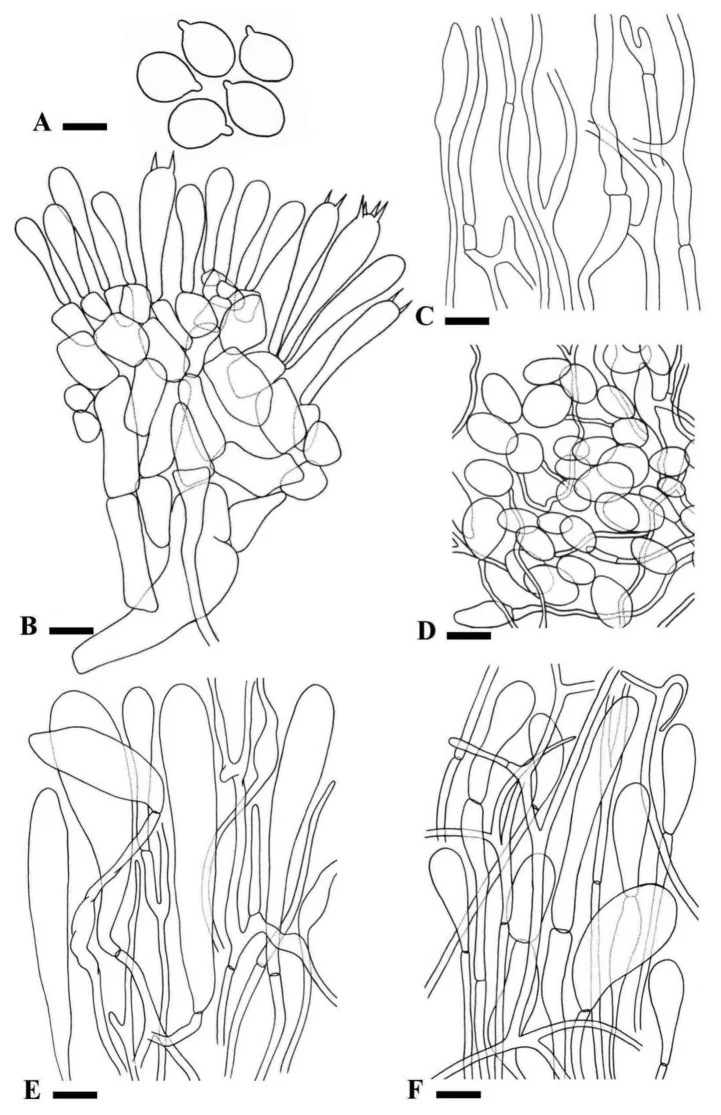
Amanita ahmadii LAH35010 (holotype). A Basidiospores B Basidia, basidioles and subhymenium C Pileipellis D Universal veil remnants on pileus surface E Hyphae from stipe F Partial veil. Drawings by Sana Jabeen. Scale bars: 5.5 µm (A); 8 µm (B–D); 22 µm (E, F).
Kredit dan penggunaan
Sana Jabeen, Munazza Kiran, Junaid Khan, Ishtiaq Ahmad, Habib Ahmad, Hassan Sher, Abdul Nasir Khalid
Ukuran dan format gambar disesuaikan tanpa pemotongan, retus, atau penambahan skala. Lisensi sumber dipertahankan.
Sumber profil
- [1] Amanita ahmadii, a new species of Amanita subgenus Amanitina section Validae from Pakistan — Amanita ahmadii
- [2] Catalogue of Life Base2026-09-11 — Amanita ahmadii
- [3] Dokumentasi visual — Amanita ahmadii
- [4] Dokumentasi visual — Amanita ahmadii
Rujukan halaman ini
Fungi. Amanita ahmadii. Rilis data fungi-2026-10-12-expansion-2. https://fungi-atlas.mgadib.chatgpt.site/jamur/amanita-ahmadii/.
Status: impor sumber; pemeriksaan editorial per profil belum selesai. Untuk klaim biologis, gunakan rujukan pada bagian terkait dan periksa konteks sumber aslinya.