Ciri dan struktur
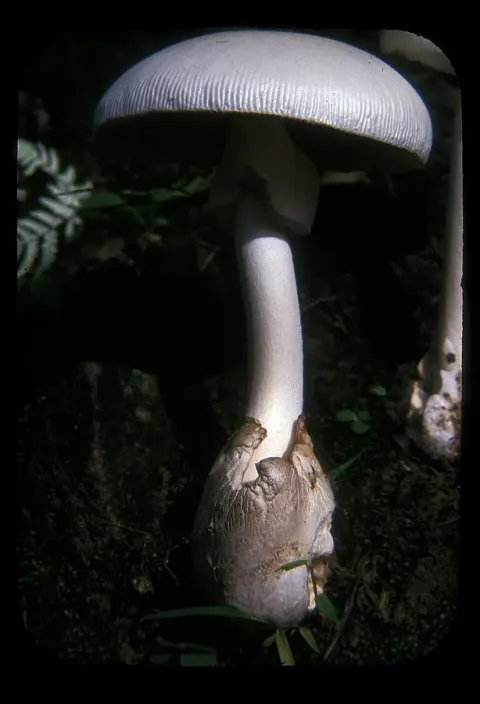
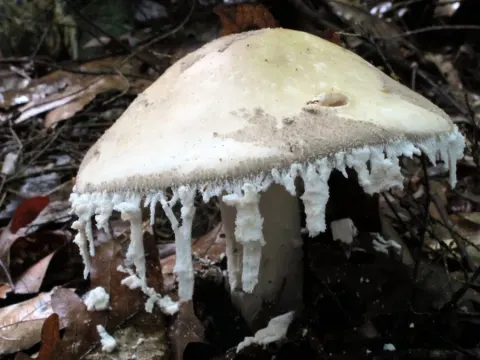
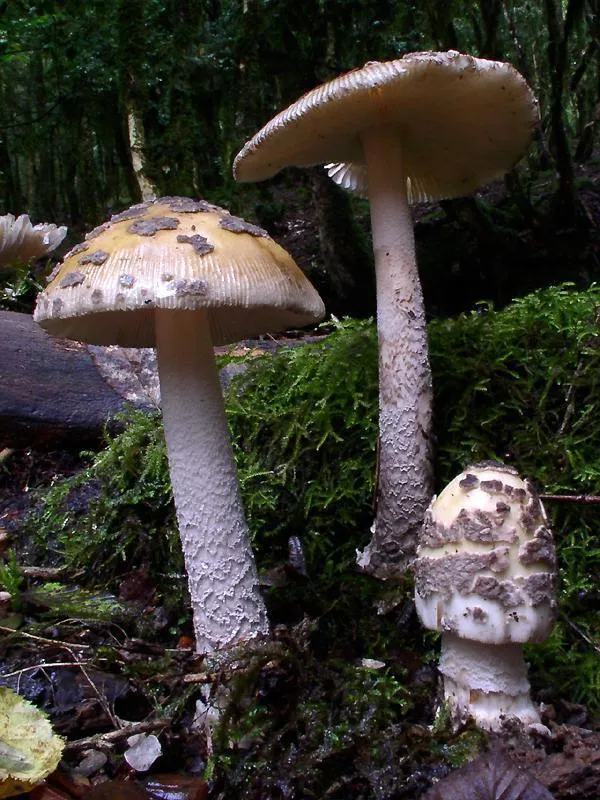
Amanita ceciliae is characterized by bearing a large fruit body with a brown cap 5 – 12 cm across. The cap has charcoal-grey patches, which are easily removable. The stipe is 7 – 18 cm long, white in colour, and there is no ring on it. It is slightly tapered to the top, and has irregular cottony bands girdling the base. The universal veil is grey. Spores are white, spherical in shape, non-amyloid, and measure 10.2–11.7 micrometres. The cap is 5 - 12 cm across, shape ranging from convex to flat. It is upturned, and has a deep-coloured margin. There is a low umbo. It is grey to a brownish black in colour, darkest in the center and paler towards the margin. Generally smooth, the cap surface is slightly sticky when moist. The cap surface is characterized by having loose, fleecy, charcoal-grey patches of volval remnants scattered across it. The patches are easily removed. The margin is strongly striated. The cap colour may vary, and pale forms are known to exist, for example, as in the types A. c. f. decolora and A. c. var. pallida. A. c. var. royeri, first described by mycologist L. Maire in 2008 and occurring in France, is a cinder black-capped variation. Gills are free and closely spaced, and white in colour. They can be thick, and are often forked. The stem is 7 – 18 cm long, and 120 - 200 mm x 20 - 40 mm thick. It is lightly stuffed (filled with a cottony tissue) and then hollow, and there is a slight tapering to the top. It is white in colour, with flat grey hairs, often in a zig-zag pattern. It does not bear a ring and has fragile, cottony, brownish or charcoal-coloured oblique girdles of volval remnants around the stem base and lower stem.
Habitat dan peran ekologis
Eropa Di Eropa, Amanita ceciliae tersebar di mana-mana, meskipun jarang ditemukan. It often inhabits deciduous forests with hornbeam (Carpinus), oak (Quercus), beech (Fagus) and birch (Betula), but it can also rarely occur with conifers: pine (Pinus), fir (Abies), spruce (Picea) and cedar (Cedrus). Ia lebih memilih tanah yang netral dari tanah yang berkarat. They are secara ekologis mikoriza, dan habitatnya termasuk hutan kayu keras dan hutan konifer. Jamur tumbuh sendiri, berkeliaran, atau dalam kelompok selama musim panas dan musim gugur. Ini terutama timur dalam distribusi tetapi juga dilaporkan di Pasifik Barat Laut, Barat Daya, dan Texas (dengan hubungan yang jelas dengan pohon pekan).
- Habitat atau konteks temuan
- hutan
- Substrat
- Informasi belum tersedia pada sumber rilis ini.
- Peran atau konteks
- Mitra tumbuhan
Reproduksi
The universal veil is grey. Spores are white, spherical in shape, non-amyloid, and measure 10.2–11.7 micrometres. Spores are white in colour, spherical and are not amyloid. They measure 10.2–11.7 μm. A few large-sized spores are commonly found in a mount of gill tissue. Clamps are not found at bases of basidia.
Catatan identitas dan cakupan
- Nama diterima mengikuti Catalogue of Life Base2026-09-11; uraian mempertahankan konsep dan nama sumber aslinya.
- Original geographic, specimen and life-cycle scope retained; source import awaits individual editorial review.
- Impor dan terjemahan otomatis belum diperiksa editorial per profil. Struktur reproduktif yang disebutkan tidak membuktikan seluruh siklus hidup diketahui.
- Pengukuran pada uraian mengikuti spesimen, kultur, dan metode sumber; angka tidak diperluas ke semua populasi.
Catatan distribusi dalam narasi mengikuti sumbernya. Dokumentasi spesimen atau foto mengikuti catatan sumber. Bukti wilayah Indonesia dan penilaian konservasi tidak disimpulkan dari gambar.
Melihat dengan konteks
Dokumentasi Amanita ceciliae menurut asosiasi foto pada record takson iNaturalist. Kredit: GLJIVARSKO DRUSTVO NIS. Identitas mengikuti sumber; bukan penentuan spesimen independen.
- Jenis
- Fotografi
- Kredit
- (c) GLJIVARSKO DRUSTVO NIS, some rights reserved (CC BY)
- Lisensi
- CC BY 4.0
- Sumber media
- Buka entri sumber
Sumber profil
- [1] Amanita ceciliae — Wikipedia (en)
- [2] Catalogue of Life Base2026-09-11 — Amanita ceciliae
- [3] Dokumentasi visual — Amanita ceciliae
Rujukan halaman ini
Fungi. Amanita ceciliae. Rilis data fungi-2026-10-12-expansion-2. https://fungi-atlas.mgadib.chatgpt.site/jamur/amanita-ceciliae/.
Status: impor sumber; pemeriksaan editorial per profil belum selesai. Untuk klaim biologis, gunakan rujukan pada bagian terkait dan periksa konteks sumber aslinya.