01 / Morfologi

Ciri dan struktur

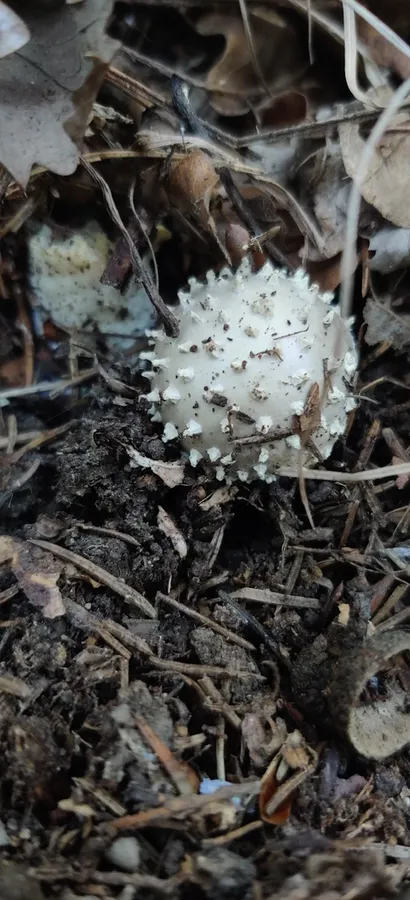
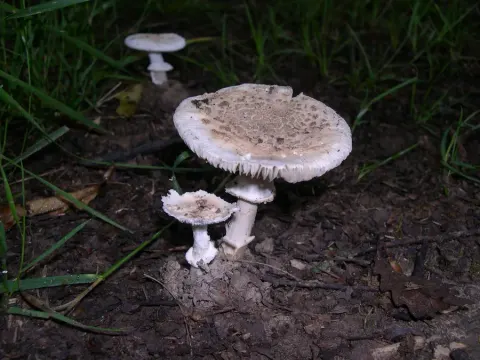
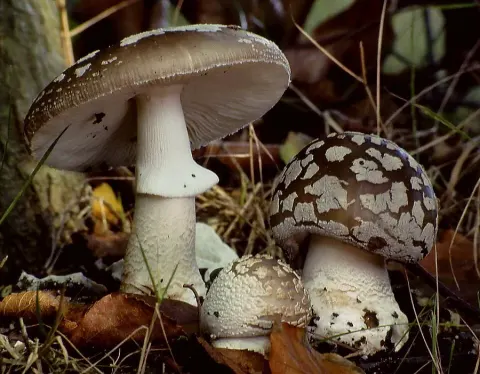
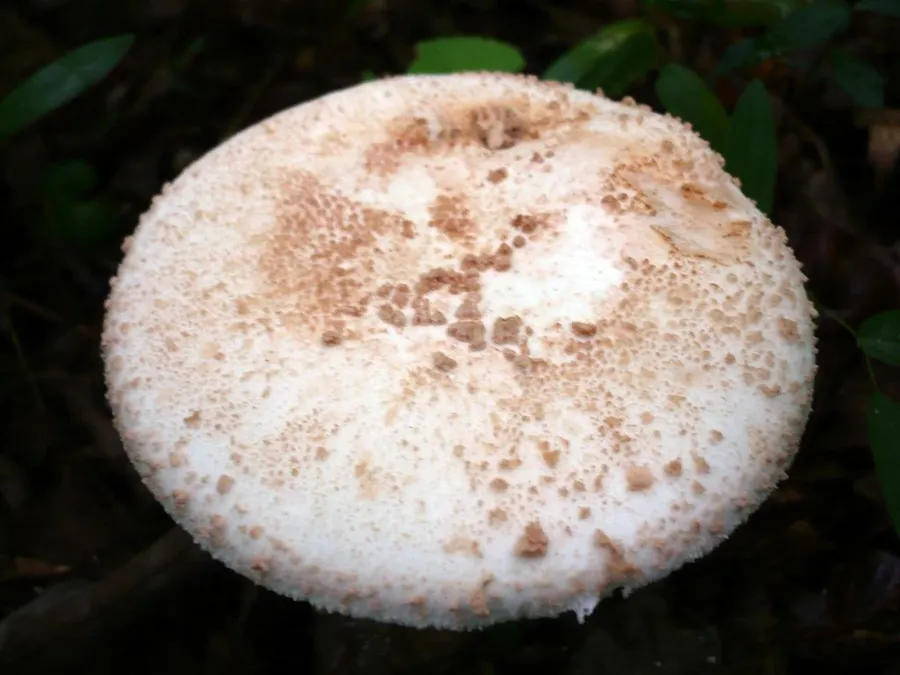
The caps of the fruit bodies initially have a convex shape before flattening out in maturity, and measure 6 to 25 cm in diameter. The cap surface is dry to shiny, and white with a pale orange hue. It is densely covered with white to pale orange or reddish-brown conical warts. The warts, remnants of the universal veil, are randomly distributed on the cap surface and become fluffier and cotton-like (flocculent) near the edge (or margin) of the cap. Drier specimens may have the cap surface completely cracked around the bases of the individual warts. The conical warts are detersile, meaning they may be easily removed from the cap surface without leaving a residue or a scar. The margin of the cap does not have striations, and like other Lepidella members, may have irregular veil remnants hanging from it. The gills are free, crowded closely together, moderately narrow, and white to yellowish white in color. The short gills that do not extend the full distance from the stem to the cap edge (known as lamellulae) are rounded to attenuate (gradually narrowing), and of varying lengths. The bulb has a circular ridge on its upper part where the universal veil was previously attached, and the bulb may have longitudinal splits. It is covered with pinkish to reddish veil remains. The partial veil forms an ephemeral ring on the upper part of the stem. It is white to pale yellow, and usually falls off as the cap expands; fragments of the ring may often be found lying on the ground near the base of the stem. The universal veil remnants, when present, are similar to that on the cap. The flesh is firm and white.

Sebagian uraian ditampilkan dalam bahasa sumber; terjemahannya belum tersedia atau belum lolos pemeriksaan.

Rujukan: [1]

Pengukuran mengikuti objek, spesimen atau kultur, dan metode yang disebutkan sumber. Baca uraian asli untuk konteks lengkap.

02 / Kehidupan

Habitat dan peran ekologis

A. daucipes is a mycorrhizal species, and its fruit bodies may be found growing solitary or scattered on the ground in mixed coniferous and deciduous forests (especially those dominated by oak trees) in Maryland, North Carolina, New Jersey, Ohio, Pennsylvania, Tennessee, Virginia, West Virginia, Kentucky, other associated tree species include hickory (genus Carya) and birch (Betula). subsequent investigations have shown it to be common in oak forests in the eastern United States.

Sebagian uraian ditampilkan dalam bahasa sumber; terjemahannya belum tersedia atau belum lolos pemeriksaan.

Rujukan: [1]

Habitat atau konteks temuan
hutan
Substrat
Informasi belum tersedia pada sumber rilis ini.
Peran atau konteks
Belum dikategorikan pada rilis ini.
Temukan hubungan serupa
03 / Siklus hidup

Reproduksi

Viewed in deposit, such as with a spore print, the spores of A. daucipes are white, cream, or yellowish in color. Viewed with a microscope, they have an ellipsoid to elongate shape (sometimes kidney-shape, or reniform), and dimensions of 8–11 by 5–7 μm. They are translucent (hyaline), with thin walls, and are amyloid, meaning that they absorb iodine when stained Melzer's reagent. The basidia (the spore-bearing cells) are 30–50 by 7–11 μm, club-shaped, and 4-spored, with clamps at their bases. The cheilocystidia are abundant, small, roughly spherical to club-shaped cells, with dimensions of 15–40 by 10–28 μm. The cap cuticle is between 75 and 180 μm thick, and consists of a dense layer of thin-walled, interwoven, and slightly gelatinized hyphae that are 2–5 μm in diameter.

Sebagian uraian ditampilkan dalam bahasa sumber; terjemahannya belum tersedia atau belum lolos pemeriksaan.

Rujukan: [1]

Sinonim menurut acuan taksonomi rilis: Agaricus daucipes; Amanitopsis daucipes; Aspidella daucipes; Pseudofarinaceus daucipes
04 / Batas informasi

Catatan identitas dan cakupan

  • Nama diterima mengikuti Catalogue of Life Base2026-09-11; uraian mempertahankan konsep dan nama sumber aslinya.
  • Original geographic, specimen and life-cycle scope retained; source import awaits individual editorial review.
  • Impor dan terjemahan otomatis belum diperiksa editorial per profil. Struktur reproduktif yang disebutkan tidak membuktikan seluruh siklus hidup diketahui.
  • Pengukuran pada uraian mengikuti spesimen, kultur, dan metode sumber; angka tidak diperluas ke semua populasi.

Catatan distribusi dalam narasi mengikuti sumbernya. Dokumentasi spesimen atau foto mengikuti catatan sumber. Bukti wilayah Indonesia dan penilaian konservasi tidak disimpulkan dari gambar.

05 / Dokumentasi

Melihat dengan konteks

Dokumentasi Amanita daucipes menurut asosiasi foto pada record takson iNaturalist. Kredit: Sabrina Setaro. Identitas mengikuti sumber; bukan penentuan spesimen independen.

Jenis
Fotografi
Kredit
(c) Sabrina Setaro, some rights reserved (CC BY)
Lisensi
CC BY 4.0
Sumber media
Buka entri sumber

Gambar menunjukkan objek menurut identifikasi sumber, bukan verifikasi independen spesimen oleh Fungi. Tidak ada skala baru yang ditambahkan.

06 / Rujukan

Sumber profil

  1. [1] Amanita daucipes — Wikipedia (en)Bagian sumber: Frozen revision 1370221542
    Tanggal penghimpunan sumber: 2026-10-12
    Teks sumber: CC BY-SA4.0 · Wikipedia contributors
  2. [2] Catalogue of Life Base2026-09-11 — Amanita daucipesBagian sumber: ColDP NameUsage.tsv ID 65ZDT; accepted species; source 2073
    Tanggal penghimpunan sumber: 2026-10-12
  3. [3] Dokumentasi visual — Amanita daucipesBagian sumber: Individual media record; identification follows the source, not independent determination
    Tanggal penghimpunan sumber: 2026-10-12
    Media sumber: CC BY 4.0 · (c) Sabrina Setaro, some rights reserved (CC BY)

Adaptasi teks: CC BY-SA 4.0. Wikipedia contributors — Amanita daucipes — Wikipedia (en)

Uraian asli dan riwayat sumber

Riwayat atau halaman sumber

Ringkasan sumber

Amanita daucipes is a species of fungus in the family Amanitaceae of the mushroom order Agaricales. Found exclusively in North America, the mushroom may be recognized in the field by the medium to large white caps with pale orange tints, and the dense covering of pale orange or reddish-brown powdery conical warts on the cap surface. The mushroom also has a characteristic large bulb at the base of its stem with a blunt short rooting base, whose shape is suggestive of the common names carrot-footed lepidella, carrot-foot amanita, or turnip-foot amanita.

Revisi sumber

Morfologi sumber

The caps of the fruit bodies initially have a convex shape before flattening out in maturity, and measure 6 to 25 cm in diameter. The cap surface is dry to shiny, and white with a pale orange hue. It is densely covered with white to pale orange or reddish-brown conical warts. The warts, remnants of the universal veil, are randomly distributed on the cap surface and become fluffier and cotton-like (flocculent) near the edge (or margin) of the cap. Drier specimens may have the cap surface completely cracked around the bases of the individual warts. The conical warts are detersile, meaning they may be easily removed from the cap surface without leaving a residue or a scar. The margin of the cap does not have striations, and like other Lepidella members, may have irregular veil remnants hanging from it. The gills are free, crowded closely together, moderately narrow, and white to yellowish white in color. The short gills that do not extend the full distance from the stem to the cap edge (known as lamellulae) are rounded to attenuate (gradually narrowing), and of varying lengths. The bulb has a circular ridge on its upper part where the universal veil was previously attached, and the bulb may have longitudinal splits. It is covered with pinkish to reddish veil remains. The partial veil forms an ephemeral ring on the upper part of the stem. It is white to pale yellow, and usually falls off as the cap expands; fragments of the ring may often be found lying on the ground near the base of the stem. The universal veil remnants, when present, are similar to that on the cap. The flesh is firm and white.

Revisi sumber

Ekologi sumber

A. daucipes is a mycorrhizal species, and its fruit bodies may be found growing solitary or scattered on the ground in mixed coniferous and deciduous forests (especially those dominated by oak trees) in Maryland, North Carolina, New Jersey, Ohio, Pennsylvania, Tennessee, Virginia, West Virginia, Kentucky, other associated tree species include hickory (genus Carya) and birch (Betula). subsequent investigations have shown it to be common in oak forests in the eastern United States.

Revisi sumber

Struktur reproduksi sumber

Viewed in deposit, such as with a spore print, the spores of A. daucipes are white, cream, or yellowish in color. Viewed with a microscope, they have an ellipsoid to elongate shape (sometimes kidney-shape, or reniform), and dimensions of 8–11 by 5–7 μm. They are translucent (hyaline), with thin walls, and are amyloid, meaning that they absorb iodine when stained Melzer's reagent. The basidia (the spore-bearing cells) are 30–50 by 7–11 μm, club-shaped, and 4-spored, with clamps at their bases. The cheilocystidia are abundant, small, roughly spherical to club-shaped cells, with dimensions of 15–40 by 10–28 μm. The cap cuticle is between 75 and 180 μm thick, and consists of a dense layer of thin-walled, interwoven, and slightly gelatinized hyphae that are 2–5 μm in diameter.

Revisi sumber

Rujukan halaman ini

Fungi. Amanita daucipes. Rilis data fungi-2026-10-12-expansion-2. https://fungi-atlas.mgadib.chatgpt.site/jamur/amanita-daucipes/.

Status: impor sumber; pemeriksaan editorial per profil belum selesai. Untuk klaim biologis, gunakan rujukan pada bagian terkait dan periksa konteks sumber aslinya.