01 / Morfologi

Ciri dan struktur

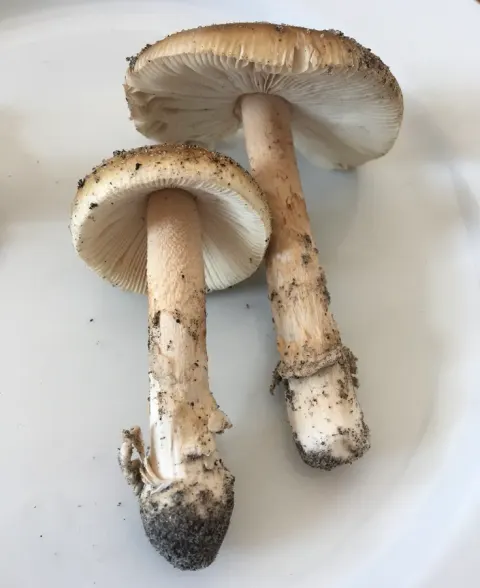
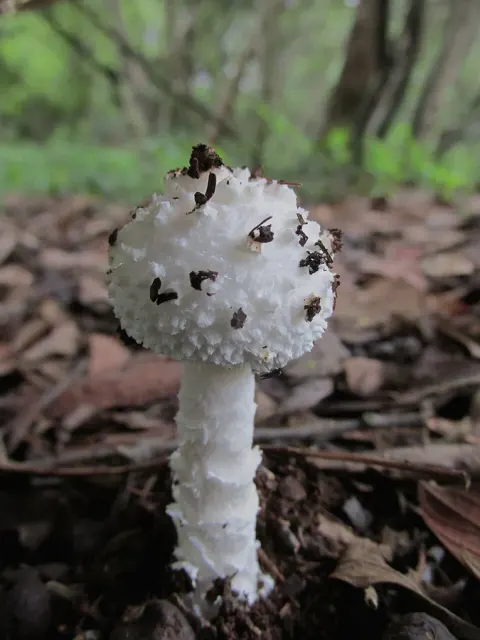
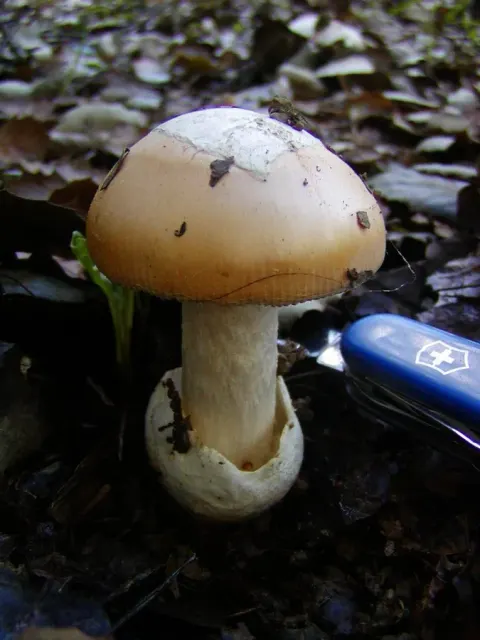
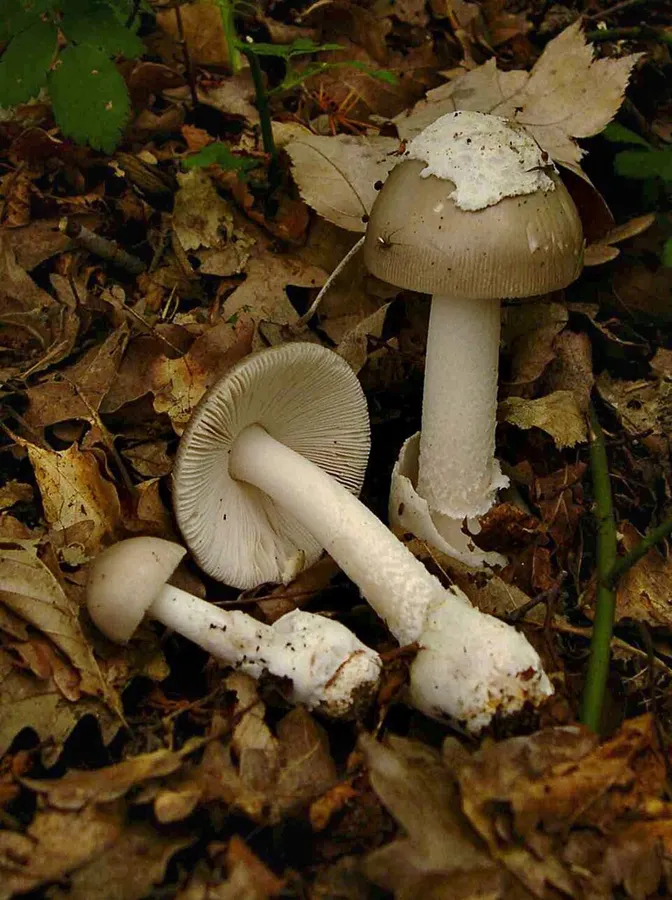
The cap is 3 to 10 cm in diameter and gray to grayish-brown in color; initially the cap is oval, then as it matures it becomes progressively conical, convex, and eventually flattened, sometimes with a small umbo (a rounded elevation in the center of the cap). The gills are white, free (not attached to the stem) to narrowly attached, moderately crowded together, and sometimes have a grayish tint; the lamellulae (small gills that run from the edge of the cap towards the stem) are truncate. The flesh is white and thin, and does not change color upon bruising. The stem is 8 to 22 cm long and 1 to 2 cm thick. Unlike many other Amanitas with stems that are swollen at the base (bulbous), the thickness of the stem is about the same at both ends. The stem surface is covered with a finely powdered bloom (pruinose), especially near the top; faint longitudinal lines may be seen. The variant A. vaginata var. alba is pure white, and has a volva that is either absent, or not constricted around the base of the stem. The spores are roughly spherical, 8–12 μm in diameter, thin-walled, and nonamyloid (that is, not absorbing iodine stain in Melzer's reagent). The pileipellis (cap cuticle) is composed of filamentous interwoven hyphae, 2–7 μm diameter, gelatinized. The spore-bearing cells, the basidia, are 36–52 by 4–13 μm, 4–sterigmate, without clamps. The volva is largely made of filamentous hyphae, 2–8 μm diameter, inflated cells broadly elliptic, elliptical, fusiform, to clavate, 40–85 by 10–35 μm, mostly terminal. The stem tissue is made up of filamentous hyphae with diameters of 2–6 μm; the inflated cells are terminal, club-shaped, longitudinally oriented, with dimensions of up to 289 by 31 μm.

Sebagian uraian ditampilkan dalam bahasa sumber; terjemahannya belum tersedia atau belum lolos pemeriksaan.

Rujukan: [1]

Pengukuran mengikuti objek, spesimen atau kultur, dan metode yang disebutkan sumber. Baca uraian asli untuk konteks lengkap.

02 / Kehidupan

Habitat dan peran ekologis

Spesies ini tersebar luas di Amerika Utara. Ia juga ditemukan di Azores, Australia, Iran and Skotlandia. A mycorrhizal species, A. vaginata grows singly or numerous in both coniferous and hardwood forests. Hal ini juga telah dicatat sering terjadi di daerah rumput di tepi hutan, rumput yang tidak dijaga, dan daerah pinggiran kota di mana tanah baru-baru ini terganggu. Spesies yang tersebar luas dan umum, bermunculan dari musim semi sampai musim gugur. Spesies ini telah tercatat sebagai makanan terkadang dari orang dewasa kumbang menggemparkan Tritoma biguttata biguttata, T.erythrocephala dan T.humeralis (yang mungkin bersifat konspesif), dan T.mimetica. One field panduan mencatat bahwa sapi menikmati makan jamur ini.

Sebagian uraian ditampilkan dalam bahasa sumber; terjemahannya belum tersedia atau belum lolos pemeriksaan.

Rujukan: [1]

Habitat atau konteks temuan
hutan
Substrat
Informasi belum tersedia pada sumber rilis ini.
Peran atau konteks
Mitra tumbuhan
Temukan hubungan serupa
03 / Siklus hidup

Reproduksi

The spores are roughly spherical, 8–12 μm in diameter, thin-walled, and nonamyloid (that is, not absorbing iodine stain in Melzer's reagent). The pileipellis (cap cuticle) is composed of filamentous interwoven hyphae, 2–7 μm diameter, gelatinized. The spore-bearing cells, the basidia, are 36–52 by 4–13 μm, 4–sterigmate, without clamps. The volva is largely made of filamentous hyphae, 2–8 μm diameter, inflated cells broadly elliptic, elliptical, fusiform, to clavate, 40–85 by 10–35 μm, mostly terminal. The stem tissue is made up of filamentous hyphae with diameters of 2–6 μm; the inflated cells are terminal, club-shaped, longitudinally oriented, with dimensions of up to 289 by 31 μm.

Sebagian uraian ditampilkan dalam bahasa sumber; terjemahannya belum tersedia atau belum lolos pemeriksaan.

Rujukan: [1]

Sinonim menurut acuan taksonomi rilis: Agaricus fungites; Agaricus hyalinus; Agaricus hyperboreus; Agaricus plumbeus; Agaricus strangulatus; Agaricus urceolatus; Agaricus urceolatus var. spadiceus; Agaricus vaginatus; Agaricus vaginatus albida; Agaricus vaginatus f. fulvus; Agaricus vaginatus var. albus; Agaricus vaginatus var. cinereus; Agaricus vaginatus var. griseus; Agaricus vaginatus var. lividus; Amanita hyperborea; Amanita livida; Amanita livida var. fuscescens; Amanita livida var. hyalina; Amanita livida var. pallescens; Amanita strangulata; Amanita vaginata f. cinerea; Amanita vaginata f. fuscescens; Amanita vaginata f. grisea; Amanita vaginata f. hyalina; Amanita vaginata f. hyperborea; Amanita vaginata f. livida; Amanita vaginata f. luteoumbrina; Amanita vaginata f. olivaceoviridis; Amanita vaginata f. pallescens; Amanita vaginata f. plumbea; Amanita vaginata f. radicans; Amanita vaginata f. violacea; Amanita vaginata subsp. lutescens; Amanita vaginata subsp. plumbea; Amanita vaginata subsp. urceolata; Amanita vaginata var. alba; Amanita vaginata var. albida; Amanita vaginata var. alutaceovergens; Amanita vaginata var. argentata; Amanita vaginata var. cinerea; Amanita vaginata var. fungites; Amanita vaginata var. fuscescens; Amanita vaginata var. grisea; Amanita vaginata var. hyalina; Amanita vaginata var. hyperborea; Amanita vaginata var. livida; Amanita vaginata var. major; Amanita vaginata var. pallescens; Amanita vaginata var. plumbea; Amanita vaginata var. roseilamellata; Amanita vaginata var. spadicea; Amanita vaginata var. strangulata; Amanita vaginata var. violacea; Amanita violacea; Amanitopsis albida; Amanitopsis hyperborea; Amanitopsis plumbea; Amanitopsis strangulata; Amanitopsis urceolata; Amanitopsis vaginata; Amanitopsis vaginata var. alba; Amanitopsis vaginata var. cinnabarina; Amanitopsis vaginata var. crassivolvata; Amanitopsis vaginata var. lutescens; Amanitopsis vaginata var. olivaceoviridis; Amanitopsis vaginata var. plumbea; Amanitopsis vaginata var. tota-alba; Amanitopsis vaginata var. violacea; Collybia ventricosa var. alba; Fungus phalloides; Pseudofarinaceus hyperboreus; Pseudofarinaceus strangulatus; Pseudofarinaceus urceolatus; Vaginata hyperborea; Vaginata livida; Vaginata strangulata
04 / Batas informasi

Catatan identitas dan cakupan

  • Nama diterima mengikuti Catalogue of Life Base2026-09-11; uraian mempertahankan konsep dan nama sumber aslinya.
  • Original geographic, specimen and life-cycle scope retained; source import awaits individual editorial review.
  • Impor dan terjemahan otomatis belum diperiksa editorial per profil. Struktur reproduktif yang disebutkan tidak membuktikan seluruh siklus hidup diketahui.
  • Pengukuran pada uraian mengikuti spesimen, kultur, dan metode sumber; angka tidak diperluas ke semua populasi.

Catatan distribusi dalam narasi mengikuti sumbernya. Dokumentasi spesimen atau foto mengikuti catatan sumber. Bukti wilayah Indonesia dan penilaian konservasi tidak disimpulkan dari gambar.

05 / Dokumentasi

Melihat dengan konteks

Dokumentasi Amanita vaginata dari Wikimedia Commons. Amanita vaginata (Bull.) Lam. Identifikasi mengikuti record berkas sumber.

Jenis
Fotografi
Kredit
AmanitaVaginata.jpg : archenzo derivative work: Jplm — Archenzo
Sumber media
Buka entri sumber

Gambar menunjukkan objek menurut identifikasi sumber, bukan verifikasi independen spesimen oleh Fungi. Tidak ada skala baru yang ditambahkan.

06 / Rujukan

Sumber profil

  1. [1] Amanita vaginata — Wikipedia (en)Bagian sumber: Frozen revision 1363024326
    Tanggal penghimpunan sumber: 2026-10-12
    Teks sumber: CC BY-SA4.0 · Wikipedia contributors
  2. [2] Catalogue of Life Base2026-09-11 — Amanita vaginataBagian sumber: ColDP NameUsage.tsv ID 5TYQY; accepted species; source 2073
    Tanggal penghimpunan sumber: 2026-10-12
  3. [3] Dokumentasi visual — Amanita vaginataBagian sumber: Individual media record; identification follows the source, not independent determination
    Tanggal penghimpunan sumber: 2026-10-12
    Media sumber: CC BY-SA 3.0 · AmanitaVaginata.jpg : archenzo derivative work: Jplm — Archenzo

Adaptasi teks: CC BY-SA 4.0. Wikipedia contributors — Amanita vaginata — Wikipedia (en)

Uraian asli dan riwayat sumber

Riwayat atau halaman sumber

Ringkasan sumber

Amanita vaginata, commonly known as the grisette or the grisette amanita, is an edible mushroom in the fungus family Amanitaceae, but must be thoroughly cooked to destroy its toxins. The cap is gray or brownish, 5 to 10 cm in diameter, and has furrows around the edge that duplicate the gill pattern underneath. Unlike many other Amanita mushrooms, A. vaginata lacks a ring on the stem. A. vaginata is widely distributed in Europe and North America. It is not recommended for consumption due to the possibility of confusing it with related poisonous species.

Revisi sumber

Morfologi sumber

The cap is 3 to 10 cm in diameter and gray to grayish-brown in color; initially the cap is oval, then as it matures it becomes progressively conical, convex, and eventually flattened, sometimes with a small umbo (a rounded elevation in the center of the cap). The gills are white, free (not attached to the stem) to narrowly attached, moderately crowded together, and sometimes have a grayish tint; the lamellulae (small gills that run from the edge of the cap towards the stem) are truncate. The flesh is white and thin, and does not change color upon bruising. The stem is 8 to 22 cm long and 1 to 2 cm thick. Unlike many other Amanitas with stems that are swollen at the base (bulbous), the thickness of the stem is about the same at both ends. The stem surface is covered with a finely powdered bloom (pruinose), especially near the top; faint longitudinal lines may be seen. The variant A. vaginata var. alba is pure white, and has a volva that is either absent, or not constricted around the base of the stem. The spores are roughly spherical, 8–12 μm in diameter, thin-walled, and nonamyloid (that is, not absorbing iodine stain in Melzer's reagent). The pileipellis (cap cuticle) is composed of filamentous interwoven hyphae, 2–7 μm diameter, gelatinized. The spore-bearing cells, the basidia, are 36–52 by 4–13 μm, 4–sterigmate, without clamps. The volva is largely made of filamentous hyphae, 2–8 μm diameter, inflated cells broadly elliptic, elliptical, fusiform, to clavate, 40–85 by 10–35 μm, mostly terminal. The stem tissue is made up of filamentous hyphae with diameters of 2–6 μm; the inflated cells are terminal, club-shaped, longitudinally oriented, with dimensions of up to 289 by 31 μm.

Revisi sumber

Ekologi sumber

This species is widely distributed in North America. It is also found in the Azores, Australia, Iran and Scotland. A mycorrhizal species, A. vaginata grows singly or numerous in both coniferous and hardwood forests. It has also been noted to occur frequently in grassy areas at the edge of forests, unkempt lawns, and suburban area where the ground has been recently disturbed. A widely distributed and common species, it fruits from the spring to the fall. This species has been recorded as an occasional food of adults of the pleasing fungus beetles Tritoma biguttata biguttata, T.erythrocephala and T.humeralis (which may be conspecific), and T.mimetica. One field guide notes that cows enjoy eating this mushroom.

Revisi sumber

Struktur reproduksi sumber

The spores are roughly spherical, 8–12 μm in diameter, thin-walled, and nonamyloid (that is, not absorbing iodine stain in Melzer's reagent). The pileipellis (cap cuticle) is composed of filamentous interwoven hyphae, 2–7 μm diameter, gelatinized. The spore-bearing cells, the basidia, are 36–52 by 4–13 μm, 4–sterigmate, without clamps. The volva is largely made of filamentous hyphae, 2–8 μm diameter, inflated cells broadly elliptic, elliptical, fusiform, to clavate, 40–85 by 10–35 μm, mostly terminal. The stem tissue is made up of filamentous hyphae with diameters of 2–6 μm; the inflated cells are terminal, club-shaped, longitudinally oriented, with dimensions of up to 289 by 31 μm.

Revisi sumber

Rujukan halaman ini

Fungi. Amanita vaginata. Rilis data fungi-2026-10-12-expansion-2. https://fungi-atlas.mgadib.chatgpt.site/jamur/amanita-vaginata/.

Status: impor sumber; pemeriksaan editorial per profil belum selesai. Untuk klaim biologis, gunakan rujukan pada bagian terkait dan periksa konteks sumber aslinya.