Ciri dan struktur
Arthrobotrys musiformis has septate hyphae less than 5 μm in diameter that form branching mycelium that may become very dense to catch nematodes with. When kept as a colony, the colony is white and radial This fungi produces spores on curved, obvoid conidia that are 32 to 42 μm in length and 10 to 12 μm in width. The conidia are developed in 1 to 2 weeks on conidiophores that range between 250 and 375 μm long. Following germination of conidia or production of nets, A. musiformis may produce chlamdospores 10-20 μm in diameter. A. musiformis may be identified using its conidiaphores as they form a globalar, 'head' structure containing 5 to 15 conidia. To catch nematodes, the fungi produces 3 dimensional adhesive nets. These adhesive nets can be used to identify A. musiformis from its close relatives, as many Arthrobotrys produce identifying, horseshoe like 2 dimensional rings. The fungi forms nets with 2 to 7 loops 18-20 μm in inside diameter that connect back to the mycelium near where the net branched off. These nets may capture nematodes by entangling them, though some studies suggest they are captured using strong adhesives on the net instead. Following capture, the fungi may develop assimilative hyphae that grow into the nematode and digest it.
Habitat dan peran ekologis
Arthrobotrys musiformis obtains nutrients through breaking down organic debris or capturing nematodes, known as saprotrophy and nematophagy respectively. These two modes require the fungus to switch in lifestyle, which is accompanied by differential regulation of gene expression. Some studies find that nematophagous fungi have limited impact on large scale ecological systems in California, though they caution that it is difficult to confidently reject fungi's involvement in processes such as the distribution of nematodes. In China, studies indicate that A. musiformis may be a dominant nematophagous fungi species in livestock fields, able to survive in soil and feces while continuing predacious and reproductive activity. The success of A. musiformis in this environment is estimated to be a result of lower nutritional costs, higher growing rates and greater reproductive ability in feces. While capable of surviving temperatures as low as 1 degree Celsius, the fungi performs best in wet, warm environments, with the greatest population being recorded in the rainy season at the end of summer. Likewise, the fungus did poorly during dry and cold weather at the end of winter While the first description of A. musiformis described it as being distributed along the East Coast of the United States, additional studies describe the distribution as ranging into Ireland, Canada, Denmark, and China.
- Habitat atau konteks temuan
- Informasi belum tersedia pada sumber rilis ini.
- Substrat
- Informasi belum tersedia pada sumber rilis ini.
- Peran atau konteks
- Pengurai
Reproduksi
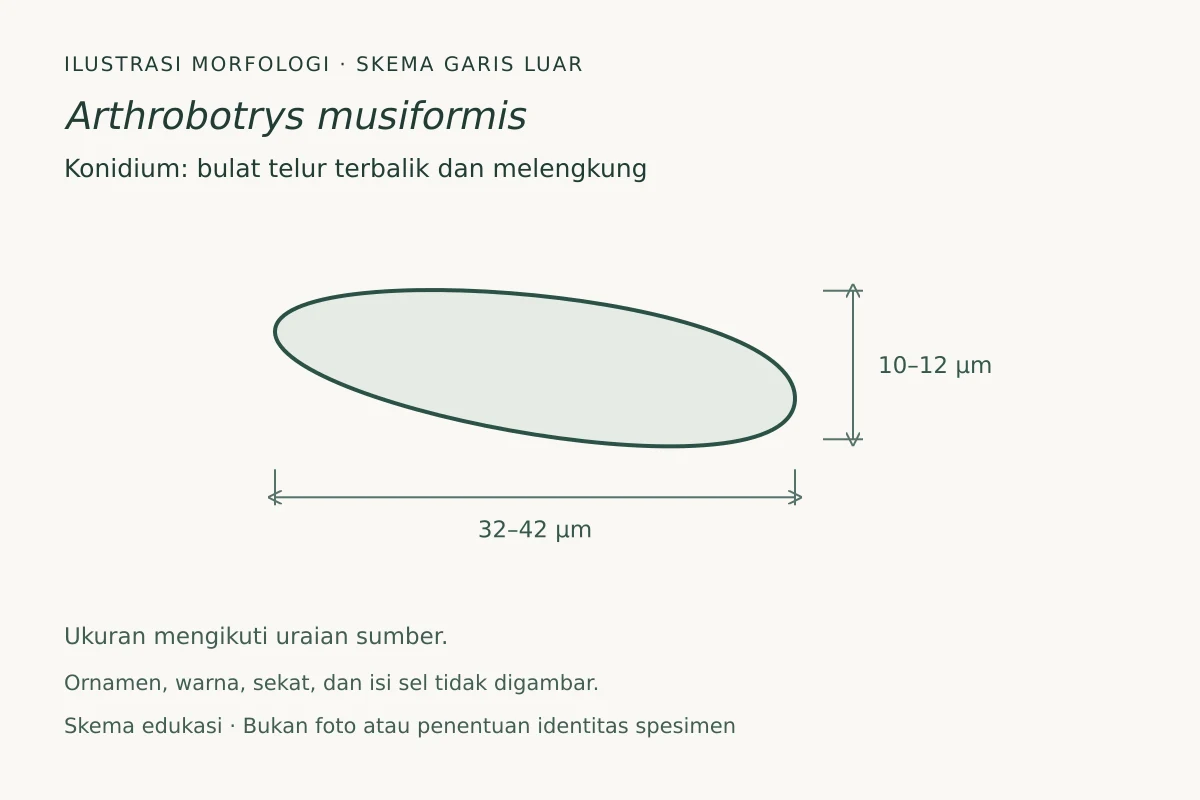
This fungi produces spores on curved, obvoid conidia that are 32 to 42 μm in length and 10 to 12 μm in width. The conidia are developed in 1 to 2 weeks on conidiophores that range between 250 and 375 μm long. Following germination of conidia or production of nets, A. musiformis may produce chlamdospores 10-20 μm in diameter. A. musiformis may be identified using its conidiaphores as they form a globalar, 'head' structure containing 5 to 15 conidia.
Catatan identitas dan cakupan
- Nama diterima mengikuti Catalogue of Life Base2026-09-11; uraian mempertahankan konsep dan nama sumber aslinya.
- Original geographic, specimen and life-cycle scope retained; source import awaits individual editorial review.
- Impor dan terjemahan otomatis belum diperiksa editorial per profil. Struktur reproduktif yang disebutkan tidak membuktikan seluruh siklus hidup diketahui.
- Pengukuran pada uraian mengikuti spesimen, kultur, dan metode sumber; angka tidak diperluas ke semua populasi.
Catatan distribusi dalam narasi mengikuti sumbernya. Dokumentasi spesimen atau foto mengikuti catatan sumber. Bukti wilayah Indonesia dan penilaian konservasi tidak disimpulkan dari gambar.
Melihat dengan konteks
Ilustrasi skematis garis luar konidium Arthrobotrys musiformis, berdasarkan uraian sumber; ukuran yang dilaporkan 32–42 × 10–12 µm. Proporsi disederhanakan, bukan salinan satu spesimen. Ornamen permukaan, warna, sekat, dan isi sel tidak direkonstruksi. Konidium melengkung dan bulat telur terbalik, panjang 32–42 µm serta lebar 10–12 µm. Kelengkungan digambar secara skematis; sudut atau radiusnya tidak diukur sumber.
- Jenis
- Ilustrasi skematis
- Kredit
- Fungi, ilustrasi orisinal (2026); fakta morfologi berdasarkan Wikipedia contributors
- Lisensi
- CC BY-SA 4.0
- Sumber media
- Buka entri sumber
Sumber profil
- [1] Arthrobotrys musiformis — Wikipedia (en)
- [2] Catalogue of Life Base2026-09-11 — Arthrobotrys musiformis
Rujukan halaman ini
Fungi. Arthrobotrys musiformis. Rilis data fungi-2026-10-12-expansion-2. https://fungi-atlas.mgadib.chatgpt.site/jamur/arthrobotrys-musiformis/.
Status: impor sumber; pemeriksaan editorial per profil belum selesai. Untuk klaim biologis, gunakan rujukan pada bagian terkait dan periksa konteks sumber aslinya.