01 / Morfologi

Ciri dan struktur

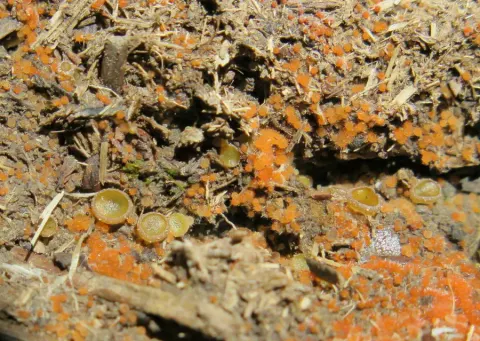
The mycelium of A. nigricans consisted of hyaline cylindrical hyphae that do not produce conidia and spermatia. Apothecium, the cup-shaped fruit body of A. nigricans, could be alone or gregarious and its small size make this species difficult to be collected frequently from the natural environment. However, the structure of apothecium would be observed clearly when it grows on artificial media. It consists of exposed hymenium which contains several unprotected asci surrounding with abundant unbranched paraphyses. Apothecium also contained hypothecium which formed by thin-walled hyphae and without excipulum. The tiny apothecium is hemispherical and flattens as aging. The clavate asci which contain ascospores are produced by the ascogenous hyphae with the broad base or a short broad stalk. Only a cluster of asci would be formed in a mature apothecium, and as the asci successfully mature, the asci shrink to a short stipe and give rise to a large attached operculum. Randomly arranged ascospores that set in the upper area of asci would be discharged through operculum at the asci tip. The ultrastructure of ascospores of A. nigricans was investigated to have a deeper understanding of the formation of wall layers and ornamentation of ascospores. The invagination of the plasma membrane of ascus generates the two unit membranes that consist of the ascus vesicle. Then partially invaginated ascus vesicle form the delimiting membranes for ascospore which also consist of two unit membranes with close space between them. Subsequently, a primary and secondary wall of ascospore would be formed.

Sebagian uraian ditampilkan dalam bahasa sumber; terjemahannya belum tersedia atau belum lolos pemeriksaan.

Rujukan: [1]

Pengukuran mengikuti objek, spesimen atau kultur, dan metode yang disebutkan sumber. Baca uraian asli untuk konteks lengkap.

02 / Kehidupan

Habitat dan peran ekologis

As a coprophilous fungus, A. nigricans is commonly isolated from the dung of both omnivorous and herbivore animals, such as dogs, goat, sheep, rat, donkey, pig, fox and ostrich. It also was found from the soil contaminated by dung. Basically, A. nigricans is a cosmopolitan species. Its distributions cover France, India, Italy, Portugal, Canada, U.S.A., England, Denmark, Sweden. In addition to this, it was found in Asia, Africa, Australia occasionally.

Sebagian uraian ditampilkan dalam bahasa sumber; terjemahannya belum tersedia atau belum lolos pemeriksaan.

Rujukan: [1]

Habitat atau konteks temuan
Informasi belum tersedia pada sumber rilis ini.
Substrat
Informasi belum tersedia pada sumber rilis ini.
Peran atau konteks
Belum dikategorikan pada rilis ini.
Temukan hubungan serupa
03 / Siklus hidup

Reproduksi

The mycelium of A. nigricans consisted of hyaline cylindrical hyphae that do not produce conidia and spermatia. Apothecium, the cup-shaped fruit body of A. nigricans, could be alone or gregarious and its small size make this species difficult to be collected frequently from the natural environment. However, the structure of apothecium would be observed clearly when it grows on artificial media. It consists of exposed hymenium which contains several unprotected asci surrounding with abundant unbranched paraphyses. Apothecium also contained hypothecium which formed by thin-walled hyphae and without excipulum. The tiny apothecium is hemispherical and flattens as aging. The clavate asci which contain ascospores are produced by the ascogenous hyphae with the broad base or a short broad stalk.

Sebagian uraian ditampilkan dalam bahasa sumber; terjemahannya belum tersedia atau belum lolos pemeriksaan.

Rujukan: [1]

04 / Batas informasi

Catatan identitas dan cakupan

  • Nama diterima mengikuti Catalogue of Life Base2026-09-11; uraian mempertahankan konsep dan nama sumber aslinya.
  • Original geographic, specimen and life-cycle scope retained; source import awaits individual editorial review.
  • Impor dan terjemahan otomatis belum diperiksa editorial per profil. Struktur reproduktif yang disebutkan tidak membuktikan seluruh siklus hidup diketahui.
  • Pengukuran pada uraian mengikuti spesimen, kultur, dan metode sumber; angka tidak diperluas ke semua populasi.

Catatan distribusi dalam narasi mengikuti sumbernya. Dokumentasi spesimen atau foto mengikuti catatan sumber. Bukti wilayah Indonesia dan penilaian konservasi tidak disimpulkan dari gambar.

05 / Dokumentasi

Melihat dengan konteks

Dokumentasi visual yang memenuhi pemeriksaan subjek dan hak penggunaan belum tersedia. Foto gejala, label, dan gambar yang meragukan tidak dihitung.

06 / Rujukan

Sumber profil

  1. [1] Ascodesmis nigricans — Wikipedia (en)Bagian sumber: Frozen revision 1354674349
    Tanggal penghimpunan sumber: 2026-10-12
    Teks sumber: CC BY-SA4.0 · Wikipedia contributors
  2. [2] Catalogue of Life Base2026-09-11 — Ascodesmis nigricansBagian sumber: ColDP NameUsage.tsv ID H83B; accepted species; source 2073
    Tanggal penghimpunan sumber: 2026-10-12

Adaptasi teks: CC BY-SA 4.0. Wikipedia contributors — Ascodesmis nigricans — Wikipedia (en)

Uraian asli dan riwayat sumber

Riwayat atau halaman sumber

Ringkasan sumber

The mycelium of A. nigricans consisted of hyaline cylindrical hyphae that do not produce conidia and spermatia. Apothecium, the cup-shaped fruit body of A. nigricans, could be alone or gregarious and its small size make this species difficult to be collected frequently from the natural environment. However, the structure of apothecium would be observed clearly when it grows on artificial media. It consists of exposed hymenium which contains several unprotected asci surrounding with abundant unbranched paraphyses.

Revisi sumber

Morfologi sumber

The mycelium of A. nigricans consisted of hyaline cylindrical hyphae that do not produce conidia and spermatia. Apothecium, the cup-shaped fruit body of A. nigricans, could be alone or gregarious and its small size make this species difficult to be collected frequently from the natural environment. However, the structure of apothecium would be observed clearly when it grows on artificial media. It consists of exposed hymenium which contains several unprotected asci surrounding with abundant unbranched paraphyses. Apothecium also contained hypothecium which formed by thin-walled hyphae and without excipulum. The tiny apothecium is hemispherical and flattens as aging. The clavate asci which contain ascospores are produced by the ascogenous hyphae with the broad base or a short broad stalk. Only a cluster of asci would be formed in a mature apothecium, and as the asci successfully mature, the asci shrink to a short stipe and give rise to a large attached operculum. Randomly arranged ascospores that set in the upper area of asci would be discharged through operculum at the asci tip. The ultrastructure of ascospores of A. nigricans was investigated to have a deeper understanding of the formation of wall layers and ornamentation of ascospores. The invagination of the plasma membrane of ascus generates the two unit membranes that consist of the ascus vesicle. Then partially invaginated ascus vesicle form the delimiting membranes for ascospore which also consist of two unit membranes with close space between them. Subsequently, a primary and secondary wall of ascospore would be formed.

Revisi sumber

Ekologi sumber

As a coprophilous fungus, A. nigricans is commonly isolated from the dung of both omnivorous and herbivore animals, such as dogs, goat, sheep, rat, donkey, pig, fox and ostrich. It also was found from the soil contaminated by dung. Basically, A. nigricans is a cosmopolitan species. Its distributions cover France, India, Italy, Portugal, Canada, U.S.A., England, Denmark, Sweden. In addition to this, it was found in Asia, Africa, Australia occasionally.

Revisi sumber

Struktur reproduksi sumber

The mycelium of A. nigricans consisted of hyaline cylindrical hyphae that do not produce conidia and spermatia. Apothecium, the cup-shaped fruit body of A. nigricans, could be alone or gregarious and its small size make this species difficult to be collected frequently from the natural environment. However, the structure of apothecium would be observed clearly when it grows on artificial media. It consists of exposed hymenium which contains several unprotected asci surrounding with abundant unbranched paraphyses. Apothecium also contained hypothecium which formed by thin-walled hyphae and without excipulum. The tiny apothecium is hemispherical and flattens as aging. The clavate asci which contain ascospores are produced by the ascogenous hyphae with the broad base or a short broad stalk.

Revisi sumber

Rujukan halaman ini

Fungi. Ascodesmis nigricans. Rilis data fungi-2026-10-12-expansion-2. https://fungi-atlas.mgadib.chatgpt.site/jamur/ascodesmis-nigricans/.

Status: impor sumber; pemeriksaan editorial per profil belum selesai. Untuk klaim biologis, gunakan rujukan pada bagian terkait dan periksa konteks sumber aslinya.