Ciri dan struktur
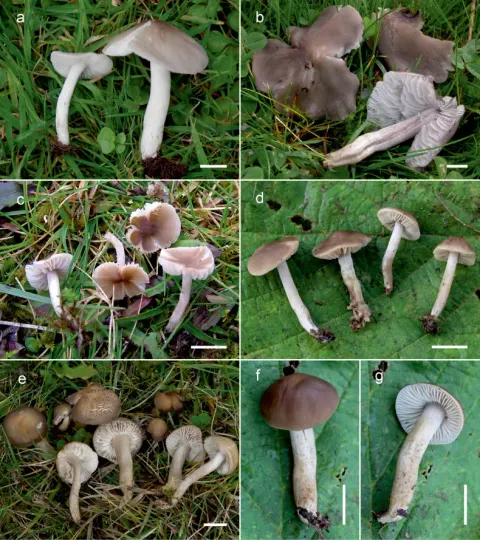
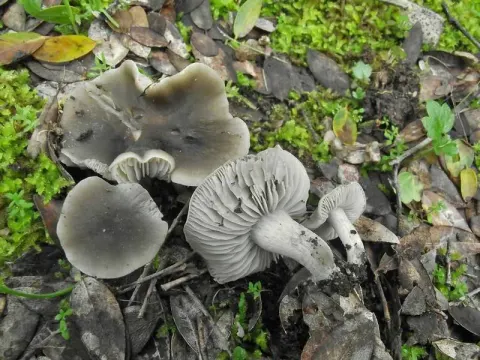
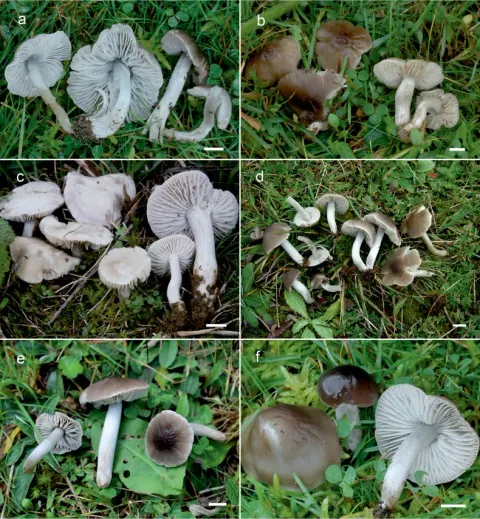
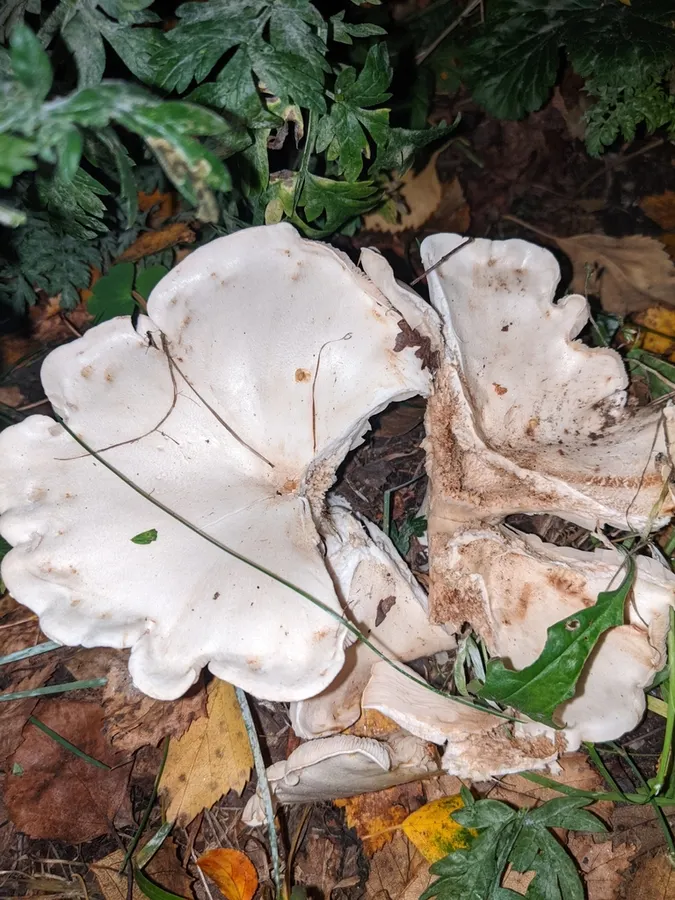
The cap can become rather large, ranging from 10-50 cm, rarely even 70 cm in diameter with a thickness of 1 to 1.4 cm at half the radius. The cap is initially convex with an inrolled margin, then flattens out and becomes shallowly funnel-shaped. The cap is smooth and creamy white in color, but may develop brown stains and circular cracks with age. The cream-colored gills are narrow, crowded close together, and have a decurrent attachment—running down the length of the stem; in age the gills will darken to a buff color. The stem is off-white with reddish-brown fibers and has dimensions, when mature, of 3 to 10 cm tall and 2 to 5 cm thick. There is no ring on the stem. At the base of the stem there is typically a dense, white mycelium that may form a mat. The flesh is firm, and also is white. Mature specimens are fragile, and difficult to remove from the ground without breaking. When viewed in deposit, such as with a spore print, the spores appear white. When viewed with a light microscope, the spores are ovoid to ellipsoid, translucent (hyaline), have a smooth surface, and possess a broadly rounded apex and base; the spore dimensions are 6–8 by 3.5–5 μm. The spores of A. giganteus are amyloid—meaning that they will absorb iodine when stained with Melzer's reagent—however, the extent of the stain may be variable. The spore-bearing cells, the basidia, are 25–40 by 4.5–8 μm, narrowly club-shaped, and are attached to either 2 or 4 spores. The hyphae of this species invariably have clamp connections. The odor has been said to be farinaceous or similar to fish meal. Burrows suggests preparing specimens by cutting them up and boiling the pieces, and disposing of the water; then they may be used in dishes such as stews and casseroles.
Habitat dan peran ekologis
Aspropaxillus giganteus can form fairy rings in grassy areas like pastures, and is also found along roadsides; it produces fruiting bodies in summer and autumn. It is a saprobic species, and so derives nutrients by decomposing organic matter. The fungus has a cosmopolitan distribution, and occurs throughout the temperate zone of the northern hemisphere. It is found in North America, Britain, and Europe. David Arora reports that in North America, it is most common in the Pacific Northwest and the Rocky Mountains.
- Habitat atau konteks temuan
- Informasi belum tersedia pada sumber rilis ini.
- Substrat
- Informasi belum tersedia pada sumber rilis ini.
- Peran atau konteks
- Pengurai
Reproduksi
When viewed in deposit, such as with a spore print, the spores appear white. When viewed with a light microscope, the spores are ovoid to ellipsoid, translucent (hyaline), have a smooth surface, and possess a broadly rounded apex and base; the spore dimensions are 6–8 by 3.5–5 μm. The spores of A. giganteus are amyloid—meaning that they will absorb iodine when stained with Melzer's reagent—however, the extent of the stain may be variable. The spore-bearing cells, the basidia, are 25–40 by 4.5–8 μm, narrowly club-shaped, and are attached to either 2 or 4 spores. The hyphae of this species invariably have clamp connections.
Catatan identitas dan cakupan
- Nama diterima mengikuti Catalogue of Life Base2026-09-11; uraian mempertahankan konsep dan nama sumber aslinya.
- Original geographic, specimen and life-cycle scope retained; source import awaits individual editorial review.
- Impor dan terjemahan otomatis belum diperiksa editorial per profil. Struktur reproduktif yang disebutkan tidak membuktikan seluruh siklus hidup diketahui.
- Pengukuran pada uraian mengikuti spesimen, kultur, dan metode sumber; angka tidak diperluas ke semua populasi.
Catatan distribusi dalam narasi mengikuti sumbernya. Dokumentasi spesimen atau foto mengikuti catatan sumber. Bukti wilayah Indonesia dan penilaian konservasi tidak disimpulkan dari gambar.
Melihat dengan konteks
Dokumentasi Aspropaxillus giganteus menurut asosiasi foto pada record takson iNaturalist. Kredit: jollero. Identitas mengikuti sumber; bukan penentuan spesimen independen.
- Jenis
- Fotografi
- Kredit
- (c) jollero, some rights reserved (CC BY-SA)
- Lisensi
- CC BY-SA 4.0
- Sumber media
- Buka entri sumber
Sumber profil
- [1] Aspropaxillus giganteus — Wikipedia (en)
- [2] Catalogue of Life Base2026-09-11 — Aspropaxillus giganteus
- [3] Dokumentasi visual — Aspropaxillus giganteus
Rujukan halaman ini
Fungi. Aspropaxillus giganteus. Rilis data fungi-2026-10-12-expansion-2. https://fungi-atlas.mgadib.chatgpt.site/jamur/aspropaxillus-giganteus/.
Status: impor sumber; pemeriksaan editorial per profil belum selesai. Untuk klaim biologis, gunakan rujukan pada bagian terkait dan periksa konteks sumber aslinya.