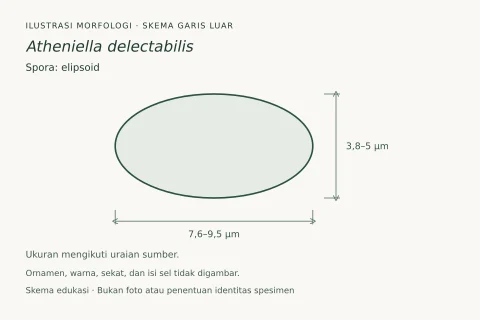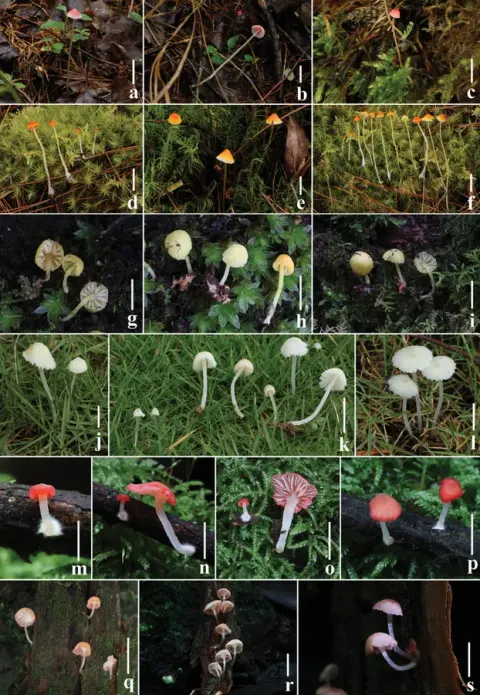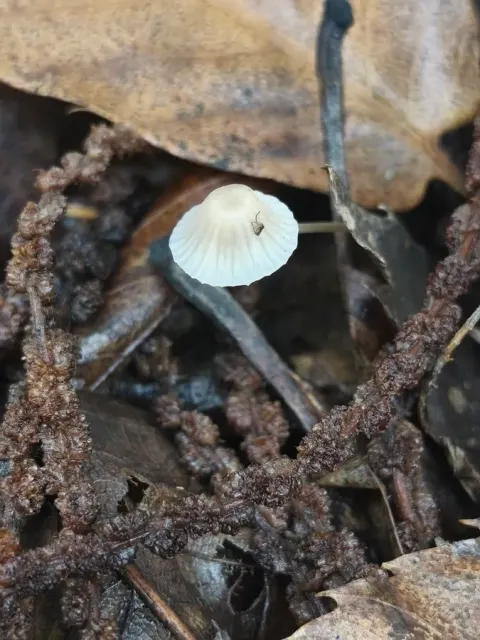
01 / Morfologi

Ciri dan struktur

The cap initially has a sharply conic shape, but expands to a narrow bell-shape or a broad cone in maturity, typically reaching 0.5 to 1.2 cm in diameter. It is scarlet red when young, becoming orange to yellowish. The cap margin, which is initially pressed against the stem, is opaque or nearly so at first. The mushroom is hygrophanous, and fades to an orange buff when dry. The flesh is thin, the same color as the cap, fragile, and without any distinctive taste or odor. The gills are ascending-adnate (attaching at much less than a right angle, appearing to curve upward toward stem) or attached by a tooth, subdistant to close, with 14–16 gills reaching the stem. Additionally, there are two or three tiers of lamellulae—short gills that do not extend fully from the cap edge to the stem. The gills are narrow, and yellowish or with a reddish tinge at first; the margins are paler and the same color as the faces. The stem is 2–4 cm long and 1–2 mm thick, and roughly equal in width throughout. It is tubular, fragile, initially pruinose (covered with a fine powder), polished and smooth with age, pale yellow, becoming whitish, with the base often dirty yellow or brownish. The spores are narrowly ellipsoid, inamyloid, and measure 6–7 by 3–3.5 μm. The basidia (spore-bearing cells) are four-spored and measure 20–22 by 6–7 μm. The cheilocystidia and pleurocystidia (cystidia found on the edges and faces, respectively, of the gills) are abundant and similar in shape and markings, 40–58 by 10–15 μm, tapering somewhat on either end and usually with a long needle-shaped neck (which is branched in some).

Sebagian uraian ditampilkan dalam bahasa sumber; terjemahannya belum tersedia atau belum lolos pemeriksaan.

Rujukan: [1]

Pengukuran mengikuti objek, spesimen atau kultur, dan metode yang disebutkan sumber. Baca uraian asli untuk konteks lengkap.

02 / Kehidupan

Habitat dan peran ekologis

The fruit bodies of A. adonis grow solitarily or in groups in conifer forests and heaths, and appear in the spring and autumn. The fruit bodies grow in groups or scattered on needle beds under spruce and hemlock in wet coastal conifer forests, or in the higher mountains, where it is not uncommon in the spring and autumn months. Jamur ini ditemukan di Europe and di Amerika Utara barat, di mana Mycena specialist Alexander H. Smith found spesies di Washington, Oregon, dan California. Di 2007, laporan itu berasal dari lembah Ussuri River in di timur laut China. In one instance, fruit bodies were found growing on the deciduous trees Spanish Maple (Acer granatense) and willow (Salix alba) near Amsterdam. Diperkirakan bahwa kulit pohon-pohon ini telah menjadi lebih asam dalam beberapa tahun terakhir karena meningkatnya polusi atmosfer (khususnya, peningkatan kadar asam sulfurik dan nitrat dari asap industri), memberikan substrat yang lebih cocok untuk jamur.

Sebagian uraian ditampilkan dalam bahasa sumber; terjemahannya belum tersedia atau belum lolos pemeriksaan.

Rujukan: [1]

Habitat atau konteks temuan
hutan
Substrat
Informasi belum tersedia pada sumber rilis ini.
Peran atau konteks
Belum dikategorikan pada rilis ini.
Temukan hubungan serupa
03 / Siklus hidup

Reproduksi

The spores are narrowly ellipsoid, inamyloid, and measure 6–7 by 3–3.5 μm. The basidia (spore-bearing cells) are four-spored and measure 20–22 by 6–7 μm. The cheilocystidia and pleurocystidia (cystidia found on the edges and faces, respectively, of the gills) are abundant and similar in shape and markings, 40–58 by 10–15 μm, tapering somewhat on either end and usually with a long needle-shaped neck (which is branched in some). The cystidia are generally smooth, but when dried material is mounted in potassium hydroxide for observation under light microscopy, an amorphous substance apparently holds spores and debris around the neck or apex, making them appear encrusted. The flesh of the gill is very faintly vinaceous-brown when stained in iodine.

Sebagian uraian ditampilkan dalam bahasa sumber; terjemahannya belum tersedia atau belum lolos pemeriksaan.

Rujukan: [1]

Sinonim menurut acuan taksonomi rilis: Agaricus adonis; Agaricus adonis var. viridis; Agaricus floridulus; Collybia floridula; Hemimycena adonis; Hemimycena floridula; Marasmiellus adonis; Marasmiellus floridulus; Mycena adonis; Mycena adonis var. variegata; Mycena floridula; Mycena floridula f. evanida; Mycena rubella
04 / Batas informasi

Catatan identitas dan cakupan

  • Nama diterima mengikuti Catalogue of Life Base2026-09-11; uraian mempertahankan konsep dan nama sumber aslinya.
  • Original geographic, specimen and life-cycle scope retained; source import awaits individual editorial review.
  • Impor dan terjemahan otomatis belum diperiksa editorial per profil. Struktur reproduktif yang disebutkan tidak membuktikan seluruh siklus hidup diketahui.
  • Pengukuran pada uraian mengikuti spesimen, kultur, dan metode sumber; angka tidak diperluas ke semua populasi.

Catatan distribusi dalam narasi mengikuti sumbernya. Dokumentasi spesimen atau foto mengikuti catatan sumber. Bukti wilayah Indonesia dan penilaian konservasi tidak disimpulkan dari gambar.

05 / Dokumentasi

Melihat dengan konteks

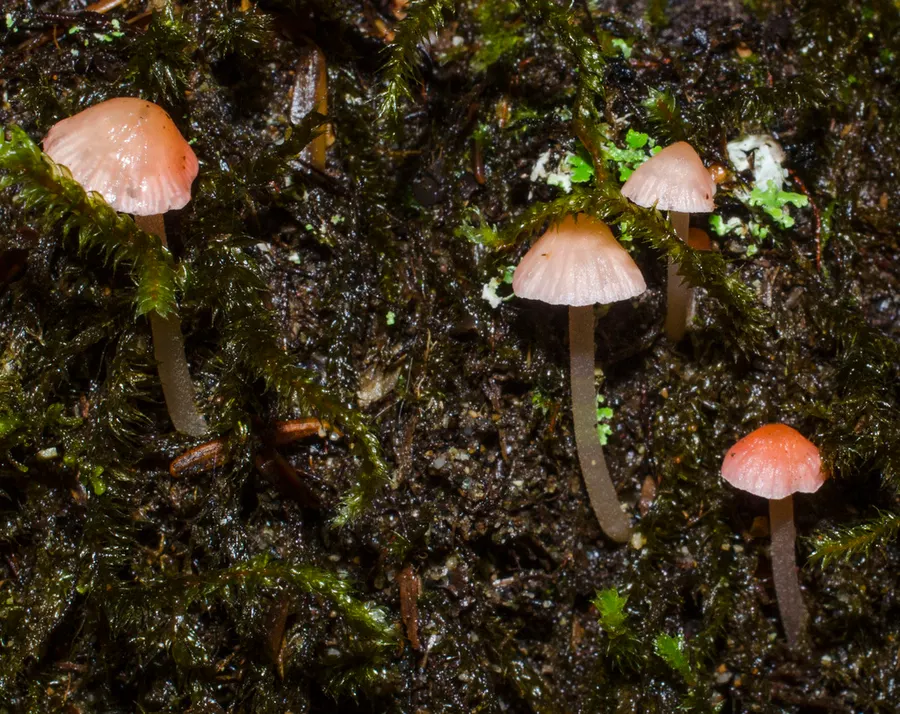
Dokumentasi Atheniella adonis menurut asosiasi foto pada record takson iNaturalist. Kredit: Tim Sage. Identitas mengikuti sumber; bukan penentuan spesimen independen.

Jenis
Fotografi
Kredit
(c) Tim Sage, some rights reserved (CC BY-SA), uploaded by Tim Sage
Sumber media
Buka entri sumber

Gambar menunjukkan objek menurut identifikasi sumber, bukan verifikasi independen spesimen oleh Fungi. Tidak ada skala baru yang ditambahkan.

06 / Rujukan

Sumber profil

  1. [1] Atheniella adonis — Wikipedia (en)Bagian sumber: Frozen revision 1285309400
    Tanggal penghimpunan sumber: 2026-10-12
    Teks sumber: CC BY-SA4.0 · Wikipedia contributors
  2. [2] Catalogue of Life Base2026-09-11 — Atheniella adonisBagian sumber: ColDP NameUsage.tsv ID 67VC9; accepted species; source 2073
    Tanggal penghimpunan sumber: 2026-10-12
  3. [3] Dokumentasi visual — Atheniella adonisBagian sumber: Individual media record; identification follows the source, not independent determination
    Tanggal penghimpunan sumber: 2026-10-12
    Media sumber: CC BY-SA 4.0 · (c) Tim Sage, some rights reserved (CC BY-SA), uploaded by Tim Sage

Adaptasi teks: CC BY-SA 4.0. Wikipedia contributors — Atheniella adonis — Wikipedia (en)

Uraian asli dan riwayat sumber

Riwayat atau halaman sumber

Ringkasan sumber

Atheniella adonis, which has the recommended name of scarlet bonnet in the UK, is a species of agaric in the family Cyphellaceae.It produces small orangish to reddish mushrooms with caps up to 1.2 cm in diameter and thin pinkish-white stems reaching 4 cm long. The fungus typically grows in conifer woods in Eurasia and North America.

Revisi sumber

Morfologi sumber

The cap initially has a sharply conic shape, but expands to a narrow bell-shape or a broad cone in maturity, typically reaching 0.5 to 1.2 cm in diameter. It is scarlet red when young, becoming orange to yellowish. The cap margin, which is initially pressed against the stem, is opaque or nearly so at first. The mushroom is hygrophanous, and fades to an orange buff when dry. The flesh is thin, the same color as the cap, fragile, and without any distinctive taste or odor. The gills are ascending-adnate (attaching at much less than a right angle, appearing to curve upward toward stem) or attached by a tooth, subdistant to close, with 14–16 gills reaching the stem. Additionally, there are two or three tiers of lamellulae—short gills that do not extend fully from the cap edge to the stem. The gills are narrow, and yellowish or with a reddish tinge at first; the margins are paler and the same color as the faces. The stem is 2–4 cm long and 1–2 mm thick, and roughly equal in width throughout. It is tubular, fragile, initially pruinose (covered with a fine powder), polished and smooth with age, pale yellow, becoming whitish, with the base often dirty yellow or brownish. The spores are narrowly ellipsoid, inamyloid, and measure 6–7 by 3–3.5 μm. The basidia (spore-bearing cells) are four-spored and measure 20–22 by 6–7 μm. The cheilocystidia and pleurocystidia (cystidia found on the edges and faces, respectively, of the gills) are abundant and similar in shape and markings, 40–58 by 10–15 μm, tapering somewhat on either end and usually with a long needle-shaped neck (which is branched in some).

Revisi sumber

Ekologi sumber

The fruit bodies of A. adonis grow solitarily or in groups in conifer forests and heaths, and appear in the spring and autumn. The fruit bodies grow in groups or scattered on needle beds under spruce and hemlock in wet coastal conifer forests, or in the higher mountains, where it is not uncommon in the spring and autumn months. The fungus is found in Europe and in western North America, where Mycena specialist Alexander H. Smith found the species in Washington, Oregon, and California. In 2007, it was reported from the valley of the Ussuri River in the northeast of China. In one instance, fruit bodies were found growing on the deciduous trees Spanish Maple (Acer granatense) and willow (Salix alba) near Amsterdam. It was hypothesized that the bark of these trees had become more acidic in recent years because of increasing atmospheric pollution (specifically, increases in the levels of sulfuric and nitric acid from industrial smoke), providing a more suitable substrate for the fungus.

Revisi sumber

Struktur reproduksi sumber

The spores are narrowly ellipsoid, inamyloid, and measure 6–7 by 3–3.5 μm. The basidia (spore-bearing cells) are four-spored and measure 20–22 by 6–7 μm. The cheilocystidia and pleurocystidia (cystidia found on the edges and faces, respectively, of the gills) are abundant and similar in shape and markings, 40–58 by 10–15 μm, tapering somewhat on either end and usually with a long needle-shaped neck (which is branched in some). The cystidia are generally smooth, but when dried material is mounted in potassium hydroxide for observation under light microscopy, an amorphous substance apparently holds spores and debris around the neck or apex, making them appear encrusted. The flesh of the gill is very faintly vinaceous-brown when stained in iodine.

Revisi sumber

Rujukan halaman ini

Fungi. Atheniella adonis. Rilis data fungi-2026-10-12-expansion-2. https://fungi-atlas.mgadib.chatgpt.site/jamur/atheniella-adonis/.

Status: impor sumber; pemeriksaan editorial per profil belum selesai. Untuk klaim biologis, gunakan rujukan pada bagian terkait dan periksa konteks sumber aslinya.