Ciri dan struktur
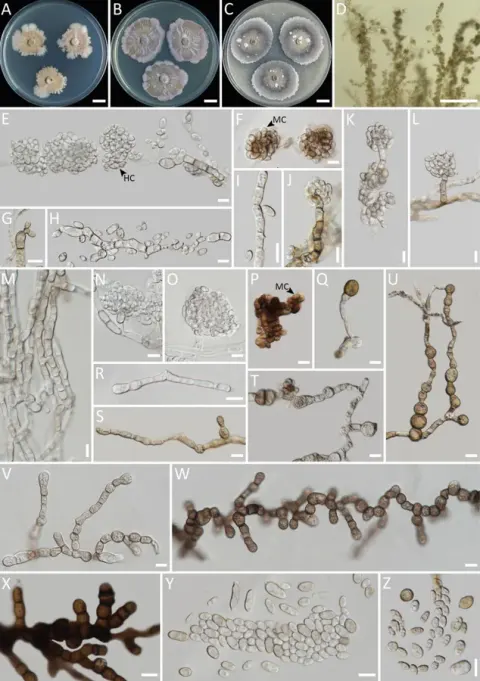
After 14 days of incubation at 25 °C in the dark, colonies on PDA reaching 45–65 mm diam., surface flat, spreading with entire margin, zonate, orange white (5A2), with brownish gray (4E2) to olive brown (4E6) at the margin; on MEA reaching 65–70 mm diam., surface flat, spreading with entire margin, velvety, zonate, dark brown (6F8) at center, becoming brownish orange (6C8), with brownish gray (4E2) and white at the margin; on OA 60–75 mm diam., surface flat, spreading with irregular margin, velvety, grayish orange (6B5), with brownish gray (4E2) at the margin. Anamorph in vitro dematiaceous hyphomycetes. Vegetative hyphae (2.3–)3.0–5.5(–8.0) μm wide, mostly hyaline, light brown to brown, branched, septate, constricted at the septa, smooth, thin-walled, getting darker and thicker with age. Conidiogenous cells (3.8–)5.3–11.0(–12.5) × (3.2–)4.0–7.5(–8.3) μm (x̄ = 8.7 × 5.3 μm, n = 25), undifferentiated, intercalary, rarely terminal, producing conidia percurrently from indistinct lateral denticles, giving rise to conidia that aggregate in a mucoid mass, or differentiated from hyphae, hyaline to lightly melanized. Conidia (3.6–)5.5–8.5(–11.4) × (2.0–)2.8–6.0 μm (x̄ = 7.1 × 4.1 μm, n = 150), obovoid to ellipsoid, or subglobose, hyaline, becoming lightly melanized with age, aseptate, occasionally with an indistinct truncated base and a hilum, guttulate, smooth-walled. Chlamydospores (10.0)11.5–14.0(–16.3) μm wide (x̄ = 12.8 μm, n = 50), frequent produced in aerial hyphae, mostly intercalary, solitary or in branched chains, subglobose to ellipsoidal, pigmented, light to dark brown, smooth-, thick-walled, septate, constricted near the septa.
Habitat dan peran ekologis
Flowers of Jasminum sambac and Ocimum tenuiflorum in Thailand (this study). Aureobasidium melanogenum is found worldwide in diverse environments and materials, including air, soil, water, and indoor and plant surfaces, and is also considered an opportunistic human pathogen (Zalar et al. 2008; Gostinčar et al. 2014; Nasr et al. 2018; da Silva et al. 2024; Černoša et al. 2025; Patel et al. 2025).
- Habitat atau konteks temuan
- Informasi belum tersedia pada sumber rilis ini.
- Substrat
- Informasi belum tersedia pada sumber rilis ini.
- Peran atau konteks
- Belum dikategorikan pada rilis ini.
Reproduksi
Anamorph in vitro dematiaceous hyphomycetes. Vegetative hyphae (2.3–)3.0–5.5(–8.0) μm wide, mostly hyaline, light brown to brown, branched, septate, constricted at the septa, smooth, thin-walled, getting darker and thicker with age. Conidiogenous cells (3.8–)5.3–11.0(–12.5) × (3.2–)4.0–7.5(–8.3) μm (x̄ = 8.7 × 5.3 μm, n = 25), undifferentiated, intercalary, rarely terminal, producing conidia percurrently from indistinct lateral denticles, giving rise to conidia that aggregate in a mucoid mass, or differentiated from hyphae, hyaline to lightly melanized. Conidia (3.6–)5.5–8.5(–11.4) × (2.0–)2.8–6.0 μm (x̄ = 7.1 × 4.1 μm, n = 150), obovoid to ellipsoid, or subglobose, hyaline, becoming lightly melanized with age, aseptate, occasionally with an indistinct truncated base and a hilum, guttulate, smooth-walled.
Catatan identitas dan cakupan
- Nama diterima mengikuti Catalogue of Life Base2026-09-11; uraian mempertahankan konsep dan nama sumber aslinya.
- Preserve original treatment localities, hosts and substrate scope. Materials examined describe documented specimens, not the full global range.
- Impor dan terjemahan otomatis belum diperiksa editorial per profil. Struktur reproduktif yang disebutkan tidak membuktikan seluruh siklus hidup diketahui.
- Pengukuran pada uraian mengikuti spesimen, kultur, dan metode sumber; angka tidak diperluas ke semua populasi.
Catatan distribusi dalam narasi mengikuti sumbernya. Dokumentasi spesimen atau foto mengikuti catatan sumber. Bukti wilayah Indonesia dan penilaian konservasi tidak disimpulkan dari gambar.
Melihat dengan konteks
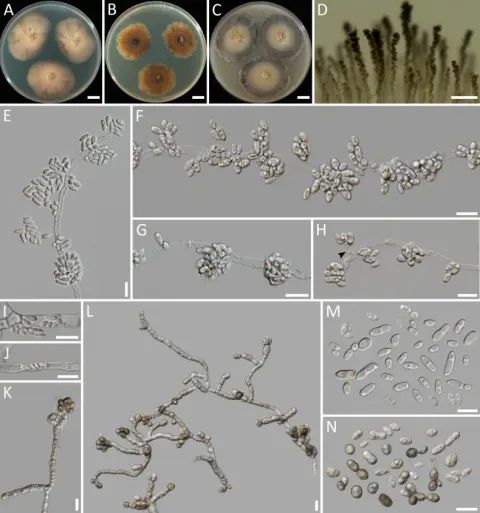
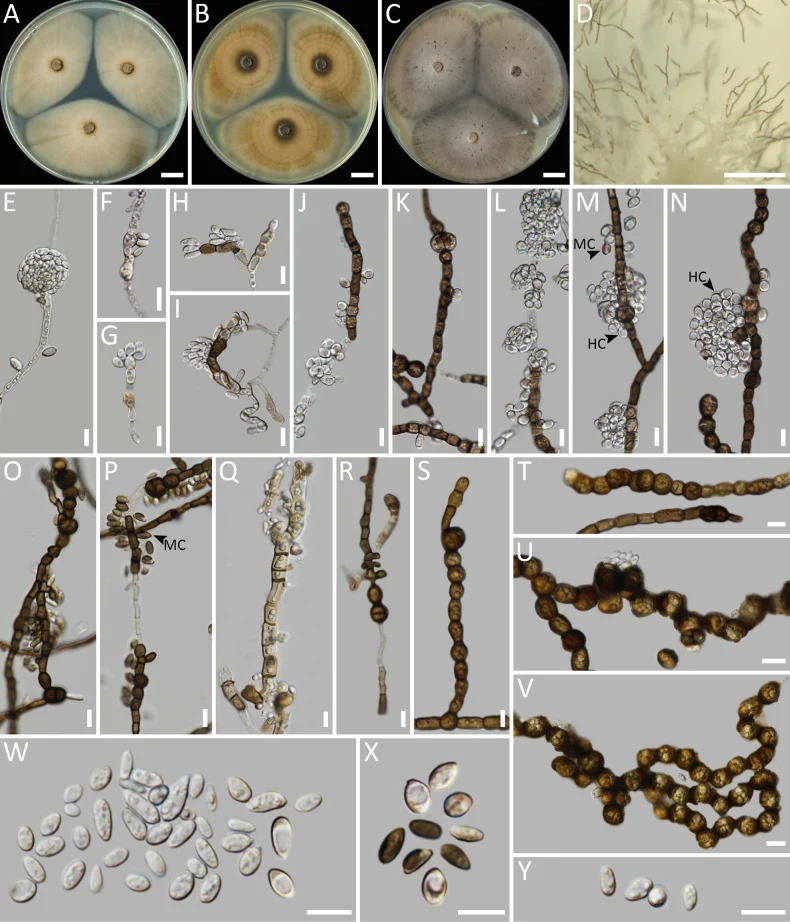
Aureobasidium melanogenum (SDBR-CMU855). A–C colonies on PDA, MEA, and OA, respectively, after 14 d at 25 °C; D close-up of an immersed hyphal-tip colony on PDA after 14 d; E hyphae with groups of hyaline conidia; F–I Hormonema -like conidiogenous cells with hyaline conidia; J–Q melanized hyphae with groups of hyaline conidia (HC) and melanized conidia (MC); R–T melanized hyphae developing into chlamydospores; U, V, Y chlamydospores budding to produce hyaline conidia; W, X conidia. Scale bars: 1 cm (A–C); 500 μm (D); 10 μm (E–Y).
- Jenis
- Pelat ilmiah
- Kredit
- Chanokned Senwanna, Pratthana Kodchasee, Chirayut Kathongthung, Milan C. Samarakoon, Pannida Khunnamwong, Jaturong Kumla, Nakarin Suwannarach
- Lisensi
- CC BY 4.0
- Sumber media
- Buka entri sumber
Sumber profil
- [1] Unexpected diversity of flower-associated Aureobasidium reveals sixteen novel species from northern Thailand — Aureobasidium melanogenum
- [2] Catalogue of Life Base2026-09-11 — Aureobasidium melanogenum
- [3] Dokumentasi visual — Aureobasidium melanogenum
Rujukan halaman ini
Fungi. Aureobasidium melanogenum. Rilis data fungi-2026-10-12-expansion-2. https://fungi-atlas.mgadib.chatgpt.site/jamur/aureobasidium-melanogenum/.
Status: impor sumber; pemeriksaan editorial per profil belum selesai. Untuk klaim biologis, gunakan rujukan pada bagian terkait dan periksa konteks sumber aslinya.