01 / Morfologi

Ciri dan struktur

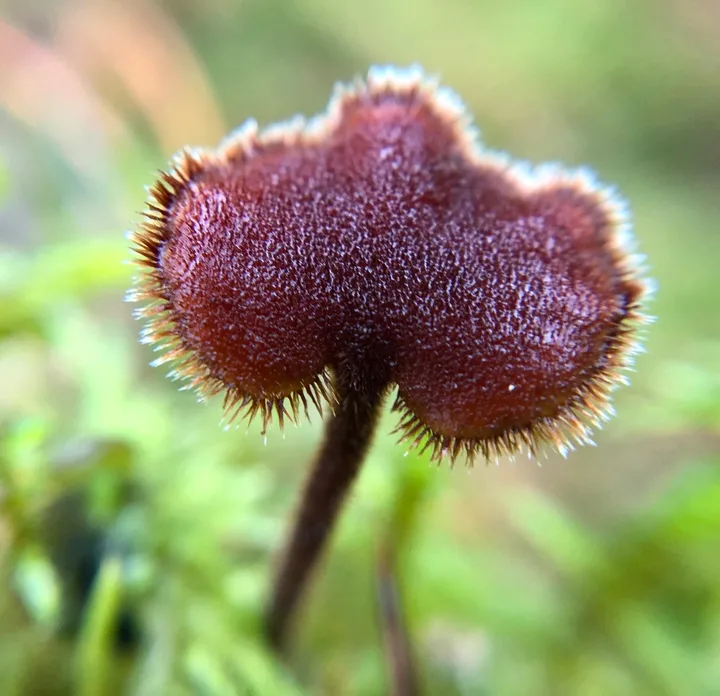
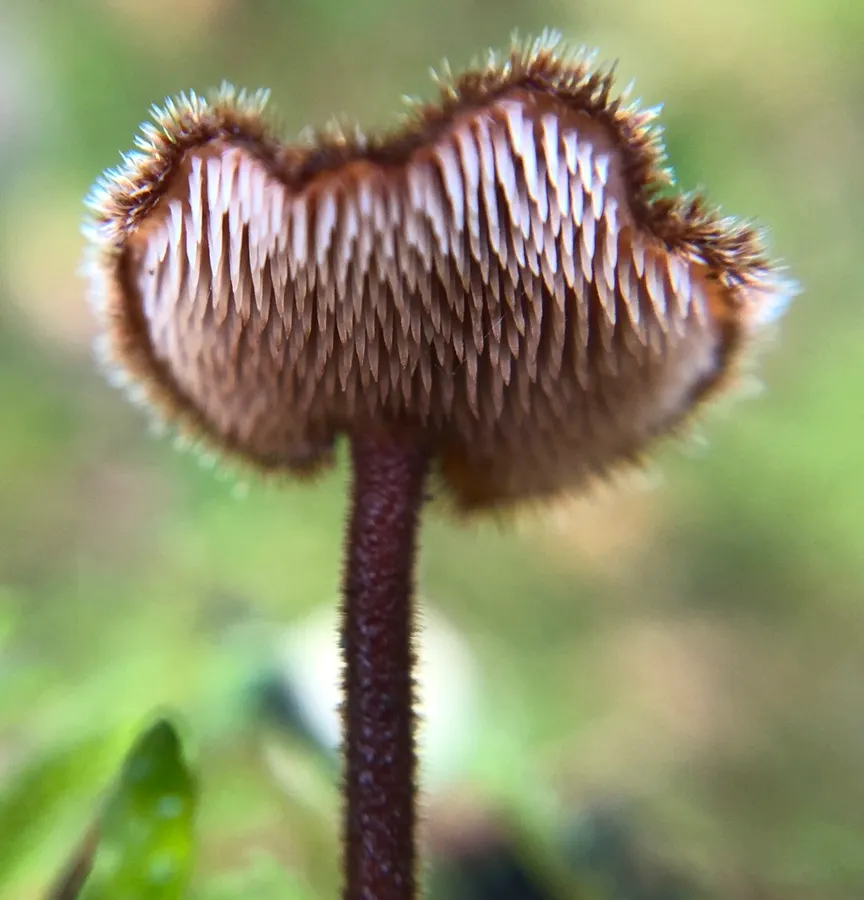
The fruit body of A. vulgare is fibrous when fresh and becomes stiff when dry. It is a small species rarely exceeding 5.5 cm in height, with a cap usually smaller than an adult's fingernails: 0.5 to 2 cm—although it has been known to reach up to 4 cm. Its surface is covered with hairy fibers, and its mature color is a dark chestnut brown. The cap flesh is composed of two distinct layers: a thin, compact, black-brown and hairy upper layer, and a thick, soft, white to light brown lower layer that is made of thin, thread-like filaments arranged in a roughly parallel fashion. The stem is similarly divided, with a thin, dark and hairy cortical layer covered by hairs, which encircles inner ochre-colored flesh. A drop of potassium hydroxide applied to the surface of the mushroom will cause it to instantly stain black. The mushroom has no distinct taste or odor, is generally considered inedible because of its toughness and diminutive size. An 1887 textbook noted, however, that it was "commonly eaten in France and Italy". In deposit, the spores are white. Viewed under a light microscope, the spores appear hyaline (translucent), covered with minute wart-like bumps, and are spherical or nearly so, with dimensions of 4.6–5.5 by 4–5 μm. They are amyloid (reacting to Melzer's reagent) and cyanophilous (staining in methyl blue). The basidia (spore-bearing cells of the hymenium) are four-spored with basal clamps, and measure 15–24 by 3–4 μm, and sterigmata (extensions of the basidia that bear the spores) are swollen at the base and roughly 3 μm long. The hyphal system is dimitic, comprising both generative (undifferentiated) and skeletal (structural) hyphae.

Sebagian uraian ditampilkan dalam bahasa sumber; terjemahannya belum tersedia atau belum lolos pemeriksaan.

Rujukan: [1]

Pengukuran mengikuti objek, spesimen atau kultur, dan metode yang disebutkan sumber. Baca uraian asli untuk konteks lengkap.

02 / Kehidupan

Habitat dan peran ekologis

Auriscalpium vulgare adalah spesies saprobik. Jamurnya tumbuh sendiri atau berkelompok di atas kerucut pinus yang jatuh, terutama yang sepenuhnya atau sebagian dikubur. Biasanya mendukung Scots pine (Pinus sylvestris), tetapi juga telah dilaporkan pada kerucut semak, dan pada California grows terutama pada kerucut Douglas-fir. One author mencatat menemukan jamur pada jarum celah di atas lubang tupai di mana ada braket kerucut di lantai hutan. Dalam sebuah studi yang dilakukan di Laojun Mountain region Yunnan, China, A. vulgare ditemukan sebagai salah satu spesies yang paling dominan yang dikumpulkan dari hutan campuran di ketinggian 2600–3000 m. Sebuah studi tentang efek dari praktik pemotongan dan pembakaran di timur laut India showed menunjukkan bahwa jamur lebih memilih buah daripada kuning yang terbakar dari Khasi pine, dan bahwa jumlah tubuh buah pada kuning yang tidak terbakar meningkat seiring dengan gir kuning. The fungus is widely distributed in Europe, Central and North America, temperate Asia, and Turkey. Di Amerika Utara, rentangnya mulai dari Canada to Trans-Meksiko Volcano Belt south di Kota Meksiko. Jamur ini umum, muncul di musim panas dan musim gugur, meskipun mudah diabaikan karena ukurannya yang kecil dan warna yang tidak jelas.

Sebagian uraian ditampilkan dalam bahasa sumber; terjemahannya belum tersedia atau belum lolos pemeriksaan.

Rujukan: [1]

Habitat atau konteks temuan
hutan
Substrat
Informasi belum tersedia pada sumber rilis ini.
Peran atau konteks
Pengurai
Temukan hubungan serupa
03 / Siklus hidup

Reproduksi

In deposit, the spores are white. Viewed under a light microscope, the spores appear hyaline (translucent), covered with minute wart-like bumps, and are spherical or nearly so, with dimensions of 4.6–5.5 by 4–5 μm. They are amyloid (reacting to Melzer's reagent) and cyanophilous (staining in methyl blue). The basidia (spore-bearing cells of the hymenium) are four-spored with basal clamps, and measure 15–24 by 3–4 μm, and sterigmata (extensions of the basidia that bear the spores) are swollen at the base and roughly 3 μm long. The hyphal system is dimitic, comprising both generative (undifferentiated) and skeletal (structural) hyphae. The thin-walled generative hyphae are hyaline, and have clamp connections; the thick-walled skeletal hyphae are thicker overall and lack such connections.

Sebagian uraian ditampilkan dalam bahasa sumber; terjemahannya belum tersedia atau belum lolos pemeriksaan.

Rujukan: [1]

Sinonim menurut acuan taksonomi rilis: Auriscalpium fechtneri; Hydnum atrotomentosum; Hydnum auriscalpium; Hydnum auriscalpium var. bicolor; Hydnum auriscalpium var. spadiceum; Hydnum fechtneri; Leptodon auriscalpium; Pleurodon auriscalpium; Pleurodon fechtneri; Scutiger auriscalpium
04 / Batas informasi

Catatan identitas dan cakupan

  • Nama diterima mengikuti Catalogue of Life Base2026-09-11; uraian mempertahankan konsep dan nama sumber aslinya.
  • Original geographic, specimen and life-cycle scope retained; source import awaits individual editorial review.
  • Impor dan terjemahan otomatis belum diperiksa editorial per profil. Struktur reproduktif yang disebutkan tidak membuktikan seluruh siklus hidup diketahui.
  • Pengukuran pada uraian mengikuti spesimen, kultur, dan metode sumber; angka tidak diperluas ke semua populasi.

Catatan distribusi dalam narasi mengikuti sumbernya. Dokumentasi spesimen atau foto mengikuti catatan sumber. Bukti wilayah Indonesia dan penilaian konservasi tidak disimpulkan dari gambar.

05 / Dokumentasi

Melihat dengan konteks

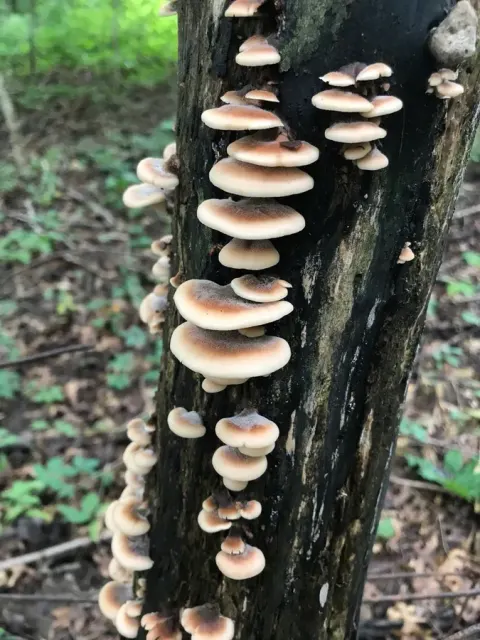
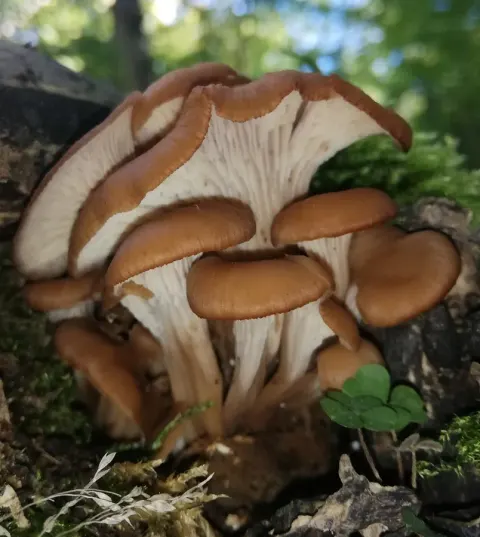
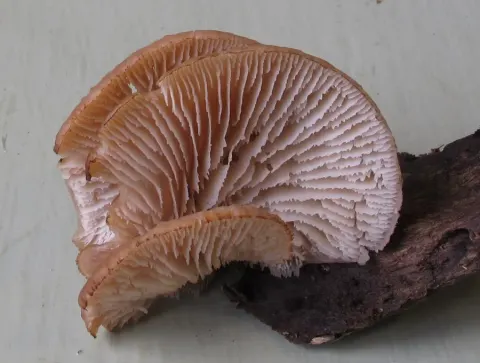
Dokumentasi Auriscalpium vulgare menurut asosiasi foto pada record takson iNaturalist. Kredit: Katrin Simon. Identitas mengikuti sumber; bukan penentuan spesimen independen.

Jenis
Fotografi
Kredit
(c) Katrin Simon, some rights reserved (CC BY), uploaded by Katrin Simon
Lisensi
CC BY 4.0
Sumber media
Buka entri sumber

Gambar menunjukkan objek menurut identifikasi sumber, bukan verifikasi independen spesimen oleh Fungi. Tidak ada skala baru yang ditambahkan.

Dokumentasi tambahan

06 / Rujukan

Sumber profil

  1. [1] Auriscalpium vulgare — Wikipedia (en)Bagian sumber: Frozen revision 1363925852
    Tanggal penghimpunan sumber: 2026-10-12
    Teks sumber: CC BY-SA4.0 · Wikipedia contributors
  2. [2] Catalogue of Life Base2026-09-11 — Auriscalpium vulgareBagian sumber: ColDP NameUsage.tsv ID 689XL; accepted species; source 2073
    Tanggal penghimpunan sumber: 2026-10-12
  3. [3] Dokumentasi visual — Auriscalpium vulgareBagian sumber: Identitas mengikuti sumber dokumentasi; bukan penentuan spesimen independen.
    Tanggal penghimpunan sumber: 2026-10-17
    Media sumber: CC BY 4.0 · (c) Katrin Simon, some rights reserved (CC BY), uploaded by Katrin Simon
  4. [4] Dokumentasi visual — Auriscalpium vulgareBagian sumber: Identitas mengikuti sumber dokumentasi; bukan penentuan spesimen independen.
    Tanggal penghimpunan sumber: 2026-10-17
    Teks sumber: CC BY 4.0 · (c) Katrin Simon, some rights reserved (CC BY), uploaded by Katrin Simon

Adaptasi teks: CC BY-SA 4.0. Wikipedia contributors — Auriscalpium vulgare — Wikipedia (en)

Uraian asli dan riwayat sumber

Riwayat atau halaman sumber

Ringkasan sumber

Auriscalpium vulgare, commonly known as the pinecone mushroom, the cone tooth, or the ear-pick fungus, is a species of fungus in the family Auriscalpiaceae of the order Russulales. It was first described in 1753 by Carl Linnaeus, who included it as a member of the tooth fungi genus Hydnum, but British mycologist Samuel Frederick Gray recognized its uniqueness and in 1821 transferred it to the genus Auriscalpium that he created to contain it. The fruit bodies (mushrooms) grow on conifer litter or on conifer cones that may be partially or completely buried in soil.

Revisi sumber

Morfologi sumber

The fruit body of A. vulgare is fibrous when fresh and becomes stiff when dry. It is a small species rarely exceeding 5.5 cm in height, with a cap usually smaller than an adult's fingernails: 0.5 to 2 cm—although it has been known to reach up to 4 cm. Its surface is covered with hairy fibers, and its mature color is a dark chestnut brown. The cap flesh is composed of two distinct layers: a thin, compact, black-brown and hairy upper layer, and a thick, soft, white to light brown lower layer that is made of thin, thread-like filaments arranged in a roughly parallel fashion. The stem is similarly divided, with a thin, dark and hairy cortical layer covered by hairs, which encircles inner ochre-colored flesh. A drop of potassium hydroxide applied to the surface of the mushroom will cause it to instantly stain black. The mushroom has no distinct taste or odor, is generally considered inedible because of its toughness and diminutive size. An 1887 textbook noted, however, that it was "commonly eaten in France and Italy". In deposit, the spores are white. Viewed under a light microscope, the spores appear hyaline (translucent), covered with minute wart-like bumps, and are spherical or nearly so, with dimensions of 4.6–5.5 by 4–5 μm. They are amyloid (reacting to Melzer's reagent) and cyanophilous (staining in methyl blue). The basidia (spore-bearing cells of the hymenium) are four-spored with basal clamps, and measure 15–24 by 3–4 μm, and sterigmata (extensions of the basidia that bear the spores) are swollen at the base and roughly 3 μm long. The hyphal system is dimitic, comprising both generative (undifferentiated) and skeletal (structural) hyphae.

Revisi sumber

Ekologi sumber

Auriscalpium vulgare is a saprobic species. Its mushrooms grow solitary or clustered on fallen pine cones, especially those that are fully or partially buried. It typically favors Scots pine (Pinus sylvestris), but has also been reported on spruce cones, and in California grows primarily on Douglas-fir cones. One author noted finding the mushroom on spruce needles on top of squirrel dens where cone bracts were present in the forest floor. In a study conducted in the Laojun Mountain region of Yunnan, China, A. vulgare was found to be one of the most dominant species collected from mixed forest at an altitude of 2600–3000 m. A study on the effect of slash and burn practices in northeast India showed that the fungus prefers to fruit on burned cones of the Khasi pine, and that the number of fruit bodies on unburned cones increases with cone girth. The fungus is widely distributed in Europe, Central and North America, temperate Asia, and Turkey. In North America, its range extends from Canada to the Trans-Mexican Volcanic Belt south of Mexico City. The mushroom is common, appearing in the summer and autumn, although it is easily overlooked because of its small size and nondescript coloration.

Revisi sumber

Struktur reproduksi sumber

In deposit, the spores are white. Viewed under a light microscope, the spores appear hyaline (translucent), covered with minute wart-like bumps, and are spherical or nearly so, with dimensions of 4.6–5.5 by 4–5 μm. They are amyloid (reacting to Melzer's reagent) and cyanophilous (staining in methyl blue). The basidia (spore-bearing cells of the hymenium) are four-spored with basal clamps, and measure 15–24 by 3–4 μm, and sterigmata (extensions of the basidia that bear the spores) are swollen at the base and roughly 3 μm long. The hyphal system is dimitic, comprising both generative (undifferentiated) and skeletal (structural) hyphae. The thin-walled generative hyphae are hyaline, and have clamp connections; the thick-walled skeletal hyphae are thicker overall and lack such connections.

Revisi sumber

Rujukan halaman ini

Fungi. Auriscalpium vulgare. Rilis data fungi-2026-10-12-expansion-2. https://fungi-atlas.mgadib.chatgpt.site/jamur/auriscalpium-vulgare/.

Status: impor sumber; pemeriksaan editorial per profil belum selesai. Untuk klaim biologis, gunakan rujukan pada bagian terkait dan periksa konteks sumber aslinya.