01 / Morfologi

Ciri dan struktur

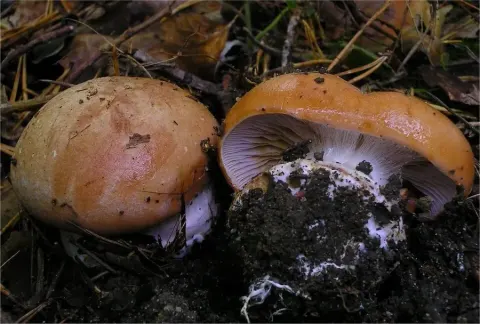
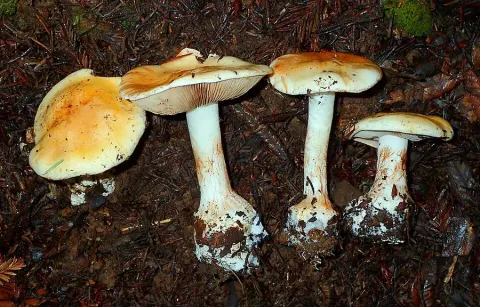
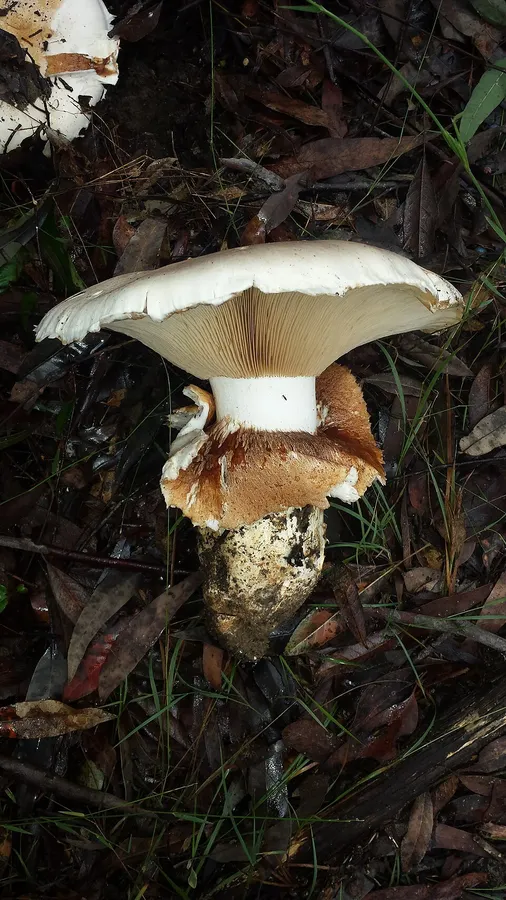
The fruitbodies of this fungus have convex to flattened caps with diameters typically in the range 5 to 7.5 cm, although specimens up to 30 cm have been noted. There is no discernible odour. The cap colour is whitish with brown tints, and ragged fragments of the partial veil often remain attached to the cap margin. The stipe is bulbous, with dimensions of 15 cm long and 3.7 – 6.2 cm, although it is often much smaller than this. The gills on the cap underside have an initially adnate attachment to the stipe and pale straw colour; later, the gill attachment becomes sinuate to nearly free, and colour deepens to rusty brown as the spores mature. The gills can be up to 1 cm deep. Remnants of a ring often persist on the stipe until maturity, as well as bits of the universal veil that once enclosed the immature mushroom. The ring is often stained dark brown from the spores falling from the gills. The ellipsoid to almond-shaped spores measure 10–13 by 5.4–6.9 μm, and turn yellowish brown in KOH. Western Australian specimens have slightly larger spores, averaging 11.1 by 5.9 μm. The edibility of this mushroom is unknown, and it should be avoided, as some of its close relatives contain lethal toxins. Young fruitbodies of A. australiensis can resemble those of Amanita ovoidea. A. australiensis can be mistaken for the similar-looking dumpy webcap (Cortinarius sublargus), though the latter species is generally smaller, lacks the prominent ring and generally only grows in recently burnt areas.

Sebagian uraian ditampilkan dalam bahasa sumber; terjemahannya belum tersedia atau belum lolos pemeriksaan.

Rujukan: [1]

Pengukuran mengikuti objek, spesimen atau kultur, dan metode yang disebutkan sumber. Baca uraian asli untuk konteks lengkap.

02 / Kehidupan

Habitat dan peran ekologis

Austrocortinarius australiensis has been recorded from New South Wales, and Mount Lofty Ranges, Kuitpo and Ashton in South Australia. It has been recorded from the wet forests of Tasmania, but is rare there. The fungus is mycorrhizal with eucalypts. Large clumps of fruitbodies appear in eucalypt forests between April and July. A. australiensis has the largest mushrooms of any species native to Jarrah forests of southwestern Australia, and they are often eaten by native mammals. The mushroom also occurs in New Zealand, where it grows with Leptospermum.

Sebagian uraian ditampilkan dalam bahasa sumber; terjemahannya belum tersedia atau belum lolos pemeriksaan.

Rujukan: [1]

Habitat atau konteks temuan
hutan
Substrat
Informasi belum tersedia pada sumber rilis ini.
Peran atau konteks
Mitra tumbuhan
Temukan hubungan serupa
03 / Siklus hidup

Reproduksi

The fruitbodies of this fungus have convex to flattened caps with diameters typically in the range 5 to 7.5 cm, although specimens up to 30 cm have been noted. There is no discernible odour. The cap colour is whitish with brown tints, and ragged fragments of the partial veil often remain attached to the cap margin. The stipe is bulbous, with dimensions of 15 cm long and 3.7 – 6.2 cm, although it is often much smaller than this. The gills on the cap underside have an initially adnate attachment to the stipe and pale straw colour; later, the gill attachment becomes sinuate to nearly free, and colour deepens to rusty brown as the spores mature. The gills can be up to 1 cm deep. Remnants of a ring often persist on the stipe until maturity, as well as bits of the universal veil that once enclosed the immature mushroom.

Sebagian uraian ditampilkan dalam bahasa sumber; terjemahannya belum tersedia atau belum lolos pemeriksaan.

Rujukan: [1]

Sinonim menurut acuan taksonomi rilis: Cortinarius australiensis; Locellina australiensis; Rozites australiensis
04 / Batas informasi

Catatan identitas dan cakupan

  • Nama diterima mengikuti Catalogue of Life Base2026-09-11; uraian mempertahankan konsep dan nama sumber aslinya.
  • Original geographic, specimen and life-cycle scope retained; source import awaits individual editorial review.
  • Impor dan terjemahan otomatis belum diperiksa editorial per profil. Struktur reproduktif yang disebutkan tidak membuktikan seluruh siklus hidup diketahui.
  • Pengukuran pada uraian mengikuti spesimen, kultur, dan metode sumber; angka tidak diperluas ke semua populasi.

Catatan distribusi dalam narasi mengikuti sumbernya. Dokumentasi spesimen atau foto mengikuti catatan sumber. Bukti wilayah Indonesia dan penilaian konservasi tidak disimpulkan dari gambar.

05 / Dokumentasi

Melihat dengan konteks

Dokumentasi Austrocortinarius australiensis dari Wikimedia Commons. Cortinarius australiensis, Lane Cove National Park - from side, showing spores discolouring ring Identifikasi mengikuti record berkas sumber.

Jenis
Fotografi
Kredit
Casliber
Sumber media
Buka entri sumber

Gambar menunjukkan objek menurut identifikasi sumber, bukan verifikasi independen spesimen oleh Fungi. Tidak ada skala baru yang ditambahkan.

06 / Rujukan

Sumber profil

  1. [1] Austrocortinarius australiensis — Wikipedia (en)Bagian sumber: Frozen revision 1349884782
    Tanggal penghimpunan sumber: 2026-10-12
    Teks sumber: CC BY-SA4.0 · Wikipedia contributors
  2. [2] Catalogue of Life Base2026-09-11 — Austrocortinarius australiensisBagian sumber: ColDP NameUsage.tsv ID B2NWM; accepted species; source 2073
    Tanggal penghimpunan sumber: 2026-10-12
  3. [3] Dokumentasi visual — Austrocortinarius australiensisBagian sumber: Individual media record; identification follows the source, not independent determination
    Tanggal penghimpunan sumber: 2026-10-12
    Media sumber: CC BY-SA 4.0 · Casliber

Adaptasi teks: CC BY-SA 4.0. Wikipedia contributors — Austrocortinarius australiensis — Wikipedia (en)

Uraian asli dan riwayat sumber

Riwayat atau halaman sumber

Ringkasan sumber

The fruitbodies of this fungus have convex to flattened caps with diameters typically in the range 5 to 7.5 cm, although specimens up to 30 cm have been noted. There is no discernible odour. The cap colour is whitish with brown tints, and ragged fragments of the partial veil often remain attached to the cap margin. The stipe is bulbous, with dimensions of 15 cm long and 3.7 – 6.2 cm, although it is often much smaller than this. The gills on the cap underside have an initially adnate attachment to the stipe and pale straw colour; later, the gill attachment becomes sinuate to nearly free, and colour deepens to rusty brown as the spores mature.

Revisi sumber

Morfologi sumber

The fruitbodies of this fungus have convex to flattened caps with diameters typically in the range 5 to 7.5 cm, although specimens up to 30 cm have been noted. There is no discernible odour. The cap colour is whitish with brown tints, and ragged fragments of the partial veil often remain attached to the cap margin. The stipe is bulbous, with dimensions of 15 cm long and 3.7 – 6.2 cm, although it is often much smaller than this. The gills on the cap underside have an initially adnate attachment to the stipe and pale straw colour; later, the gill attachment becomes sinuate to nearly free, and colour deepens to rusty brown as the spores mature. The gills can be up to 1 cm deep. Remnants of a ring often persist on the stipe until maturity, as well as bits of the universal veil that once enclosed the immature mushroom. The ring is often stained dark brown from the spores falling from the gills. The ellipsoid to almond-shaped spores measure 10–13 by 5.4–6.9 μm, and turn yellowish brown in KOH. Western Australian specimens have slightly larger spores, averaging 11.1 by 5.9 μm. The edibility of this mushroom is unknown, and it should be avoided, as some of its close relatives contain lethal toxins. Young fruitbodies of A. australiensis can resemble those of Amanita ovoidea. A. australiensis can be mistaken for the similar-looking dumpy webcap (Cortinarius sublargus), though the latter species is generally smaller, lacks the prominent ring and generally only grows in recently burnt areas.

Revisi sumber

Ekologi sumber

Austrocortinarius australiensis has been recorded from New South Wales, and Mount Lofty Ranges, Kuitpo and Ashton in South Australia. It has been recorded from the wet forests of Tasmania, but is rare there. The fungus is mycorrhizal with eucalypts. Large clumps of fruitbodies appear in eucalypt forests between April and July. A. australiensis has the largest mushrooms of any species native to Jarrah forests of southwestern Australia, and they are often eaten by native mammals. The mushroom also occurs in New Zealand, where it grows with Leptospermum.

Revisi sumber

Struktur reproduksi sumber

The fruitbodies of this fungus have convex to flattened caps with diameters typically in the range 5 to 7.5 cm, although specimens up to 30 cm have been noted. There is no discernible odour. The cap colour is whitish with brown tints, and ragged fragments of the partial veil often remain attached to the cap margin. The stipe is bulbous, with dimensions of 15 cm long and 3.7 – 6.2 cm, although it is often much smaller than this. The gills on the cap underside have an initially adnate attachment to the stipe and pale straw colour; later, the gill attachment becomes sinuate to nearly free, and colour deepens to rusty brown as the spores mature. The gills can be up to 1 cm deep. Remnants of a ring often persist on the stipe until maturity, as well as bits of the universal veil that once enclosed the immature mushroom.

Revisi sumber

Rujukan halaman ini

Fungi. Austrocortinarius australiensis. Rilis data fungi-2026-10-12-expansion-2. https://fungi-atlas.mgadib.chatgpt.site/jamur/austrocortinarius-australiensis/.

Status: impor sumber; pemeriksaan editorial per profil belum selesai. Untuk klaim biologis, gunakan rujukan pada bagian terkait dan periksa konteks sumber aslinya.