01 / Morfologi

Ciri dan struktur

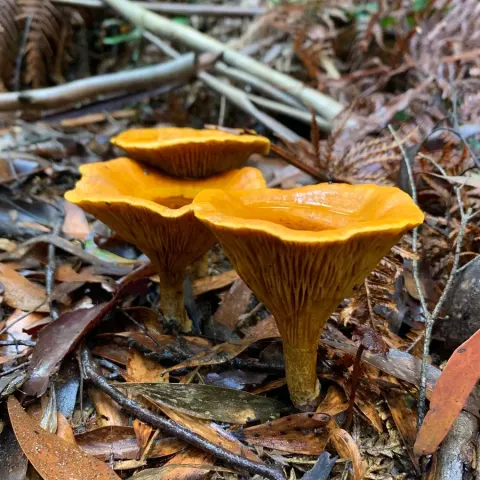
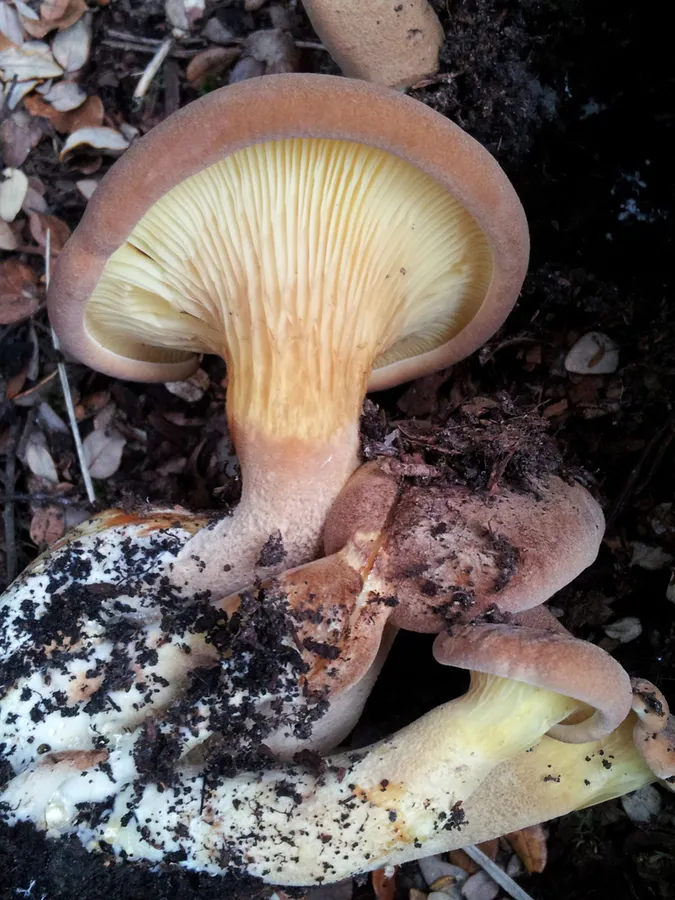
PILEUS: convex when young, infundibuliform or irregularly infundibuliform at maturity, 6-18 cm diam., dry, velutinate, finely felted, or subtomentose, often circumferentially creviced and exposing the bright yellow context at maturity, bronze, oak brown, cinnamon brown, or cocoa brown; cuticle a trichodermium when young, composed of erect, filamentous hyphae with conspicuous clamp connections and brown contents, terminal cells cylindrical to subclavate, thin-walled or slightly thick-walled, often externally roughened, 7-15 µm. diam., becoming disorganised at maturity; margins strongly involute when young, irregularly involute and often undulate and irregularly lobed at maturity. LAMELLAE: crowded, deeply decurrent, repeatedly dichotomously branched 4-(6) times, occasionally anastomosing, thick, 4-8 mm deep, maize yellow to amber yellow, often spotted and stained dark reddish brown at maturity, lamellulae absent. STIPE: 2-7 cm long, subequal or tapering basally, 1-2.5 cm diam. apically, 1-2 cm diam. basally, central or occasionally eccentric, solid, dry, finely velutinate, felted, or subtomentose by presence of filamentous, clamped hyphae with dark brown contents, concolorous with pileus; flesh brownish white to yellowish white, unchanging on exposure to air; veil absent. SPORES: spore print orange-brown (between Sudan Brown and Antique Brown); spores golden-melleous to bright rusty brown, elliptical, broadly elliptical, or ovate and flattened on one side, minutely apiculate, germ pore absent, 7.8-11 X 4.5-5.8-(6.8) µm., moderately thick-walled, smooth. HYMENIUM: basidia hyaline, subclavate, 38-58 X 6.5-9.5 µm., (2)-4-spored: cystidia absent but numerous sterile, paraphysis-like structures present.

Sebagian uraian ditampilkan dalam bahasa sumber; terjemahannya belum tersedia atau belum lolos pemeriksaan.

Rujukan: [1]

Pengukuran mengikuti objek, spesimen atau kultur, dan metode yang disebutkan sumber. Baca uraian asli untuk konteks lengkap.

02 / Kehidupan

Habitat dan peran ekologis

Of the sections of Paxillus distinguished by Singer (1962), P. nothofagi fits most readily within sect. Veluticipites. The major point of disagreement between P. nothofagi and Singer's sectional diagnosis is in spore length, but this is possibly not of great importance, since the section is based on a single Australian species, P. veluticeps (Cooke & Mass.) Singer. The spores of P. veluticeps measure 13-18.3 X 4.5-6.3µm. and are considerably longer than those of P. nothofagi. As in sect. Defibulati, the two species admitted to sect. Veluticipites are both of south temperate distribution. The strict association of P. nothofagi with Nothofagus suggests that it is a mycorrhizal species. It may be distinguished from P. squarrosus and P. aurantiacus by the larger fruitbodies, smaller elliptical spores, and the presence of clamp connections.

Sebagian uraian ditampilkan dalam bahasa sumber; terjemahannya belum tersedia atau belum lolos pemeriksaan.

Rujukan: [1]

Habitat atau konteks temuan
Informasi belum tersedia pada sumber rilis ini.
Substrat
Informasi belum tersedia pada sumber rilis ini.
Peran atau konteks
Mitra tumbuhan
Temukan hubungan serupa
03 / Siklus hidup

Reproduksi

PILEUS: convex when young, infundibuliform or irregularly infundibuliform at maturity, 6-18 cm diam., dry, velutinate, finely felted, or subtomentose, often circumferentially creviced and exposing the bright yellow context at maturity, bronze, oak brown, cinnamon brown, or cocoa brown; cuticle a trichodermium when young, composed of erect, filamentous hyphae with conspicuous clamp connections and brown contents, terminal cells cylindrical to subclavate, thin-walled or slightly thick-walled, often externally roughened, 7-15 µm. diam., becoming disorganised at maturity; margins strongly involute when young, irregularly involute and often undulate and irregularly lobed at maturity. LAMELLAE: crowded, deeply decurrent, repeatedly dichotomously branched 4-(6) times, occasionally anastomosing, thick, 4-8 mm deep, maize yellow to amber yellow, often spotted and stained dark reddish brown at maturity, lamellulae absent.

Sebagian uraian ditampilkan dalam bahasa sumber; terjemahannya belum tersedia atau belum lolos pemeriksaan.

Rujukan: [1]

Sinonim menurut acuan taksonomi rilis: Paxillus nothofagi
04 / Batas informasi

Catatan identitas dan cakupan

  • Nama diterima mengikuti Catalogue of Life Base2026-09-11; uraian mempertahankan konsep dan nama sumber aslinya.
  • Historical description as cited by BiotaNZ. Preserve explicit New Zealand/locality, host and specimen qualifiers. Distribution is the cited source scope, not a current global range.
  • Impor dan terjemahan otomatis belum diperiksa editorial per profil. Struktur reproduktif yang disebutkan tidak membuktikan seluruh siklus hidup diketahui.
  • Pengukuran pada uraian mengikuti spesimen, kultur, dan metode sumber; angka tidak diperluas ke semua populasi.

Catatan distribusi dalam narasi mengikuti sumbernya. Dokumentasi spesimen atau foto mengikuti catatan sumber. Bukti wilayah Indonesia dan penilaian konservasi tidak disimpulkan dari gambar.

05 / Dokumentasi

Melihat dengan konteks

Dokumentasi Austropaxillus nothofagi menurut asosiasi foto pada record takson iNaturalist. Kredit: Peter de Lange. Identitas mengikuti sumber; bukan penentuan spesimen independen.

Jenis
Fotografi
Kredit
no rights reserved, uploaded by Peter de Lange
Lisensi
CC0 1.0
Sumber media
Buka entri sumber

Gambar menunjukkan objek menurut identifikasi sumber, bukan verifikasi independen spesimen oleh Fungi. Tidak ada skala baru yang ditambahkan.

06 / Rujukan

Sumber profil

  1. [1] McNabb, R.F.R. 1969: The Paxillaceae of New Zealand. New Zealand Journal of Botany 7(4): 349-362. — Paxillus nothofagiBagian sumber: biota:1cb0ffd5-36b9-11d5-9548-00d0592d548c:1cb1979d-36b9-11d5-9548-00d0592d548c
    Tanggal penghimpunan sumber: 2026-10-12
    Teks sumber: CC BY 4.0 · McNabb, R.F.R. 1969: The Paxillaceae of New Zealand. New Zealand Journal of Botany 7(4): 349-362.
  2. [2] Catalogue of Life Base2026-09-11 — Austropaxillus nothofagiBagian sumber: ColDP NameUsage.tsv ID JXNH; accepted species; source 2073
    Tanggal penghimpunan sumber: 2026-10-12
  3. [3] Dokumentasi visual — Austropaxillus nothofagiBagian sumber: Individual media record; identification follows the source, not independent determination
    Tanggal penghimpunan sumber: 2026-10-12
    Media sumber: CC0 1.0 · no rights reserved, uploaded by Peter de Lange

Adaptasi teks: CC BY 4.0. McNabb, R.F.R. 1969: The Paxillaceae of New Zealand. New Zealand Journal of Botany 7(4): 349-362. — McNabb, R.F.R. 1969: The Paxillaceae of New Zealand. New Zealand Journal of Botany 7(4): 349-362. — Paxillus nothofagi

Uraian asli dan riwayat sumber

Riwayat atau halaman sumber

Ringkasan sumber

PILEUS: convex when young, infundibuliform or irregularly infundibuliform at maturity, 6-18 cm diam., dry, velutinate, finely felted, or subtomentose, often circumferentially creviced and exposing the bright yellow context at maturity, bronze, oak brown, cinnamon brown, or cocoa brown; cuticle a trichodermium when young, composed of erect, filamentous hyphae with conspicuous clamp connections and brown contents, terminal cells cylindrical to subclavate, thin-walled or slightly thick-walled, often externally roughened, 7-15 µm. diam., becoming disorganised at maturity; margins strongly involute when young, irregularly involute and often undulate and irregularly lobed at maturity.

Revisi sumber

Morfologi sumber

PILEUS: convex when young, infundibuliform or irregularly infundibuliform at maturity, 6-18 cm diam., dry, velutinate, finely felted, or subtomentose, often circumferentially creviced and exposing the bright yellow context at maturity, bronze, oak brown, cinnamon brown, or cocoa brown; cuticle a trichodermium when young, composed of erect, filamentous hyphae with conspicuous clamp connections and brown contents, terminal cells cylindrical to subclavate, thin-walled or slightly thick-walled, often externally roughened, 7-15 µm. diam., becoming disorganised at maturity; margins strongly involute when young, irregularly involute and often undulate and irregularly lobed at maturity. LAMELLAE: crowded, deeply decurrent, repeatedly dichotomously branched 4-(6) times, occasionally anastomosing, thick, 4-8 mm deep, maize yellow to amber yellow, often spotted and stained dark reddish brown at maturity, lamellulae absent. STIPE: 2-7 cm long, subequal or tapering basally, 1-2.5 cm diam. apically, 1-2 cm diam. basally, central or occasionally eccentric, solid, dry, finely velutinate, felted, or subtomentose by presence of filamentous, clamped hyphae with dark brown contents, concolorous with pileus; flesh brownish white to yellowish white, unchanging on exposure to air; veil absent. SPORES: spore print orange-brown (between Sudan Brown and Antique Brown); spores golden-melleous to bright rusty brown, elliptical, broadly elliptical, or ovate and flattened on one side, minutely apiculate, germ pore absent, 7.8-11 X 4.5-5.8-(6.8) µm., moderately thick-walled, smooth. HYMENIUM: basidia hyaline, subclavate, 38-58 X 6.5-9.5 µm., (2)-4-spored: cystidia absent but numerous sterile, paraphysis-like structures present.

Revisi sumber

Ekologi sumber

Of the sections of Paxillus distinguished by Singer (1962), P. nothofagi fits most readily within sect. Veluticipites. The major point of disagreement between P. nothofagi and Singer's sectional diagnosis is in spore length, but this is possibly not of great importance, since the section is based on a single Australian species, P. veluticeps (Cooke & Mass.) Singer. The spores of P. veluticeps measure 13-18.3 X 4.5-6.3µm. and are considerably longer than those of P. nothofagi. As in sect. Defibulati, the two species admitted to sect. Veluticipites are both of south temperate distribution. The strict association of P. nothofagi with Nothofagus suggests that it is a mycorrhizal species. It may be distinguished from P. squarrosus and P. aurantiacus by the larger fruitbodies, smaller elliptical spores, and the presence of clamp connections.

Revisi sumber

Struktur reproduksi sumber

PILEUS: convex when young, infundibuliform or irregularly infundibuliform at maturity, 6-18 cm diam., dry, velutinate, finely felted, or subtomentose, often circumferentially creviced and exposing the bright yellow context at maturity, bronze, oak brown, cinnamon brown, or cocoa brown; cuticle a trichodermium when young, composed of erect, filamentous hyphae with conspicuous clamp connections and brown contents, terminal cells cylindrical to subclavate, thin-walled or slightly thick-walled, often externally roughened, 7-15 µm. diam., becoming disorganised at maturity; margins strongly involute when young, irregularly involute and often undulate and irregularly lobed at maturity. LAMELLAE: crowded, deeply decurrent, repeatedly dichotomously branched 4-(6) times, occasionally anastomosing, thick, 4-8 mm deep, maize yellow to amber yellow, often spotted and stained dark reddish brown at maturity, lamellulae absent.

Revisi sumber

Rujukan halaman ini

Fungi. Austropaxillus nothofagi. Rilis data fungi-2026-10-12-expansion-2. https://fungi-atlas.mgadib.chatgpt.site/jamur/austropaxillus-nothofagi/.

Status: impor sumber; pemeriksaan editorial per profil belum selesai. Untuk klaim biologis, gunakan rujukan pada bagian terkait dan periksa konteks sumber aslinya.