01 / Morfologi

Ciri dan struktur

Basidiomes resupinate (Fig. 3b), 0.1–0.5 mm thick, membranaceous, covering leaves and twigs, hymenophore smooth, white (2.5Y 8/2) to pale yellow (2.5Y 8/4), forming rhizomorph-like structures up to 7 cm high and scarcely to profusely branched that may be confused with coralloid basidiomes (Fig. 3a, b). Substrate: On dead twigs and leaves. Hyphal system dimitic, profusely interwoven. Generative hyphae 2–5 μm wide, thin-walled, without clamps. Skeletal hyphae 2–6 μm (up to 10 μm in KOH) wide, walls dextrinoid, up to 1.5 μm thick, strongly swelling in KOH (up to 4.5 μm). Termini of hymenial skeletal hyphae papillate, presenting short protuberances 2–10 × 1.5–2.5 μm, sometimes ramified resembling skeletodendrohyphidia. Putative hymenium with abundant basidioles up to 25 × 6 μm, clavate, growing immersed in the papillate hyphae. Gloeocystidia up to 80 × 8–14 μm, clavate to lanceolate, thin-walled, densely multiguttulate or with abundant granular contents. Present in all parts of the basidiomes, including the corticioid form. Basidiospores and basidia not observed.

Sebagian uraian ditampilkan dalam bahasa sumber; terjemahannya belum tersedia atau belum lolos pemeriksaan.

Rujukan: [1]

Pengukuran mengikuti objek, spesimen atau kultur, dan metode yang disebutkan sumber. Baca uraian asli untuk konteks lengkap.

02 / Kehidupan

Habitat dan peran ekologis

Brazil. Rio Grande do Sul: São Leopoldo (Corner, 1952a; Type). São Paulo: Apiaí. Santa Catarina: Florianópolis. Paraná: Foz do Iguaçu. Amazonas: Rio Preto da Eva (this study).

Sebagian uraian ditampilkan dalam bahasa sumber; terjemahannya belum tersedia atau belum lolos pemeriksaan.

Rujukan: [1]

Habitat atau konteks temuan
Informasi belum tersedia pada sumber rilis ini.
Substrat
Informasi belum tersedia pada sumber rilis ini.
Peran atau konteks
Belum dikategorikan pada rilis ini.
Temukan hubungan serupa
03 / Siklus hidup

Reproduksi

Basidiomes resupinate (Fig. 3b), 0.1–0.5 mm thick, membranaceous, covering leaves and twigs, hymenophore smooth, white (2.5Y 8/2) to pale yellow (2.5Y 8/4), forming rhizomorph-like structures up to 7 cm high and scarcely to profusely branched that may be confused with coralloid basidiomes (Fig. 3a, b). Substrate: On dead twigs and leaves. Hyphal system dimitic, profusely interwoven. Generative hyphae 2–5 μm wide, thin-walled, without clamps. Skeletal hyphae 2–6 μm (up to 10 μm in KOH) wide, walls dextrinoid, up to 1.5 μm thick, strongly swelling in KOH (up to 4.5 μm). Termini of hymenial skeletal hyphae papillate, presenting short protuberances 2–10 × 1.5–2.5 μm, sometimes ramified resembling skeletodendrohyphidia.

Sebagian uraian ditampilkan dalam bahasa sumber; terjemahannya belum tersedia atau belum lolos pemeriksaan.

Rujukan: [1]

Sinonim menurut acuan taksonomi rilis: Parapterulicium octopodites
04 / Batas informasi

Catatan identitas dan cakupan

  • Nama diterima mengikuti Catalogue of Life Base2026-09-11; uraian mempertahankan konsep dan nama sumber aslinya.
  • Preserve original treatment localities, hosts and substrate scope. Materials examined describe documented specimens, not the full global range.
  • Impor dan terjemahan otomatis belum diperiksa editorial per profil. Struktur reproduktif yang disebutkan tidak membuktikan seluruh siklus hidup diketahui.
  • Pengukuran pada uraian mengikuti spesimen, kultur, dan metode sumber; angka tidak diperluas ke semua populasi.

Catatan distribusi dalam narasi mengikuti sumbernya. Dokumentasi spesimen atau foto mengikuti catatan sumber. Bukti wilayah Indonesia dan penilaian konservasi tidak disimpulkan dari gambar.

05 / Dokumentasi

Melihat dengan konteks

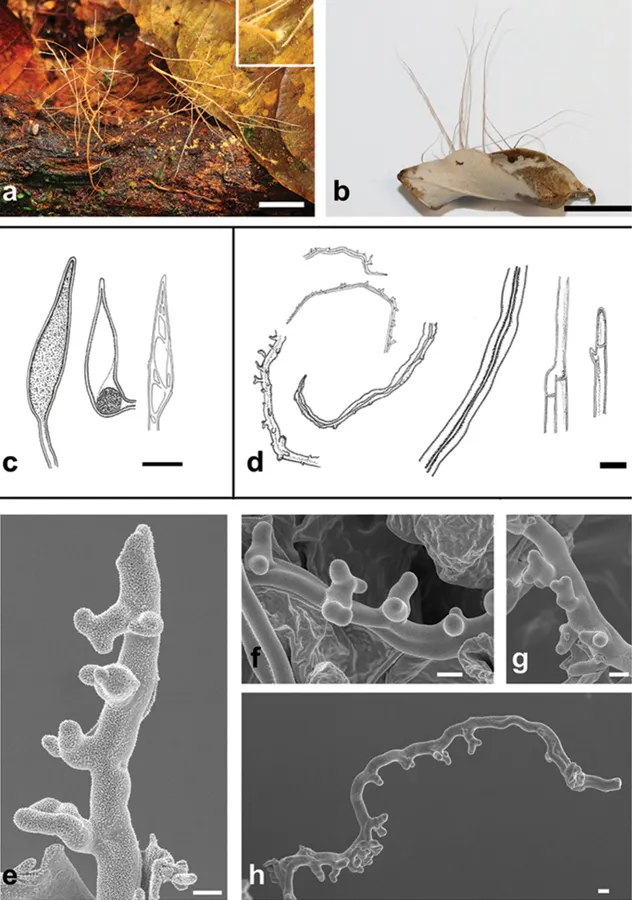
Baltazaria octopodites: a, b basidiomes in the field (INPA280140 and FLOR56460), the detail in a shows the anchorage point in the leaf, the whitish resupinate area in b shows the corticioid portion of the fungus c gloeocystidia d skeletal hyphae, skeletal hyphae inflated in KOH (third from the right) and generative hyphae (first and second from the right) e–h SEM images of papillate skeletal hyphae. Scale bars: a–b = 1 cm; c–d = 10 μm; e–h = 1 μm).

Jenis
Pelat ilmiah
Kredit
Caio A. Leal-Dutra, Maria Alice Neves, Gareth W. Griffith, Mateus A. Reck, Lina A. Clasen, Bryn T. M. Dentinger
Lisensi
CC BY 4.0
Sumber media
Buka entri sumber

Gambar menunjukkan objek menurut identifikasi sumber, bukan verifikasi independen spesimen oleh Fungi. Tidak ada skala baru yang ditambahkan.

06 / Rujukan

Sumber profil

  1. [1] Reclassification of Parapterulicium Corner (Pterulaceae, Agaricales), contributions to Lachnocladiaceae and Peniophoraceae (Russulales) and introduction of Baltazaria gen. nov. — Baltazaria octopoditesBagian sumber: PMC6081468_section_24
    Tanggal penghimpunan sumber: 2026-10-12
    Teks sumber: CC BY 4.0 · Leal-Dutra, Caio A. & Neves, Maria Alice & Griffith, Gareth W.
  2. [2] Catalogue of Life Base2026-09-11 — Baltazaria octopoditesBagian sumber: ColDP NameUsage.tsv ID KJ6W; accepted species; source 2073
    Tanggal penghimpunan sumber: 2026-10-12
  3. [3] Dokumentasi visual — Baltazaria octopoditesBagian sumber: Individual media record; identification follows the source, not independent determination
    Tanggal penghimpunan sumber: 2026-10-12
    Media sumber: CC BY 4.0 · Caio A. Leal-Dutra, Maria Alice Neves, Gareth W. Griffith, Mateus A. Reck, Lina A. Clasen, Bryn T. M. Dentinger

Adaptasi teks: CC BY 4.0. Leal-Dutra, Caio A. & Neves, Maria Alice & Griffith, Gareth W. — Reclassification of Parapterulicium Corner (Pterulaceae, Agaricales), contributions to Lachnocladiaceae and Peniophoraceae (Russulales) and introduction of Baltazaria gen. nov. — Baltazaria octopodites

Uraian asli dan riwayat sumber

Riwayat atau halaman sumber

Ringkasan sumber

Basidiomes resupinate (Fig. 3b), 0.1–0.5 mm thick, membranaceous, covering leaves and twigs, hymenophore smooth, white (2.5Y 8/2) to pale yellow (2.5Y 8/4), forming rhizomorph-like structures up to 7 cm high and scarcely to profusely branched that may be confused with coralloid basidiomes (Fig. 3a, b). Substrate: On dead twigs and leaves. Hyphal system dimitic, profusely interwoven. Generative hyphae 2–5 μm wide, thin-walled, without clamps. Skeletal hyphae 2–6 μm (up to 10 μm in KOH) wide, walls dextrinoid, up to 1.5 μm thick, strongly swelling in KOH (up to 4.5 μm).

Revisi sumber

Morfologi sumber

Basidiomes resupinate (Fig. 3b), 0.1–0.5 mm thick, membranaceous, covering leaves and twigs, hymenophore smooth, white (2.5Y 8/2) to pale yellow (2.5Y 8/4), forming rhizomorph-like structures up to 7 cm high and scarcely to profusely branched that may be confused with coralloid basidiomes (Fig. 3a, b). Substrate: On dead twigs and leaves. Hyphal system dimitic, profusely interwoven. Generative hyphae 2–5 μm wide, thin-walled, without clamps. Skeletal hyphae 2–6 μm (up to 10 μm in KOH) wide, walls dextrinoid, up to 1.5 μm thick, strongly swelling in KOH (up to 4.5 μm). Termini of hymenial skeletal hyphae papillate, presenting short protuberances 2–10 × 1.5–2.5 μm, sometimes ramified resembling skeletodendrohyphidia. Putative hymenium with abundant basidioles up to 25 × 6 μm, clavate, growing immersed in the papillate hyphae. Gloeocystidia up to 80 × 8–14 μm, clavate to lanceolate, thin-walled, densely multiguttulate or with abundant granular contents. Present in all parts of the basidiomes, including the corticioid form. Basidiospores and basidia not observed.

Revisi sumber

Ekologi sumber

Brazil. Rio Grande do Sul: São Leopoldo (Corner, 1952a; Type). São Paulo: Apiaí. Santa Catarina: Florianópolis. Paraná: Foz do Iguaçu. Amazonas: Rio Preto da Eva (this study).

Revisi sumber

Struktur reproduksi sumber

Basidiomes resupinate (Fig. 3b), 0.1–0.5 mm thick, membranaceous, covering leaves and twigs, hymenophore smooth, white (2.5Y 8/2) to pale yellow (2.5Y 8/4), forming rhizomorph-like structures up to 7 cm high and scarcely to profusely branched that may be confused with coralloid basidiomes (Fig. 3a, b). Substrate: On dead twigs and leaves. Hyphal system dimitic, profusely interwoven. Generative hyphae 2–5 μm wide, thin-walled, without clamps. Skeletal hyphae 2–6 μm (up to 10 μm in KOH) wide, walls dextrinoid, up to 1.5 μm thick, strongly swelling in KOH (up to 4.5 μm). Termini of hymenial skeletal hyphae papillate, presenting short protuberances 2–10 × 1.5–2.5 μm, sometimes ramified resembling skeletodendrohyphidia.

Revisi sumber

Rujukan halaman ini

Fungi. Baltazaria octopodites. Rilis data fungi-2026-10-12-expansion-2. https://fungi-atlas.mgadib.chatgpt.site/jamur/baltazaria-octopodites/.

Status: impor sumber; pemeriksaan editorial per profil belum selesai. Untuk klaim biologis, gunakan rujukan pada bagian terkait dan periksa konteks sumber aslinya.