Ciri dan struktur
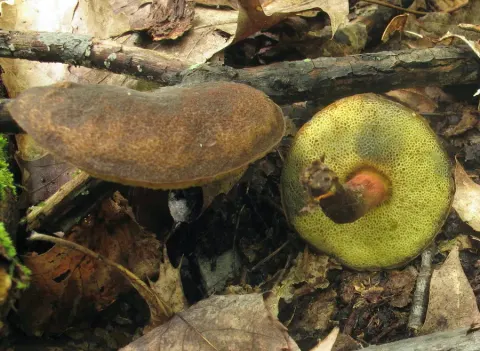
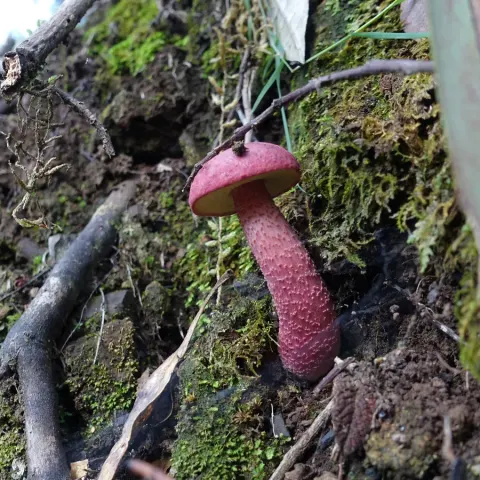
The cap of B. ananas is 3.3-10 cm wide and 6-14 mm wide, and gradually becomes larger towards the base to 10–19 mm. The top part of the stem is cream to pink, the middle finely longitudinally striate, with the striations darkening with handling, red-lavender to brown-red, lighter with age. Immediately above the basal tomentum the stem surface is cream-colored with few striations. The basal tomentum is made of stiff, coarse white hairs over the lower 6–50 mm. The flesh of the stem is solid (i.e., not hollow) white to buff-tan to light yellow, and turns slightly blue with exposure. The odor is not distinctive (although it has been described as "musty") and the taste is mild. The spores are olivaceous-brown in medium to heavy deposit. They are inamyloid, almond-shaped, contain one or more oil droplets, and measure 17.5–22.2 by 6.4–8 μm. The spore wall is 0.5–1 μm thick, with 12–14 longitudinal ridges. These ridges are less than 1 μm tall, occasionally bifurcating, converging at poles, with minute cross-striae. Although these cross-striae are visible when observed with light microscopy, they are not evident when viewed with scanning electron microscopy. The hilar appendage (the region of a spore which attaches to the basidium via the sterigma) is 0.3–1 μm long. The basidia are four-spored, club-shaped, and have numerous refractive globules; they measure 39–57 by 11–15 μm. The pleurocystidia (cystidia on the face of a gill) are 42–47 by 8-12 μm, swollen and beaked, slightly capitate. They are abundant, arising from the subhymenium, projecting 19.3–29.6 μm above the hymenial palisade, thin-walled, hyaline, and devoid of refractive contents.
Habitat dan peran ekologis
The fruit bodies of B. ananas typically grow scattered or in groups under oak and pine trees, often on their bases. Di Guyana, jamur biasanya menghasilkan buah secara tunggal atau berpasangan di dalam 1-2 m di atas permukaan tanah di batang pohon tropis Dicymbe corymbosa (subfamilia Caesalpinioideae), yang terkait dengan ektomikorris dalam akumulasi humik. Jarang ditemukan berbuah di tanah pada kayu yang sangat rusak, akarnya menembus. Rolf Singer suggested bahwa jamur itu tidak mikoriza, mencatat bahwa selain terjadi di bawah atau di dasar pohon pinus dan ek, itu terjadi dalam humus yang sedikit dan puing-puing yang terakumulasi di dinding batu. Singer concluded bahwa spesies lebih memilih untuk tumbuh di permukaan keras. Harry D. Thiers, dalam studi tentang flora bolete Texas, menulis bahwa B. ananas adalah spesies langka yang sering berbuah banyak setelah periode hujan yang panjang dan kelembaban tinggi. Some varieties dari B. ananas dari Amerika Utara tenggara, Kosta Rika, Brasil, Panama, Nikaragua, dan Guyana have telah dicatat untuk buah di batang pohon, meskipun buah darat telah dilaporkan di Malaysia and Amerika Tengah. Due to kebiasaan berbuah yang biasanya tinggi dan kejadian pada kayu mati, status ektomikoriza B. ananas telah diperdebatkan; dalam protolog Murrill noted "itu selalu terjadi baik sebagai parasit luka pada batang pinus atau di sekitar dasar pohon pinus hidup".
- Habitat atau konteks temuan
- Informasi belum tersedia pada sumber rilis ini.
- Substrat
- kayu; tanah
- Peran atau konteks
- Mitra tumbuhan
Reproduksi
The spores are olivaceous-brown in medium to heavy deposit. They are inamyloid, almond-shaped, contain one or more oil droplets, and measure 17.5–22.2 by 6.4–8 μm. The spore wall is 0.5–1 μm thick, with 12–14 longitudinal ridges. These ridges are less than 1 μm tall, occasionally bifurcating, converging at poles, with minute cross-striae. Although these cross-striae are visible when observed with light microscopy, they are not evident when viewed with scanning electron microscopy. The hilar appendage (the region of a spore which attaches to the basidium via the sterigma) is 0.3–1 μm long. The basidia are four-spored, club-shaped, and have numerous refractive globules; they measure 39–57 by 11–15 μm.
Catatan identitas dan cakupan
- Nama diterima mengikuti Catalogue of Life Base2026-09-11; uraian mempertahankan konsep dan nama sumber aslinya.
- Original geographic, specimen and life-cycle scope retained; source import awaits individual editorial review.
- Impor dan terjemahan otomatis belum diperiksa editorial per profil. Struktur reproduktif yang disebutkan tidak membuktikan seluruh siklus hidup diketahui.
- Pengukuran pada uraian mengikuti spesimen, kultur, dan metode sumber; angka tidak diperluas ke semua populasi.
Catatan distribusi dalam narasi mengikuti sumbernya. Dokumentasi spesimen atau foto mengikuti catatan sumber. Bukti wilayah Indonesia dan penilaian konservasi tidak disimpulkan dari gambar.
Melihat dengan konteks
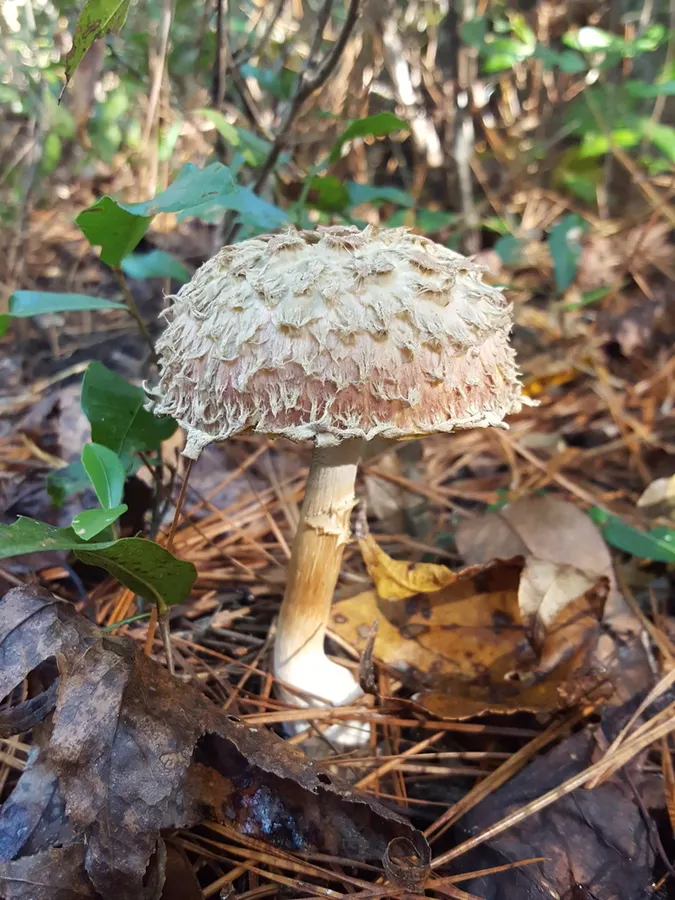
Dokumentasi Boletellus ananas menurut asosiasi foto pada record takson iNaturalist. Kredit: Alex Abair. Identitas mengikuti sumber; bukan penentuan spesimen independen.
- Jenis
- Fotografi
- Kredit
- (c) Alex Abair, some rights reserved (CC BY), uploaded by Alex Abair
- Lisensi
- CC BY 4.0
- Sumber media
- Buka entri sumber
Dokumentasi tambahan
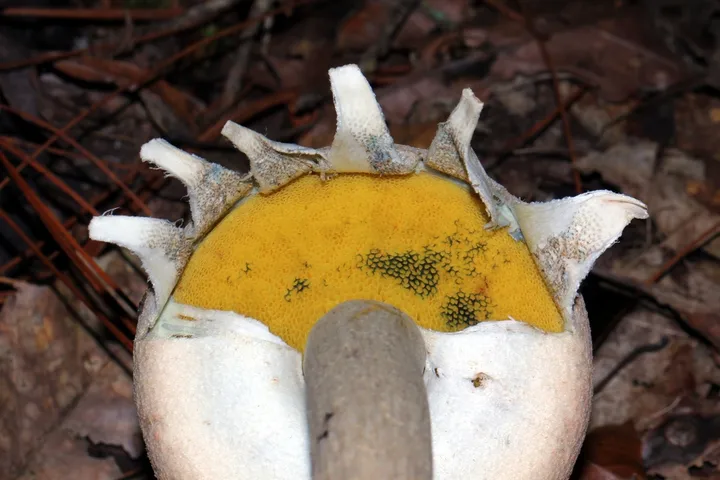
Foto yang diasosiasikan dengan Boletellus ananas pada iNaturalist. Identifikasi mengikuti sumber; bukan penentuan spesimen independen.
Kredit dan penggunaan
(c) Alan Rockefeller, some rights reserved (CC BY), uploaded by Alan Rockefeller
Ukuran dan format gambar disesuaikan tanpa pemotongan, retus, atau penambahan skala. Lisensi sumber dipertahankan.
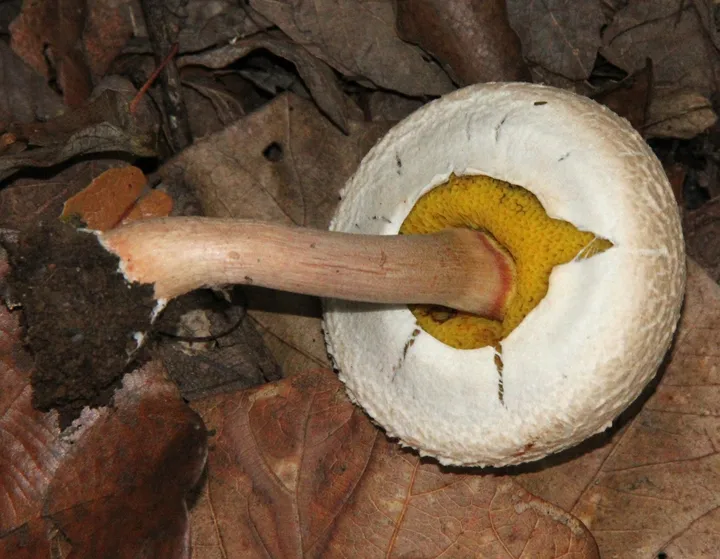
Foto yang diasosiasikan dengan Boletellus ananas pada iNaturalist. Identifikasi mengikuti sumber; bukan penentuan spesimen independen.
Kredit dan penggunaan
(c) Alan Rockefeller, some rights reserved (CC BY), uploaded by Alan Rockefeller
Ukuran dan format gambar disesuaikan tanpa pemotongan, retus, atau penambahan skala. Lisensi sumber dipertahankan.
Sumber profil
- [1] Boletellus ananas — Wikipedia (en)
- [2] Catalogue of Life Base2026-09-11 — Boletellus ananas
- [3] Dokumentasi visual — Boletellus ananas
- [4] Dokumentasi visual — Boletellus ananas
- [5] Dokumentasi visual — Boletellus ananas
Rujukan halaman ini
Fungi. Boletellus ananas. Rilis data fungi-2026-10-12-expansion-2. https://fungi-atlas.mgadib.chatgpt.site/jamur/boletellus-ananas/.
Status: impor sumber; pemeriksaan editorial per profil belum selesai. Untuk klaim biologis, gunakan rujukan pada bagian terkait dan periksa konteks sumber aslinya.