Ciri dan struktur
Basidiomata annual, medium, centrally stipitate, solitary to gregarious (Fig. 1 f). Pileus up to 12 cm in diameter, convex or irregular, clay buff (5C3) to dark brown (5F7), becoming greyish-brown (4C3) to black when dry; margin undulate and incurved. Context white (1A1), becoming pale brown (1B3) when dry. Hymenophore slightly decurrent, surface white (1A1), becoming clay buff (6D4) to fawn (7D/E4) when dry; hymenophoral pores round to angular or irregular, 1–4 per mm; tubes concolorous with hymenophoral surface, darkening when bruised. Stipe up to 9 cm long and 2 cm wide, solid, subcylindrical or tapering towards the base, concolorous with pileal surface. Hyphal system monomitic. Generative hyphae with clamp connections. Basidia thin-walled, 19–25 (35) × 8–11 μm, clavate to cylindrical, sometimes flexuous or ventricose with a peduncle, 4-spored, clamped at base, hyaline in KOH (Fig. 5 a). Basidiospores [20/1/1] 5–6 (6.5) × 4–5.5 (6) μm, Q = 1–1.25 (1.5), Q m = 1.12 ± 0.13, globose to oblong, acyanophilic and non-dextrinoid, hyaline to pale yellow in KOH; ornamentation on the surface tuberculate and sometimes furcate (Fig. 3 e, f; Fig. 5 b). Cystidia absent. Tube tramal hyphae thin-walled, 2–4 μm wide, cylindrical, sometimes branched, interwoven and occasionally subparallel in a bunch, hyaline in KOH. Hyphae of pileipellis thin-walled, 4–10 μm wide, cylindrical with finger-shaped tips, sometimes branched, interwoven, faint olivaceous in KOH; terminal cells (37) 47–77 × 4–6 μm (Fig. 5 c). Pileal tramal hyphae thin-walled, 6–30 μm wide, inflated, rarely branched, interwoven and occasionally subparallel in a bunch, hyaline in KOH.
Habitat dan peran ekologis
Growing on the ground in forests dominated by trees of the families Fagaceae (Quercus sp.) and Pinaceae (Picea balfouriana) or in pure Picea forests dominated by P. balfouriana at an altitude ranging from 2900 m to 3350 m.
- Habitat atau konteks temuan
- hutan
- Substrat
- tanah
- Peran atau konteks
- Belum dikategorikan pada rilis ini.
Reproduksi
Basidiomata annual, medium, centrally stipitate, solitary to gregarious (Fig. 1 f). Pileus up to 12 cm in diameter, convex or irregular, clay buff (5C3) to dark brown (5F7), becoming greyish-brown (4C3) to black when dry; margin undulate and incurved. Context white (1A1), becoming pale brown (1B3) when dry. Hymenophore slightly decurrent, surface white (1A1), becoming clay buff (6D4) to fawn (7D/E4) when dry; hymenophoral pores round to angular or irregular, 1–4 per mm; tubes concolorous with hymenophoral surface, darkening when bruised. Stipe up to 9 cm long and 2 cm wide, solid, subcylindrical or tapering towards the base, concolorous with pileal surface. Hyphal system monomitic. Generative hyphae with clamp connections.
Catatan identitas dan cakupan
- Nama diterima mengikuti Catalogue of Life Base2026-09-11; uraian mempertahankan konsep dan nama sumber aslinya.
- Preserve original treatment localities, hosts and substrate scope. Materials examined describe documented specimens, not the full global range.
- Impor dan terjemahan otomatis belum diperiksa editorial per profil. Struktur reproduktif yang disebutkan tidak membuktikan seluruh siklus hidup diketahui.
- Pengukuran pada uraian mengikuti spesimen, kultur, dan metode sumber; angka tidak diperluas ke semua populasi.
Catatan distribusi dalam narasi mengikuti sumbernya. Dokumentasi spesimen atau foto mengikuti catatan sumber. Bukti wilayah Indonesia dan penilaian konservasi tidak disimpulkan dari gambar.
Melihat dengan konteks
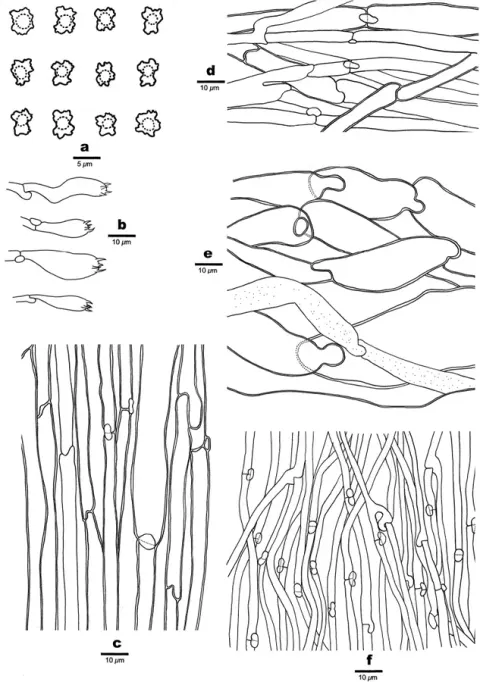
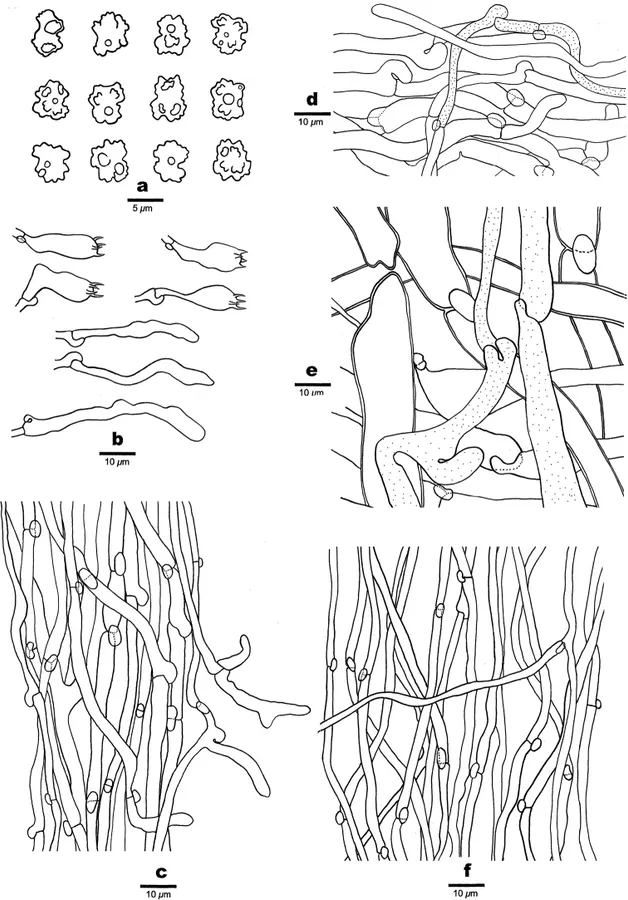
Microscopic structures of Boletopsis tibetana (Holotype) a basidiospores b basidia and basidioles c stipitipellis hyphae d pileipellis hyphae e hyphae from context f hyphae from trama.
- Jenis
- Pelat ilmiah
- Kredit
- Hong-Min Zhou, Qi Zhao, Qi Wang, Fang Wu, Yu-Cheng Dai
- Lisensi
- CC BY 4.0
- Sumber media
- Buka entri sumber
Dokumentasi tambahan
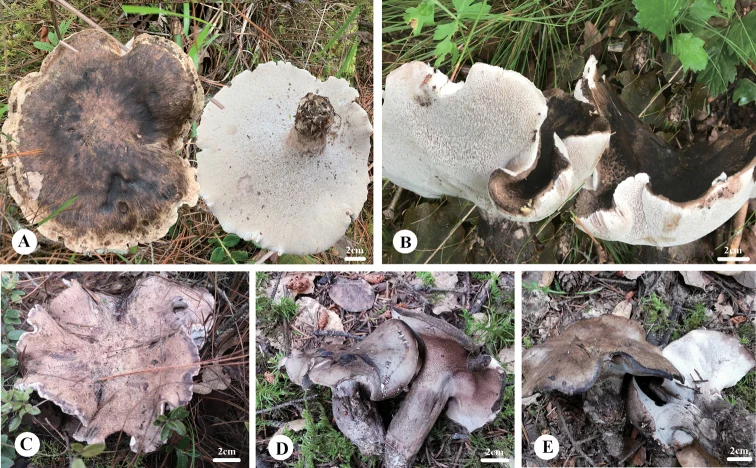
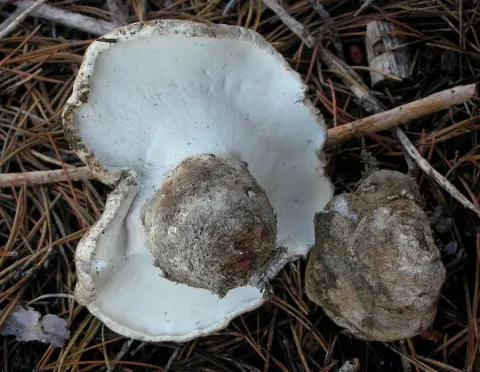
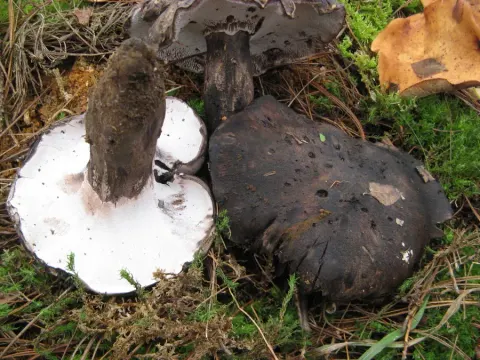
Basidiocarps of Boletopsis in China A B. macrocarpa (Dai 22728) B B. sp. 1 (Dai 22172) C B. cf. grisea (Dai 23070) D–E B. tibetana (Dai 20896 and Dai 20897).
Kredit dan penggunaan
Hong-Min Zhou, Qi Zhao, Qi Wang, Fang Wu, Yu-Cheng Dai
Ukuran dan format gambar disesuaikan tanpa pemotongan, retus, atau penambahan skala. Lisensi sumber dipertahankan.
Sumber profil
- [1] The genus Boletopsis (Bankeraceae, Thelephorales) in China — Boletopsis tibetana
- [2] Catalogue of Life Base2026-09-11 — Boletopsis tibetana
- [3] Dokumentasi visual — Boletopsis tibetana
- [4] Dokumentasi visual — Boletopsis tibetana
Rujukan halaman ini
Fungi. Boletopsis tibetana. Rilis data fungi-2026-10-12-expansion-2. https://fungi-atlas.mgadib.chatgpt.site/jamur/boletopsis-tibetana/.
Status: impor sumber; pemeriksaan editorial per profil belum selesai. Untuk klaim biologis, gunakan rujukan pada bagian terkait dan periksa konteks sumber aslinya.