Ciri dan struktur
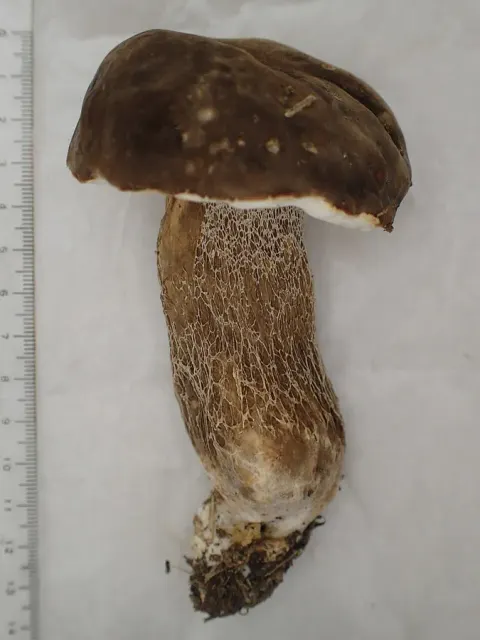
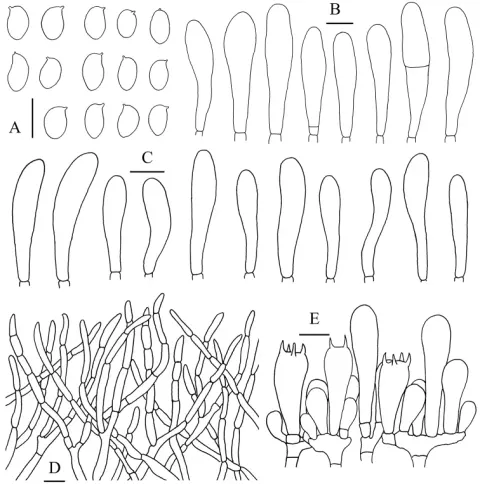
The cap of this mushroom grows up to 8–30 cm wide, sometimes more. Viscid when moist, the cap is convex when young and flattens with age. The angular pores, which do not stain when bruised, are small—roughly 2 to 3 pores per millimetre. In youth, the pores are white and appear as if stuffed with cotton (which are actually mycelia); as they age, they change colour to yellow and later to brown. The spore print is olive brown. A similarly sized specimen found in Poland in 2013 made international news. The spores are elliptical to spindle-shaped, with dimensions of 12–17 by 5–7 μm. The basidia, the spore-bearing cells, are produced in a layer lining the tubes, and arrange themselves so their ends are facing the center of the tube; this layer of cells is known technically as a hymenium. The basidia are thin-walled, mostly attached to four spores, and measure 25–30 by 8–10 μm. Another cell type present in the hymenium is the cystidia, larger sterile cells that protrude beyond the basidia into the lumen of the hymenium and act as air traps, regulating humidity. B. edulis has pleurocystidia (cystidia located on the face of a pore) that are thin-walled, roughly spindle-shaped to ventricose, and 30–45 by 7–10 μm; the "stuffed" feature of the hymenium is caused by cheilocystidia—cells found on the edges of the pores. The hyphae of B. edulis do not have clamp connections.
Habitat dan peran ekologis
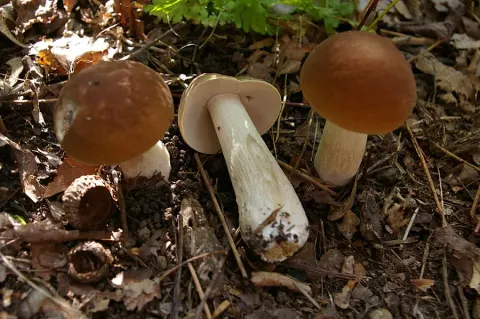
The fruit bodies of Boletus edulis can grow singly or in small clusters of two or three specimens. The mushroom's habitat consists of areas dominated by pine (Pinus spp.), spruce (Picea spp.), hemlock (Tsuga spp.) and fir (Abies spp.) trees, although other hosts include chestnut, chinquapin, beech, Keteleeria spp., Lithocarpus spp., and oak. In California, porcini have been collected in a variety of forests, such as coastal forests, dry interior oak forests and savannas and interior high-elevation montane mixed forests, In northwestern Spain, they are common in scrublands dominated by the rock rose species Cistus ladanifer and Halimium lasianthum. In the Midi region of south-west France, they are especially favoured and locally called cèpe de Bordeaux after the town from which they are traded to the north and abroad. Boletus edulis has a cosmopolitan distribution, concentrated in cool-temperate to subtropical regions. It is well known from the Borgotaro area of Parma, Italy, and has PGI status there. The European distribution extends north to Scandinavia and south to southern Italy and Morocco. In North America, it can be found from May to October inland and August to January on the West Coast.
- Habitat atau konteks temuan
- hutan
- Substrat
- Informasi belum tersedia pada sumber rilis ini.
- Peran atau konteks
- Belum dikategorikan pada rilis ini.
Reproduksi
The cap of this mushroom grows up to 8–30 cm wide, sometimes more. Viscid when moist, the cap is convex when young and flattens with age. The angular pores, which do not stain when bruised, are small—roughly 2 to 3 pores per millimetre. In youth, the pores are white and appear as if stuffed with cotton (which are actually mycelia); as they age, they change colour to yellow and later to brown. The spore print is olive brown. A similarly sized specimen found in Poland in 2013 made international news. The spores are elliptical to spindle-shaped, with dimensions of 12–17 by 5–7 μm. The basidia, the spore-bearing cells, are produced in a layer lining the tubes, and arrange themselves so their ends are facing the center of the tube; this layer of cells is known technically as a hymenium.
Catatan identitas dan cakupan
- Nama diterima mengikuti Catalogue of Life Base2026-09-11; uraian mempertahankan konsep dan nama sumber aslinya.
- Original geographic, specimen and life-cycle scope retained; source import awaits individual editorial review.
- Impor dan terjemahan otomatis belum diperiksa editorial per profil. Struktur reproduktif yang disebutkan tidak membuktikan seluruh siklus hidup diketahui.
- Pengukuran pada uraian mengikuti spesimen, kultur, dan metode sumber; angka tidak diperluas ke semua populasi.
Catatan distribusi dalam narasi mengikuti sumbernya. Dokumentasi spesimen atau foto mengikuti catatan sumber. Bukti wilayah Indonesia dan penilaian konservasi tidak disimpulkan dari gambar.
Melihat dengan konteks
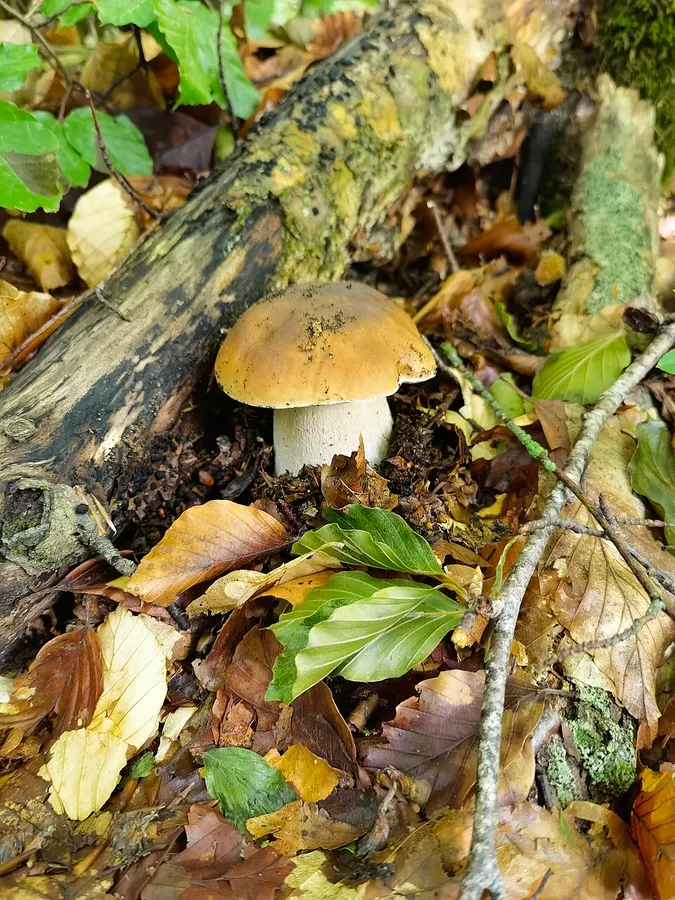
Dokumentasi Boletus edulis dari Wikimedia Commons. Boletus edulis in a mixed temperate montane forest (Abetina Reale, Emilia-Romagna , Italy ). Forest composition: Abies alba and Fagus sylvatica . Identifikasi mengikuti record berkas sumber.
- Jenis
- Fotografi
- Kredit
- ReddishClover
- Lisensi
- CC BY-SA 4.0
- Sumber media
- Buka entri sumber
Sumber profil
- [1] Boletus edulis — Wikipedia (en)
- [2] Catalogue of Life Base2026-09-11 — Boletus edulis
- [3] Dokumentasi visual — Boletus edulis
Rujukan halaman ini
Fungi. Boletus edulis. Rilis data fungi-2026-10-12-expansion-2. https://fungi-atlas.mgadib.chatgpt.site/jamur/boletus-edulis/.
Status: impor sumber; pemeriksaan editorial per profil belum selesai. Untuk klaim biologis, gunakan rujukan pada bagian terkait dan periksa konteks sumber aslinya.