01 / Morfologi

Ciri dan struktur

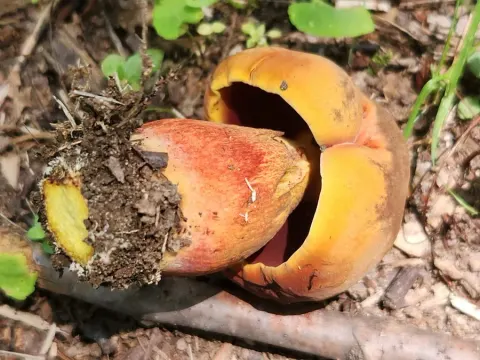
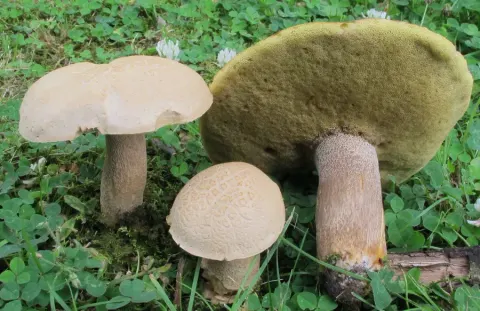
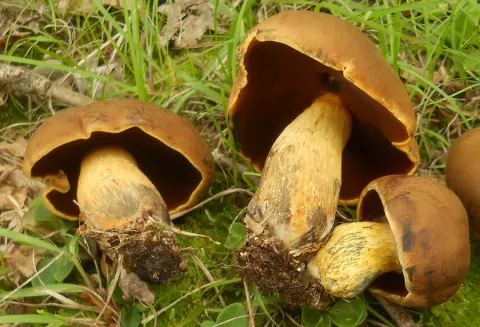
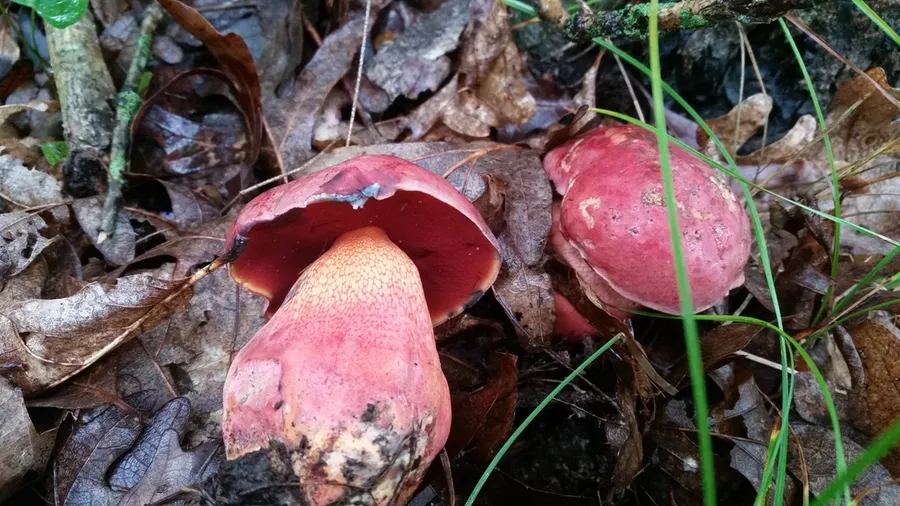
The shape of the cap of B. rubroflammeus is convex to broadly convex, and reaches a diameter of 6 – 12 cm. The margin of the cap extends slightly beyond the tubes. The cap surface is dry and initially appears appressed-fibrillose (with fibrils pressed down flat against the surface) or has a matted grayish tomentum, but later the hairs slough off and the matted tomentum is present only along the cap margin. In maturity, the center of the caps develop slight cracks. The cap is a deep vinaceous-red color that remains constant throughout the life of the fruit bodies. The flesh is thick, soft, and yellow. Its taste is mild, and it has no distinct odor. On the underside of the cap, the spore-bearing surface comprises vertically arranged minute tubes with pore-like openings. The tubes are yellow, 1 – 2 cm deep, initially adnate (fused) to the stem, but later becoming free from attachment (or nearly so). Individual pores are round and small (about 2 per mm), while the overall pore surface is uneven or pitted. Its color is initially deep red, but fades slightly in maturity; the pore surface quickly turns blue with injury. The stem is 6 – 8 cm long, 1 – 2 cm thick, solid (i.e., not hollow), and equal in width throughout to club-shaped. Inside, it is yellowish with reddish streaks. Most of the stem surface is covered with coarse dark red reticulations, although near the top the color is yellow beneath the reticulations. All parts of the mushroom will quickly stain blue when cut, bruised, or otherwise injured. The mushroom is poisonous, and if consumed can cause gastrointestinal distress; typical symptoms include cramping, nausea, bloating, vomiting, and diarrhea.

Sebagian uraian ditampilkan dalam bahasa sumber; terjemahannya belum tersedia atau belum lolos pemeriksaan.

Rujukan: [1]

Pengukuran mengikuti objek, spesimen atau kultur, dan metode yang disebutkan sumber. Baca uraian asli untuk konteks lengkap.

02 / Kehidupan

Habitat dan peran ekologis

Boletus rubroflammeus adalah spesies mikoriza, dan tubuh buahnya tumbuh berkeliaran atau berkelompok di tanah di bawah pohon-pohon kayu keras. Jamur buah di musim panas dan musim gugur bulan, dan cenderung muncul setelah cuaca panas dan hujan deras. Known only dari Amerika Utara, rentangnya membentang dari New England south ke Tennessee, dan barat ke Michigan. Itu juga telah direkam dari Meksiko.

Rujukan: [1]

Habitat atau konteks temuan
Informasi belum tersedia pada sumber rilis ini.
Substrat
tanah
Peran atau konteks
Mitra tumbuhan
Temukan hubungan serupa
03 / Siklus hidup

Reproduksi

The shape of the cap of B. rubroflammeus is convex to broadly convex, and reaches a diameter of 6 – 12 cm. The margin of the cap extends slightly beyond the tubes. The cap surface is dry and initially appears appressed-fibrillose (with fibrils pressed down flat against the surface) or has a matted grayish tomentum, but later the hairs slough off and the matted tomentum is present only along the cap margin. In maturity, the center of the caps develop slight cracks. The cap is a deep vinaceous-red color that remains constant throughout the life of the fruit bodies. The flesh is thick, soft, and yellow. Its taste is mild, and it has no distinct odor. On the underside of the cap, the spore-bearing surface comprises vertically arranged minute tubes with pore-like openings.

Sebagian uraian ditampilkan dalam bahasa sumber; terjemahannya belum tersedia atau belum lolos pemeriksaan.

Rujukan: [1]

04 / Batas informasi

Catatan identitas dan cakupan

  • Nama diterima mengikuti Catalogue of Life Base2026-09-11; uraian mempertahankan konsep dan nama sumber aslinya.
  • Original geographic, specimen and life-cycle scope retained; source import awaits individual editorial review.
  • Impor dan terjemahan otomatis belum diperiksa editorial per profil. Struktur reproduktif yang disebutkan tidak membuktikan seluruh siklus hidup diketahui.
  • Pengukuran pada uraian mengikuti spesimen, kultur, dan metode sumber; angka tidak diperluas ke semua populasi.

Catatan distribusi dalam narasi mengikuti sumbernya. Dokumentasi spesimen atau foto mengikuti catatan sumber. Bukti wilayah Indonesia dan penilaian konservasi tidak disimpulkan dari gambar.

05 / Dokumentasi

Melihat dengan konteks

Dokumentasi Boletus rubroflammeus menurut asosiasi foto pada record takson iNaturalist. Kredit: forager423. Identitas mengikuti sumber; bukan penentuan spesimen independen.

Jenis
Fotografi
Kredit
no rights reserved
Lisensi
CC0 1.0
Sumber media
Buka entri sumber

Gambar menunjukkan objek menurut identifikasi sumber, bukan verifikasi independen spesimen oleh Fungi. Tidak ada skala baru yang ditambahkan.

06 / Rujukan

Sumber profil

  1. [1] Boletus rubroflammeus — Wikipedia (en)Bagian sumber: Frozen revision 1307724216
    Tanggal penghimpunan sumber: 2026-10-12
    Teks sumber: CC BY-SA4.0 · Wikipedia contributors
  2. [2] Catalogue of Life Base2026-09-11 — Boletus rubroflammeusBagian sumber: ColDP NameUsage.tsv ID 68MW3; accepted species; source 2073
    Tanggal penghimpunan sumber: 2026-10-12
  3. [3] Dokumentasi visual — Boletus rubroflammeusBagian sumber: Individual media record; identification follows the source, not independent determination
    Tanggal penghimpunan sumber: 2026-10-12
    Media sumber: CC0 1.0 · no rights reserved

Adaptasi teks: CC BY-SA 4.0. Wikipedia contributors — Boletus rubroflammeus — Wikipedia (en)

Uraian asli dan riwayat sumber

Riwayat atau halaman sumber

Ringkasan sumber

Boletus rubroflammeus is a species of bolete fungus in the family Boletaceae. First described from Michigan in 1971, it is found in the eastern United States and Mexico, where it grows in a mycorrhizal association with hardwood trees. The fruit bodies (mushrooms) of the fungus have caps that are deep red to purplish red, and dark red pores. The stem has coarse, dark red reticulations (raised, net-like ridges) and a narrow yellow area at the top. All parts of the mushroom quickly stain blue when injured or cut.

Revisi sumber

Morfologi sumber

The shape of the cap of B. rubroflammeus is convex to broadly convex, and reaches a diameter of 6 – 12 cm. The margin of the cap extends slightly beyond the tubes. The cap surface is dry and initially appears appressed-fibrillose (with fibrils pressed down flat against the surface) or has a matted grayish tomentum, but later the hairs slough off and the matted tomentum is present only along the cap margin. In maturity, the center of the caps develop slight cracks. The cap is a deep vinaceous-red color that remains constant throughout the life of the fruit bodies. The flesh is thick, soft, and yellow. Its taste is mild, and it has no distinct odor. On the underside of the cap, the spore-bearing surface comprises vertically arranged minute tubes with pore-like openings. The tubes are yellow, 1 – 2 cm deep, initially adnate (fused) to the stem, but later becoming free from attachment (or nearly so). Individual pores are round and small (about 2 per mm), while the overall pore surface is uneven or pitted. Its color is initially deep red, but fades slightly in maturity; the pore surface quickly turns blue with injury. The stem is 6 – 8 cm long, 1 – 2 cm thick, solid (i.e., not hollow), and equal in width throughout to club-shaped. Inside, it is yellowish with reddish streaks. Most of the stem surface is covered with coarse dark red reticulations, although near the top the color is yellow beneath the reticulations. All parts of the mushroom will quickly stain blue when cut, bruised, or otherwise injured. The mushroom is poisonous, and if consumed can cause gastrointestinal distress; typical symptoms include cramping, nausea, bloating, vomiting, and diarrhea.

Revisi sumber

Ekologi sumber

Boletus rubroflammeus is a mycorrhizal species, and its fruit bodies grow scattered or in groups on the ground under hardwood trees. The fungus fruits in summer and autumn months, and tends to appear after hot weather and heavy rains. Known only from North America, its range extends from New England south to Tennessee, and west to Michigan. It has also been recorded from Mexico.

Revisi sumber

Struktur reproduksi sumber

The shape of the cap of B. rubroflammeus is convex to broadly convex, and reaches a diameter of 6 – 12 cm. The margin of the cap extends slightly beyond the tubes. The cap surface is dry and initially appears appressed-fibrillose (with fibrils pressed down flat against the surface) or has a matted grayish tomentum, but later the hairs slough off and the matted tomentum is present only along the cap margin. In maturity, the center of the caps develop slight cracks. The cap is a deep vinaceous-red color that remains constant throughout the life of the fruit bodies. The flesh is thick, soft, and yellow. Its taste is mild, and it has no distinct odor. On the underside of the cap, the spore-bearing surface comprises vertically arranged minute tubes with pore-like openings.

Revisi sumber

Rujukan halaman ini

Fungi. Boletus rubroflammeus. Rilis data fungi-2026-10-12-expansion-2. https://fungi-atlas.mgadib.chatgpt.site/jamur/boletus-rubroflammeus/.

Status: impor sumber; pemeriksaan editorial per profil belum selesai. Untuk klaim biologis, gunakan rujukan pada bagian terkait dan periksa konteks sumber aslinya.