Ciri dan struktur
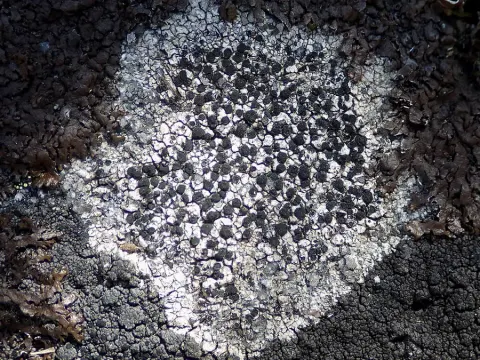
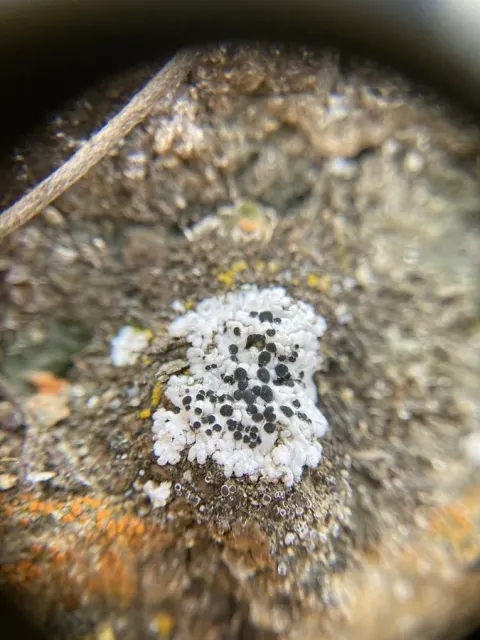
The thallus is crustose, areolate, and thin to moderately thickened, often forming a continuous layer. The prothallus is conspicuous and black, strongly developed in most specimens, growing between the areoles to form a hypothallus. The thallus surface is usually white to whitish gray, rarely dark gray, and can be dull or slightly shiny. The thallus is epruinose and phenocorticate, and lacks soredia. The apothecia exhibit a lecideine structure, with a diameter ranging from (0.2-)0.3-0.4(-0.5) mm. They are typically immersed to adnate, occasionally found in a sessile form. The margin may appear black or masked by grayish remnants of necrotic thalline material, forming a thin and usually persistent boundary, occasionally excluded as they mature. The disc is characterized by a black, epruinose surface, typically flat but occasionally developing a slight convexity over time. Within the apothecia, the proper exciple appears narrow and lacks differentiation, resembling the aethalea-type. The inner excipular hyphae are narrow, hyaline, and often prosoplectenchymatous, exhibiting structural and orientational similarities to the paraphyses. The hypothecium is characterized by a deep reddish-brown color, described as leptoclinos-brown with a textura intricata. Outer excipular hyphae are arranged parallelly, moderately swollen (textura oblita), and heavily carbonized, displaying a range of brown shades and aeruginose pigments. The hymenium is hyaline and not inspersed with oil droplets. The paraphyses are simple to moderately branched, with apically swollen tips containing a brown pigment cap.
Habitat dan peran ekologis
Buellia stellulata, an epilithic lichen, thrives on siliceous rock surfaces (typically HCl−) and is commonly found in coastal regions. However, its habitat is not restricted solely to seashore environments. Buellia stellulata exhibits a broad distribution across the Northern Hemisphere. Within the Sonoran region, this species is notably present in coastal areas spanning from southern California to Baja California and Baja California Sur.
- Habitat atau konteks temuan
- Informasi belum tersedia pada sumber rilis ini.
- Substrat
- Informasi belum tersedia pada sumber rilis ini.
- Peran atau konteks
- Pembentuk liken
Reproduksi
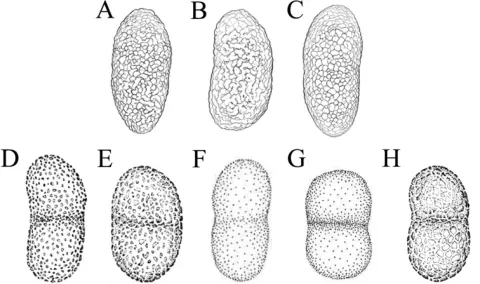
The thallus is crustose, areolate, and thin to moderately thickened, often forming a continuous layer. The prothallus is conspicuous and black, strongly developed in most specimens, growing between the areoles to form a hypothallus. The thallus surface is usually white to whitish gray, rarely dark gray, and can be dull or slightly shiny. The thallus is epruinose and phenocorticate, and lacks soredia. The asci are clavate, Bacidia-type, and 8-spored. The ascospores soon become brown, 1-septate, oblong to ellipsoid, usually not constricted, with obtuse ends, and not curved, measuring (8-)8.7-[9.9]-11.1(-13) x (4.5-)4.8-[5.5]-6.1(-7) μm. The proper septum is narrow and does not thicken during spore ontogeny (Buellia-type).
Catatan identitas dan cakupan
- Nama diterima mengikuti Catalogue of Life Base2026-09-11; uraian mempertahankan konsep dan nama sumber aslinya.
- Original geographic, specimen and life-cycle scope retained; source import awaits individual editorial review.
- Impor dan terjemahan otomatis belum diperiksa editorial per profil. Struktur reproduktif yang disebutkan tidak membuktikan seluruh siklus hidup diketahui.
- Pengukuran pada uraian mengikuti spesimen, kultur, dan metode sumber; angka tidak diperluas ke semua populasi.
Catatan distribusi dalam narasi mengikuti sumbernya. Dokumentasi spesimen atau foto mengikuti catatan sumber. Bukti wilayah Indonesia dan penilaian konservasi tidak disimpulkan dari gambar.
Melihat dengan konteks
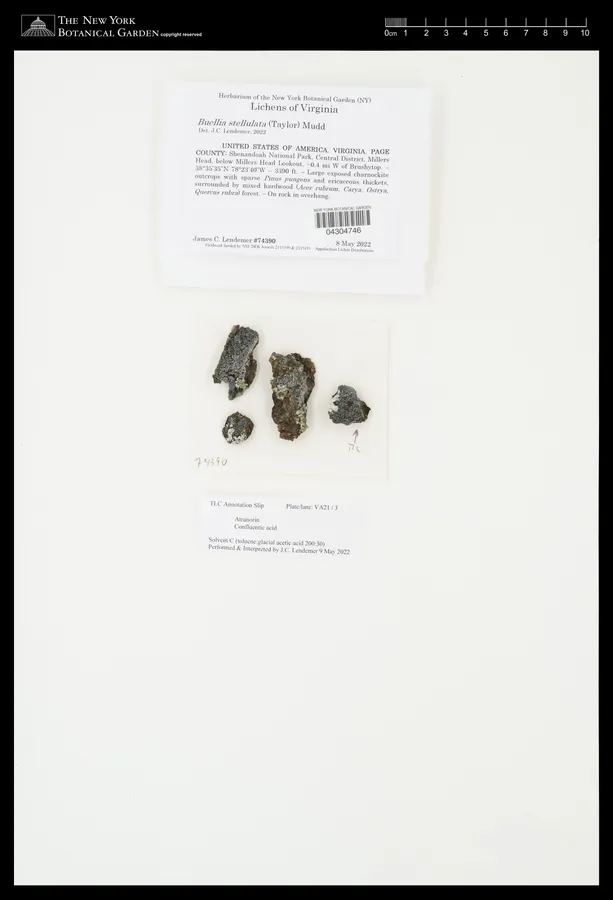
Voucher herbarium Buellia stellulata (04304746), The New York Botanical Garden. Identifikasi mengikuti record spesimen sumber. Foto bahan, kemasan, atau label herbarium sebagaimana tersedia pada record institusi; bukan foto lapangan atau penentuan spesimen independen.
- Jenis
- Voucher herbarium
- Kredit
- The New York Botanical Garden
- Lisensi
- CC BY 4.0
- Sumber media
- Buka entri sumber
Sumber profil
- [1] Buellia stellulata — Wikipedia (en)
- [2] Catalogue of Life Base2026-09-11 — Buellia stellulata
- [3] Dokumentasi visual — Buellia stellulata
Rujukan halaman ini
Fungi. Buellia stellulata. Rilis data fungi-2026-10-12-expansion-2. https://fungi-atlas.mgadib.chatgpt.site/jamur/buellia-stellulata/.
Status: impor sumber; pemeriksaan editorial per profil belum selesai. Untuk klaim biologis, gunakan rujukan pada bagian terkait dan periksa konteks sumber aslinya.