01 / Morfologi

Ciri dan struktur

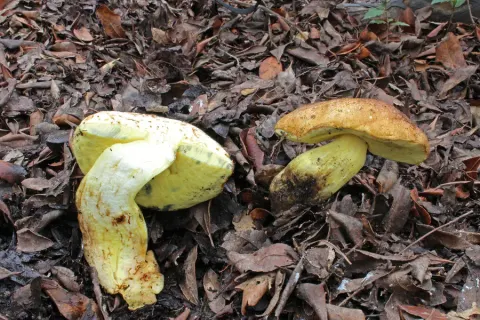
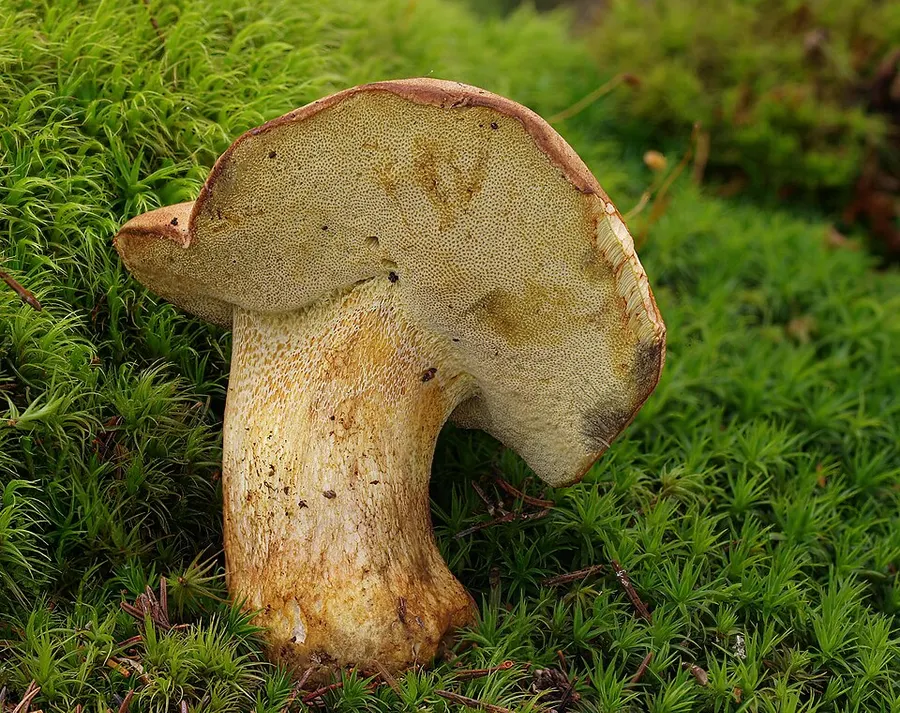
Butyriboletus subappendiculatus produces a medium-sized basidiocarp with a cap (pileus) up to 8 cm across. The young cap is hemispherical, becoming convex to flat-convex and sometimes slightly depressed with age. Its surface is dry or, in older specimens, faintly viscid, smooth to finely fibrillose or cracked, and coloured from brownish orange or cinnamon to buff or grey buff. The cap flesh does not change colour when bruised, and the margin often retains fragments of the partial veil (appendiculate). The tubes are up to 1 cm long and lemon yellow, maturing to a yellow with a faint olive tint; neither tubes nor pores bruise blue. The stipe measures up to 13 cm long and 5.5 cm thick, initially subspherical or ovoid before becoming club-shaped or cylindrical, often with a rooting base. It is pale yellowish-white to pastel yellow, occasionally discolouring to whitish or brownish, and may bear a zone of pale red to brownish-orange. A fine, concolorous reticulation covers much of the stipe, which likewise remains unchanging when handled. The flesh of the stipe is lemon yellow under the surface and fades to straw or whitish in deeper tissues; it shows no bluing on exposure. Odour and taste are mild and not distinctive. Viewed under the microscope, the spores are smooth and oval, about 10–15 μm long and 3–4.5 μm wide (roughly two to four times as long as they are wide), and each usually contains one or more oil droplets. The basidia are four-spored and club-shaped (clavate), about 30–39.5 × 7–10 μm, and the cystidia measure 35.5–45 × 8–10.5 μm. The cap cuticle (pileipellis) forms a trichoderm of interwoven, septate, slightly encrusted hyphae with mostly cylindrical, rounded terminal cells.

Sebagian uraian ditampilkan dalam bahasa sumber; terjemahannya belum tersedia atau belum lolos pemeriksaan.

Rujukan: [1]

Pengukuran mengikuti objek, spesimen atau kultur, dan metode yang disebutkan sumber. Baca uraian asli untuk konteks lengkap.

02 / Kehidupan

Habitat dan peran ekologis

Butyriboletus subappendiculatus fruits in upper-montane coniferous or mixed forests, most commonly under Norway spruce (Picea abies) or silver fir (Abies alba), on neutral to calcareous soils at elevations of 1,200–1,700 m. Fruiting occurs in midsummer, typically from July through August. In Bulgaria, it is known from the high-elevation woodlands of the Pirin and Rila mountains. More broadly, the species has been recorded wherever its coniferous hosts grow across Europe (Austria, Czech Republic, Germany, Spain, United Kingdom, Greece, France, Italy, Montenegro, Norway, Poland, Serbia, Slovenia and Slovakia) and extending into Turkey. It is considered endangered in the Czech Republic.

Sebagian uraian ditampilkan dalam bahasa sumber; terjemahannya belum tersedia atau belum lolos pemeriksaan.

Rujukan: [1]

Habitat atau konteks temuan
hutan
Substrat
Informasi belum tersedia pada sumber rilis ini.
Peran atau konteks
Belum dikategorikan pada rilis ini.
Temukan hubungan serupa
03 / Siklus hidup

Reproduksi

Butyriboletus subappendiculatus produces a medium-sized basidiocarp with a cap (pileus) up to 8 cm across. The young cap is hemispherical, becoming convex to flat-convex and sometimes slightly depressed with age. Its surface is dry or, in older specimens, faintly viscid, smooth to finely fibrillose or cracked, and coloured from brownish orange or cinnamon to buff or grey buff. The cap flesh does not change colour when bruised, and the margin often retains fragments of the partial veil (appendiculate). Viewed under the microscope, the spores are smooth and oval, about 10–15 μm long and 3–4.5 μm wide (roughly two to four times as long as they are wide), and each usually contains one or more oil droplets.

Sebagian uraian ditampilkan dalam bahasa sumber; terjemahannya belum tersedia atau belum lolos pemeriksaan.

Rujukan: [1]

Sinonim menurut acuan taksonomi rilis: Boletus subappendiculatus
04 / Batas informasi

Catatan identitas dan cakupan

  • Nama diterima mengikuti Catalogue of Life Base2026-09-11; uraian mempertahankan konsep dan nama sumber aslinya.
  • Original geographic, specimen and life-cycle scope retained; source import awaits individual editorial review.
  • Impor dan terjemahan otomatis belum diperiksa editorial per profil. Struktur reproduktif yang disebutkan tidak membuktikan seluruh siklus hidup diketahui.
  • Pengukuran pada uraian mengikuti spesimen, kultur, dan metode sumber; angka tidak diperluas ke semua populasi.

Catatan distribusi dalam narasi mengikuti sumbernya. Dokumentasi spesimen atau foto mengikuti catatan sumber. Bukti wilayah Indonesia dan penilaian konservasi tidak disimpulkan dari gambar.

05 / Dokumentasi

Melihat dengan konteks

Dokumentasi Butyriboletus subappendiculatus dari Wikimedia Commons. Boletus subappendiculatus growing under Picea abies . Nationalpark Bayerischer Wald. Identifikasi mengikuti record berkas sumber.

Jenis
Fotografi
Kredit
Andreas Kunze
Sumber media
Buka entri sumber

Gambar menunjukkan objek menurut identifikasi sumber, bukan verifikasi independen spesimen oleh Fungi. Tidak ada skala baru yang ditambahkan.

06 / Rujukan

Sumber profil

  1. [1] Butyriboletus subappendiculatus — Wikipedia (en)Bagian sumber: Frozen revision 1337711039
    Tanggal penghimpunan sumber: 2026-10-12
    Teks sumber: CC BY-SA4.0 · Wikipedia contributors
  2. [2] Catalogue of Life Base2026-09-11 — Butyriboletus subappendiculatusBagian sumber: ColDP NameUsage.tsv ID NZ8B; accepted species; source 2073
    Tanggal penghimpunan sumber: 2026-10-12
  3. [3] Dokumentasi visual — Butyriboletus subappendiculatusBagian sumber: Individual media record; identification follows the source, not independent determination
    Tanggal penghimpunan sumber: 2026-10-12
    Media sumber: CC BY-SA 3.0 · Andreas Kunze

Adaptasi teks: CC BY-SA 4.0. Wikipedia contributors — Butyriboletus subappendiculatus — Wikipedia (en)

Uraian asli dan riwayat sumber

Riwayat atau halaman sumber

Ringkasan sumber

Butyriboletus subappendiculatus is a pored mushroom in the family Boletaceae. It was originally described as a species of Boletus in 1979 before being reclassified in the genus Butyriboletus in 2014. The fungus produces medium-sized fruiting bodies with brownish-orange to buff-coloured caps up to 8 cm across, lemon-yellow tubes and pores that do not bruise blue when damaged, and yellowish stipes covered with a fine network pattern. It fruits in upper-montane coniferous or mixed forests across Europe and into Turkey, primarily under Norway spruce or silver fir on neutral to calcareous soils at elevations of 1,200–1,700 metres.

Revisi sumber

Morfologi sumber

Butyriboletus subappendiculatus produces a medium-sized basidiocarp with a cap (pileus) up to 8 cm across. The young cap is hemispherical, becoming convex to flat-convex and sometimes slightly depressed with age. Its surface is dry or, in older specimens, faintly viscid, smooth to finely fibrillose or cracked, and coloured from brownish orange or cinnamon to buff or grey buff. The cap flesh does not change colour when bruised, and the margin often retains fragments of the partial veil (appendiculate). The tubes are up to 1 cm long and lemon yellow, maturing to a yellow with a faint olive tint; neither tubes nor pores bruise blue. The stipe measures up to 13 cm long and 5.5 cm thick, initially subspherical or ovoid before becoming club-shaped or cylindrical, often with a rooting base. It is pale yellowish-white to pastel yellow, occasionally discolouring to whitish or brownish, and may bear a zone of pale red to brownish-orange. A fine, concolorous reticulation covers much of the stipe, which likewise remains unchanging when handled. The flesh of the stipe is lemon yellow under the surface and fades to straw or whitish in deeper tissues; it shows no bluing on exposure. Odour and taste are mild and not distinctive. Viewed under the microscope, the spores are smooth and oval, about 10–15 μm long and 3–4.5 μm wide (roughly two to four times as long as they are wide), and each usually contains one or more oil droplets. The basidia are four-spored and club-shaped (clavate), about 30–39.5 × 7–10 μm, and the cystidia measure 35.5–45 × 8–10.5 μm. The cap cuticle (pileipellis) forms a trichoderm of interwoven, septate, slightly encrusted hyphae with mostly cylindrical, rounded terminal cells.

Revisi sumber

Ekologi sumber

Butyriboletus subappendiculatus fruits in upper-montane coniferous or mixed forests, most commonly under Norway spruce (Picea abies) or silver fir (Abies alba), on neutral to calcareous soils at elevations of 1,200–1,700 m. Fruiting occurs in midsummer, typically from July through August. In Bulgaria, it is known from the high-elevation woodlands of the Pirin and Rila mountains. More broadly, the species has been recorded wherever its coniferous hosts grow across Europe (Austria, Czech Republic, Germany, Spain, United Kingdom, Greece, France, Italy, Montenegro, Norway, Poland, Serbia, Slovenia and Slovakia) and extending into Turkey. It is considered endangered in the Czech Republic.

Revisi sumber

Struktur reproduksi sumber

Butyriboletus subappendiculatus produces a medium-sized basidiocarp with a cap (pileus) up to 8 cm across. The young cap is hemispherical, becoming convex to flat-convex and sometimes slightly depressed with age. Its surface is dry or, in older specimens, faintly viscid, smooth to finely fibrillose or cracked, and coloured from brownish orange or cinnamon to buff or grey buff. The cap flesh does not change colour when bruised, and the margin often retains fragments of the partial veil (appendiculate). Viewed under the microscope, the spores are smooth and oval, about 10–15 μm long and 3–4.5 μm wide (roughly two to four times as long as they are wide), and each usually contains one or more oil droplets.

Revisi sumber

Rujukan halaman ini

Fungi. Butyriboletus subappendiculatus. Rilis data fungi-2026-10-12-expansion-2. https://fungi-atlas.mgadib.chatgpt.site/jamur/butyriboletus-subappendiculatus/.

Status: impor sumber; pemeriksaan editorial per profil belum selesai. Untuk klaim biologis, gunakan rujukan pada bagian terkait dan periksa konteks sumber aslinya.