Ciri dan struktur
Cacaoporus tenebrosus is characterised by having a darker context than the other species, longer basidia and cylindrical to narrowly subclavate hymenophoral cystidia. Basidiomata medium-sized. Pileus (2.3)3.1–5(9) cm in diameter, convex when young becoming plano-convex to slightly depressed with age; margin inflexed to deflexed, slightly exceeding (1–2 mm); surface even to subrugulose, minutely tomentose, slightly cracked at the centre, dull, greyish-brown (10F3) to dark brown to blackish-brown (8F4–5) to the margin; context 5–10 mm thick half-way to the margin, soft, marmorated, greyish-brown to dark brown (10F3–5) with greyish-brown (9B/D3), scattered with reddish-brown to brownish-black, fine encrustations at places, slightly reddening in paler spots when cut. Stipe central, terete, cylindrical to sometimes with slightly wider base, 4.3–7.0 × 0.7–1.4 cm, surface even, minutely tomentose, dull, dark brown to greyish-brown (9F4 to 10F3), basal mycelium white to off-white becoming reddish-white to pale red (7A3–4) when bruised; context solid, greyish-brown to dark brown (9–10F3–5) marmorated with reddish-grey (7/10B2), usually scattered with small reddish-brown to brownish-black fine encrustations, slightly reddening when cut. Hymenophore tubulate, adnate, subventricose to ventricose, slightly depressed around the stipe. Tubes (4)7–13 mm long half-way to the margin, brown to dark brown (8F3 to 9F4), not separable from the pileus context. Pores 0.8–2 mm wide at mid-radius, regularly arranged, mostly roundish at first, becoming slightly angular with age, sometime irregular, elongated around the stipe; colour distribution even, greyish-brown to dark brown (9F4) at first, becoming chocolate brown to brown (10F3 to 7–8F4–5) with age.
Habitat dan peran ekologis
Gregarious (up to 9 basidiomata) to fasciculate or solitary, on soil in hill evergreen forest dominated by Fagaceae trees, with a few Dipterocarpus spp. and Shorea spp. or in Dipterocarp forest dominated by Dipterocarpus spp., Shorea spp. with a few Lithocarpus sp., Castanopsis sp. and Quercus sp. Currently known only from Chiang Mai Province, Northern Thailand.
- Habitat atau konteks temuan
- hutan
- Substrat
- tanah
- Peran atau konteks
- Belum dikategorikan pada rilis ini.
Reproduksi
Cacaoporus tenebrosus is characterised by having a darker context than the other species, longer basidia and cylindrical to narrowly subclavate hymenophoral cystidia. Basidiomata medium-sized. Pileus (2.3)3.1–5(9) cm in diameter, convex when young becoming plano-convex to slightly depressed with age; margin inflexed to deflexed, slightly exceeding (1–2 mm); surface even to subrugulose, minutely tomentose, slightly cracked at the centre, dull, greyish-brown (10F3) to dark brown to blackish-brown (8F4–5) to the margin; context 5–10 mm thick half-way to the margin, soft, marmorated, greyish-brown to dark brown (10F3–5) with greyish-brown (9B/D3), scattered with reddish-brown to brownish-black, fine encrustations at places, slightly reddening in paler spots when cut.
Catatan identitas dan cakupan
- Nama diterima mengikuti Catalogue of Life Base2026-09-11; uraian mempertahankan konsep dan nama sumber aslinya.
- Preserve original treatment localities, hosts and substrate scope. Materials examined describe documented specimens, not the full global range.
- Impor dan terjemahan otomatis belum diperiksa editorial per profil. Struktur reproduktif yang disebutkan tidak membuktikan seluruh siklus hidup diketahui.
- Pengukuran pada uraian mengikuti spesimen, kultur, dan metode sumber; angka tidak diperluas ke semua populasi.
Catatan distribusi dalam narasi mengikuti sumbernya. Dokumentasi spesimen atau foto mengikuti catatan sumber. Bukti wilayah Indonesia dan penilaian konservasi tidak disimpulkan dari gambar.
Melihat dengan konteks
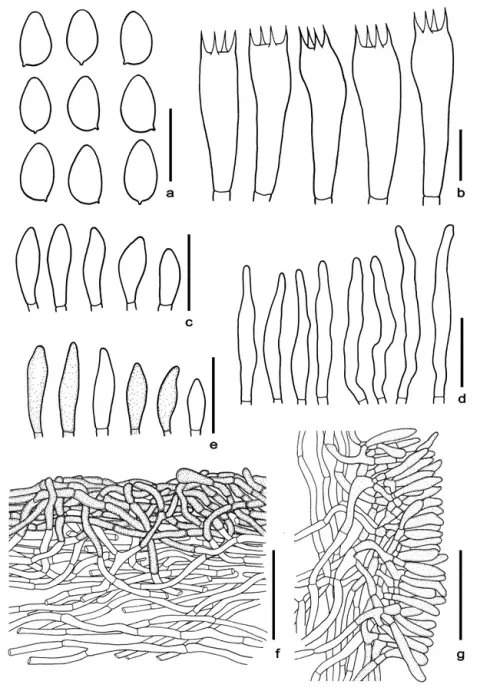
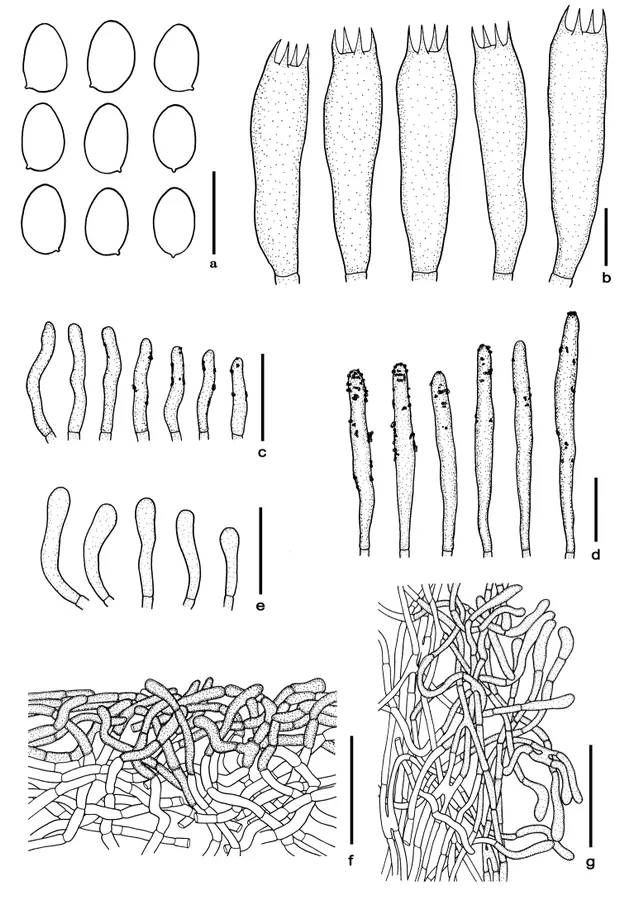
Microscopic features of Cacaoporus tenebrosus a basidiospores b basidia c cheilocystidia d pleurocystidia e caulocystidia f pileipellis g stipitipellis. Scale bars: 10 µm (a–b); 25 µm (c–e); 50 µm (f–g). All drawings were made from the type (SV0223).
- Jenis
- Pelat ilmiah
- Kredit
- Santhiti Vadthanarat, Saisamorn Lumyong, Olivier Raspé
- Lisensi
- CC BY 4.0
- Sumber media
- Buka entri sumber
Dokumentasi tambahan
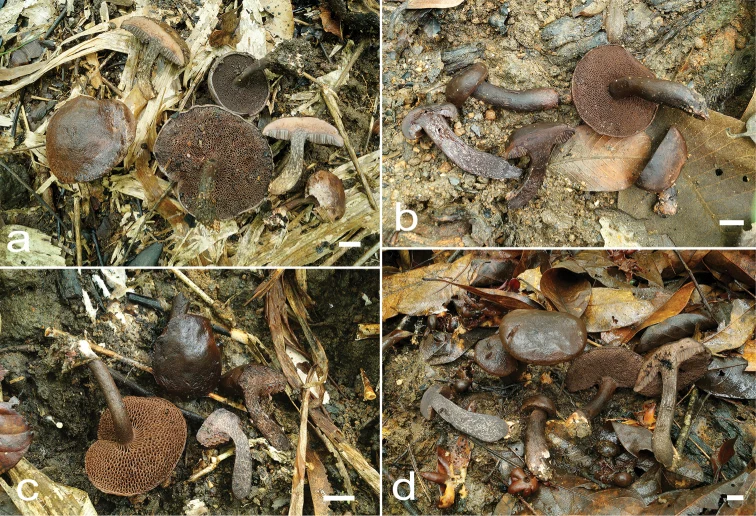
Habit of Cacaoporus species. a C. pallidicarneus (SV0221) b–d C. tenebrosus (b - SV0223, c - SV0224, d - SV0422). Scale bars: 1 cm (a–d).
Kredit dan penggunaan
Santhiti Vadthanarat, Saisamorn Lumyong, Olivier Raspé
Ukuran dan format gambar disesuaikan tanpa pemotongan, retus, atau penambahan skala. Lisensi sumber dipertahankan.
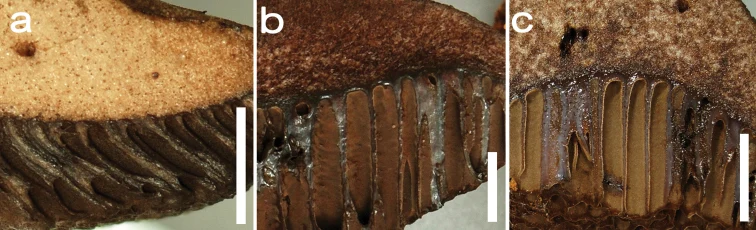
Close-ups of hymenium/pileus context transition zone in Cacaoporus species, illustrating the non-separability of both tissues a C. pallidicarneus (OR0681) b C. tenebrosus (OR0654) c C. tenebrosus (SV0452). The transition between both tissues is particularly unmarked in C. pallidicarneus (a) Scale bars: 3 mm (a); 5 mm (b–c).
Kredit dan penggunaan
Santhiti Vadthanarat, Saisamorn Lumyong, Olivier Raspé
Ukuran dan format gambar disesuaikan tanpa pemotongan, retus, atau penambahan skala. Lisensi sumber dipertahankan.
Sumber profil
- [1] Cacaoporus, a new Boletaceae genus, with two new species from Thailand — Cacaoporus tenebrosus
- [2] Catalogue of Life Base2026-09-11 — Cacaoporus tenebrosus
- [3] Dokumentasi visual — Cacaoporus tenebrosus
- [4] Dokumentasi visual — Cacaoporus tenebrosus
- [5] Dokumentasi visual — Cacaoporus tenebrosus
Rujukan halaman ini
Fungi. Cacaoporus tenebrosus. Rilis data fungi-2026-10-12-expansion-2. https://fungi-atlas.mgadib.chatgpt.site/jamur/cacaoporus-tenebrosus/.
Status: impor sumber; pemeriksaan editorial per profil belum selesai. Untuk klaim biologis, gunakan rujukan pada bagian terkait dan periksa konteks sumber aslinya.