Ciri dan struktur
Phylogenetically close to C. piauiensis and C. brassianae but differs in having smaller macroconidia. Sexual morph not observed. Conidiophores scarce on SNA, consisting of conidiogenous apparatus and stipes, branched or simple. Stipes infrequent, elongated, septate, 75–273 µm long, 2–5 µm wide near base, tapering towards apex, simple or occasionally dichotomously branched, mostly being part of conidiogenous apparatus; vesicles terminal, slightly inflate to ellipsoidal, 2–5 µm wide. Conidiogenous apparatus hyaline, simple or branched in 1–3 (–4) tiers, uncommonly developing from stipes; main axis upright, septate, 20–275 × 3–7 µm; branches doliiform to cylindrical, primary branches 8–39 × 3–7 µm, secondary branches 8–24 × 2–6 µm, tertiary branches 10–23 × 2–5 µm, quarternary branches 10–14 × 3–4 µm. Conidiogenous cells holoblastic, hyaline, discrete, cylindrical to tapered above, often constricted near base, with periclinal thickening, 8–20 × 3–5 (11.8 ± 2.71 × 3.2 ± 0.5) µm. Macroconidia hyaline, cylindrical, round at apex, 1-septate, septum sub-median or median, guttulate, 21–40 × 3–4 (30.9 ± 4.09 × 3.5 ± 0.23) µm. Chlamydospores present, scarce, in clumps or in chains. Mega - and microconidia not observed. Colonies on 2% MEA in the dark for 6 d, white on surface, pale luteous in reverse, with moderate amount of aerial mycelium, with entire edges. Optimal growth temperature at 25 °C reaching 65.2 mm in 6 d, followed by 20 °C (57.3 mm), 15 °C (39.8 mm), 10 °C (19.7 mm), 5 °C (8.2 mm), no growth at 30 °C and 35 °C. Colonies kept at 30 °C and 35 °C being relocated to 25 °C for another 6 d revived (30 °C) and showed no growth (35 °C).
Habitat dan peran ekologis
Calonectria exiguispora is a member of the C. candelabrum species complex (Liu et al. 2020). It shares some characteristics with other species in the complex, such as 1-septate macroconidia and ‘ellipsoidal to obpyriform’ shape vesicle. However, it can be distinguished from most species in the complex by its smaller conidial dimensions (21–40 × 3–4 µm, avg. 30.9 × 3.5 µm) except for C. brevistipitata (29–35 × 3–4 µm, avg. 31 × 3.5 µm, isolated from Mexican soil) and C. stipitate (27–37 × 3–6, avg. 32 × 4 µm, isolated from Colombian Eucalyptus sp.) (Lombard et al. 2016). Nevertheless, these two species are distantly related to C. exiguispora (Fig. 3). Recently Liu et al. (2020) reduced C. stipitata to synonymy with C. spathulata, the conidial dimensions of which range from 48–100 × 4–6 µm (avg. 80 × 6 µm). They regarded the smaller conidial dimensions of C. “ stipitata ” as representing intraspecific variation. Calonectria exiguispora is phylogenetically closely related to C. piauiensis and C. brassianae, which were isolated from soils associated with Eucalyptus brassiana trees in Brazil (Alfenas et al. 2015). These two species, however, have much larger conidial dimensions: C. piauiensis (38–60 × 3–5 µm, avg. 49 × 4.5 µm) and C. brassianae (35–65 × 3–5 µm, avg. 53 × 4 µm) (Alfenas et al. 2015).
- Habitat atau konteks temuan
- Informasi belum tersedia pada sumber rilis ini.
- Substrat
- Informasi belum tersedia pada sumber rilis ini.
- Peran atau konteks
- Belum dikategorikan pada rilis ini.
Reproduksi
Sexual morph not observed. Conidiophores scarce on SNA, consisting of conidiogenous apparatus and stipes, branched or simple. Stipes infrequent, elongated, septate, 75–273 µm long, 2–5 µm wide near base, tapering towards apex, simple or occasionally dichotomously branched, mostly being part of conidiogenous apparatus; vesicles terminal, slightly inflate to ellipsoidal, 2–5 µm wide. Conidiogenous apparatus hyaline, simple or branched in 1–3 (–4) tiers, uncommonly developing from stipes; main axis upright, septate, 20–275 × 3–7 µm; branches doliiform to cylindrical, primary branches 8–39 × 3–7 µm, secondary branches 8–24 × 2–6 µm, tertiary branches 10–23 × 2–5 µm, quarternary branches 10–14 × 3–4 µm.
Catatan identitas dan cakupan
- Nama diterima mengikuti Catalogue of Life Base2026-09-11; uraian mempertahankan konsep dan nama sumber aslinya.
- Preserve original treatment localities, hosts and substrate scope. Materials examined describe documented specimens, not the full global range.
- Impor dan terjemahan otomatis belum diperiksa editorial per profil. Struktur reproduktif yang disebutkan tidak membuktikan seluruh siklus hidup diketahui.
- Pengukuran pada uraian mengikuti spesimen, kultur, dan metode sumber; angka tidak diperluas ke semua populasi.
Catatan distribusi dalam narasi mengikuti sumbernya. Dokumentasi spesimen atau foto mengikuti catatan sumber. Bukti wilayah Indonesia dan penilaian konservasi tidak disimpulkan dari gambar.
Melihat dengan konteks
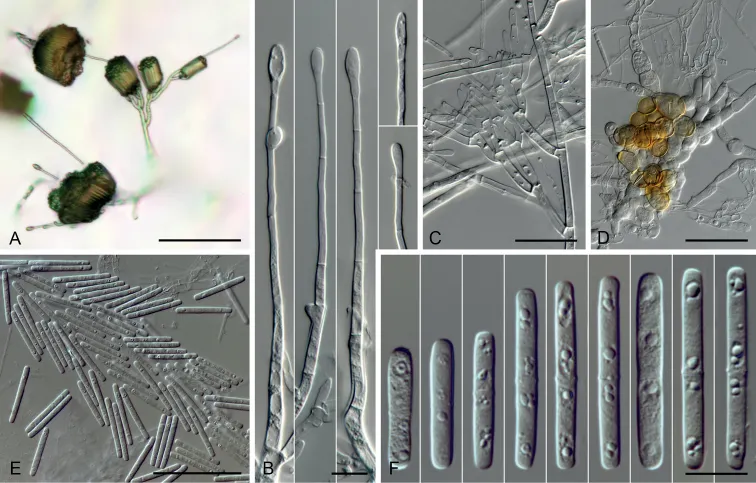
Micrographs of Calonectria exiguispora sp. nov. (ex-holotype: CMW 49752 = CMW-IA 160). A conidiophores formed on SNA B stipes and vesicles C conidiogenous apparatus D chlamydospores E conidia (× 400) F conidia (×1 000). Scale bars: 100 µm (A); 50 µm (D, E); 25 µm (C); 10 µm (B, F).
- Jenis
- Pelat ilmiah
- Kredit
- Nam Q. Pham, Seonju Marincowitz, ShuaiFei Chen, Carlos A. Rodas, Michael J. Wingfield
- Lisensi
- CC BY 4.0
- Sumber media
- Buka entri sumber
Dokumentasi tambahan
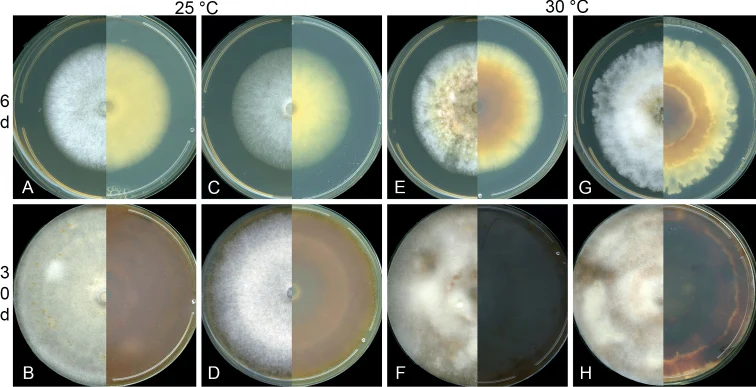
Culture morphology of Calonectria exiguispora (A–D) at 25 °C and C. guahibo (E–H) at 30 °C in the dark for 6 d (A, C, E, G) and 30 d (B, E, F, H) at its optimum temperature A, B CMW 49752 (ex-holotype) C, D CMW 49753 E, F CMW 49791 (ex-holotype) G, H CMW 49782.
Kredit dan penggunaan
Nam Q. Pham, Seonju Marincowitz, ShuaiFei Chen, Carlos A. Rodas, Michael J. Wingfield
Ukuran dan format gambar disesuaikan tanpa pemotongan, retus, atau penambahan skala. Lisensi sumber dipertahankan.
Sumber profil
- [1] Soil-borne Calonectria (Hypocreales, Nectriaceae) associated with Eucalyptus plantations in Colombia — Calonectria exiguispora
- [2] Catalogue of Life Base2026-09-11 — Calonectria exiguispora
- [3] Dokumentasi visual — Calonectria exiguispora
- [4] Dokumentasi visual — Calonectria exiguispora
Rujukan halaman ini
Fungi. Calonectria exiguispora. Rilis data fungi-2026-10-12-expansion-2. https://fungi-atlas.mgadib.chatgpt.site/jamur/calonectria-exiguispora/.
Status: impor sumber; pemeriksaan editorial per profil belum selesai. Untuk klaim biologis, gunakan rujukan pada bagian terkait dan periksa konteks sumber aslinya.