Ciri dan struktur
This new species is morphologically distinguished from other taxa in the genus by its smaller basidiomata, greenish gray to dull green pileus, white and short decurrent lamellae, and broadly elliptic basidiospores. Basidiomata small-sized. Pileus 7–12 mm broad, hemispherical, convex to plano-convex at first, then gradually applanate, becoming depressed at disc when mature, non-striate to weakly striate; margin slightly inflexed at first, soon straight, slightly crenate or lacerate when mature; surface matt, velvety, hygrophanous, greenish gray (or olive gray) to dull green (27D 2–30D2, 27D3–30D3, 27E2–30E2, 27E3–30E3), often paler at margin. Flesh 1–3 mm thick in the stipe, white to grayish white, unchanging when exposed. Lamellae 1–2 mm deep, L = 20–34, l = 1–3, short to moderately decurrent, white to weakly grayish white (1A1–1B1) at first, white to weakly greenish white (27A2–30A2) when mature, unchanging when bruised; edge entire, concolorous with the sides. Stipe 13–25 × 1.5–2.5 mm, central, cylindrical and becoming narrower downwards; glabrous and shiny, hardly tomentulose or pruinose, hygrophanous, white to greenish white at first (28A1–28A2, 29A1–29A2), becoming greenish white to light greenish gray (28A2–28B2, 29A2–29B2) when mature and in dry condition. Odor none. Taste mild. Basidiospores [60/2/2] 4–5.5(–6) × 3.5–4.5(–5) μm, av. 4.6 × 3.8 μm, Q = (1.12)1.14–1.28(1.43), av. Q = 1.21 ± 0.08, broadly ellipsoid, hyaline, smooth, inamyloid, thin-walled. Basidia 4-spored, occasionally 2-spored, (10–)15–26(–30) × 5–7 μm, av. 24.5 × 5.8 μm, hyaline, narrowly clavate, attenuated and flexuous toward base, sterigmata up to 4 μm long.
Habitat dan peran ekologis
Solitary, scattered on soil in mixed forests; currently only known from the Guizhou Province of China.
- Habitat atau konteks temuan
- hutan
- Substrat
- tanah
- Peran atau konteks
- Belum dikategorikan pada rilis ini.
Reproduksi
This new species is morphologically distinguished from other taxa in the genus by its smaller basidiomata, greenish gray to dull green pileus, white and short decurrent lamellae, and broadly elliptic basidiospores. Basidiomata small-sized. Pileus 7–12 mm broad, hemispherical, convex to plano-convex at first, then gradually applanate, becoming depressed at disc when mature, non-striate to weakly striate; margin slightly inflexed at first, soon straight, slightly crenate or lacerate when mature; surface matt, velvety, hygrophanous, greenish gray (or olive gray) to dull green (27D 2–30D2, 27D3–30D3, 27E2–30E2, 27E3–30E3), often paler at margin. Flesh 1–3 mm thick in the stipe, white to grayish white, unchanging when exposed.
Catatan identitas dan cakupan
- Nama diterima mengikuti Catalogue of Life Base2026-09-11; uraian mempertahankan konsep dan nama sumber aslinya.
- Preserve original treatment localities, hosts and substrate scope. Materials examined describe documented specimens, not the full global range.
- Impor dan terjemahan otomatis belum diperiksa editorial per profil. Struktur reproduktif yang disebutkan tidak membuktikan seluruh siklus hidup diketahui.
- Pengukuran pada uraian mengikuti spesimen, kultur, dan metode sumber; angka tidak diperluas ke semua populasi.
Catatan distribusi dalam narasi mengikuti sumbernya. Dokumentasi spesimen atau foto mengikuti catatan sumber. Bukti wilayah Indonesia dan penilaian konservasi tidak disimpulkan dari gambar.
Melihat dengan konteks
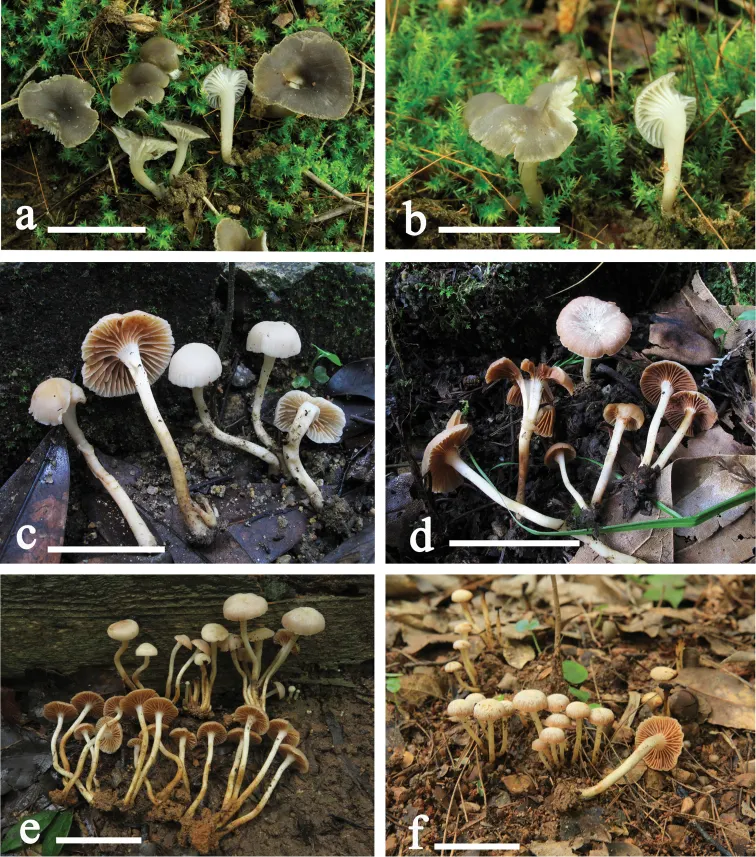
a, b Basidiomata of Camarophyllopsis olivaceogrisea (GDGM44519, holotype) c–f basidiomata of Hodophilus glaberripes (e. GDGM72518, holotype). Scale bars: 20 mm (a, b); 50 mm (c–f).
- Jenis
- Pelat ilmiah
- Kredit
- Ming Zhang, Chao-Qun Wang, Tai-Hui Li
- Lisensi
- CC BY 4.0
- Sumber media
- Buka entri sumber
Dokumentasi tambahan
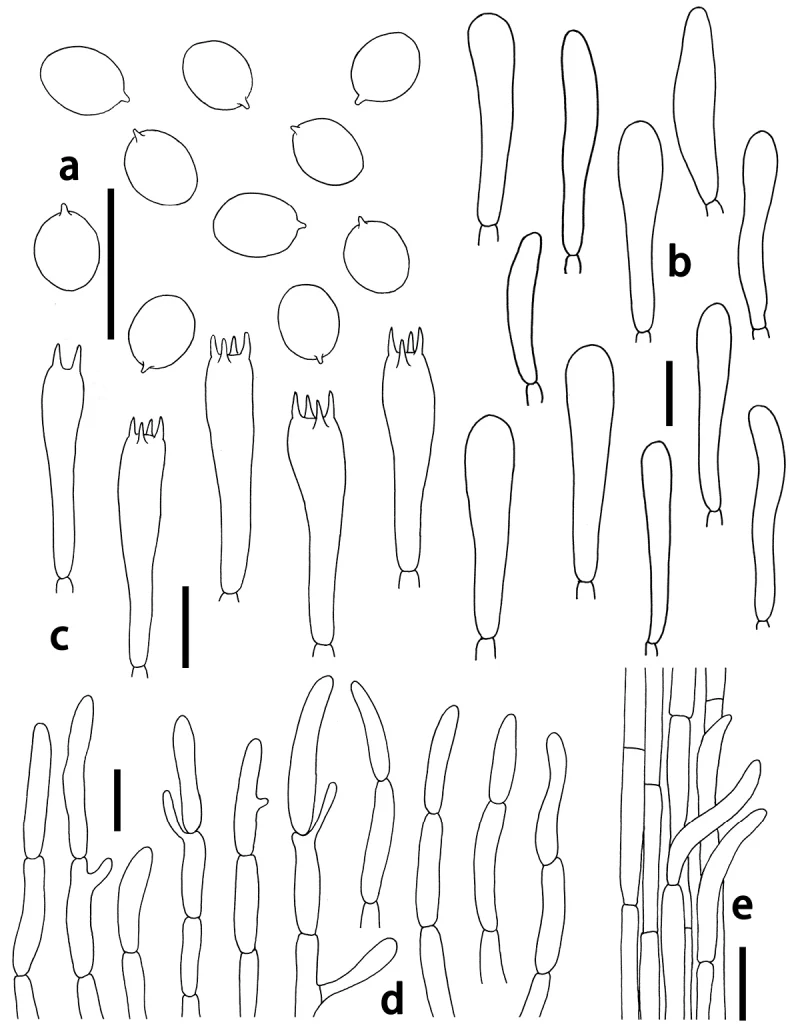
Camarophyllopsis olivaceogrisea. a Basidiospores b basidioles c Basidia d hyphal terminations in pileipellis e stipitipellis. Scale bars: 10 μm (a–c); 20 μm (d, e).
Kredit dan penggunaan
Ming Zhang, Chao-Qun Wang, Tai-Hui Li
Ukuran dan format gambar disesuaikan tanpa pemotongan, retus, atau penambahan skala. Lisensi sumber dipertahankan.
Sumber profil
- [1] Two new agaricoid species of the family Clavariaceae (Agaricales, Basidiomycota) from China, representing two newly recorded genera to the country — Camarophyllopsis olivaceogrisea
- [2] Catalogue of Life Base2026-09-11 — Camarophyllopsis olivaceogrisea
- [3] Dokumentasi visual — Camarophyllopsis olivaceogrisea
- [4] Dokumentasi visual — Camarophyllopsis olivaceogrisea
Rujukan halaman ini
Fungi. Camarophyllopsis olivaceogrisea. Rilis data fungi-2026-10-12-expansion-2. https://fungi-atlas.mgadib.chatgpt.site/jamur/camarophyllopsis-olivaceogrisea/.
Status: impor sumber; pemeriksaan editorial per profil belum selesai. Untuk klaim biologis, gunakan rujukan pada bagian terkait dan periksa konteks sumber aslinya.