Ciri dan struktur
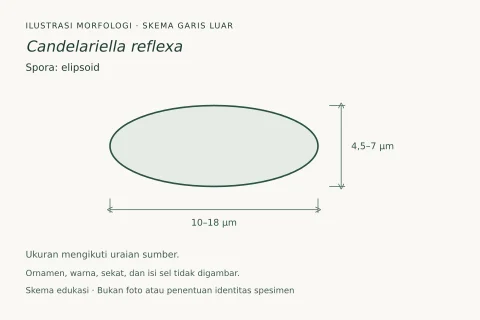
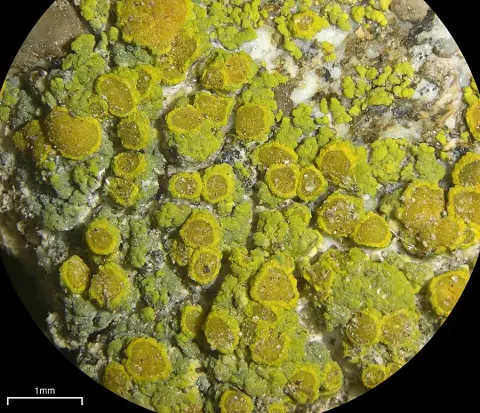
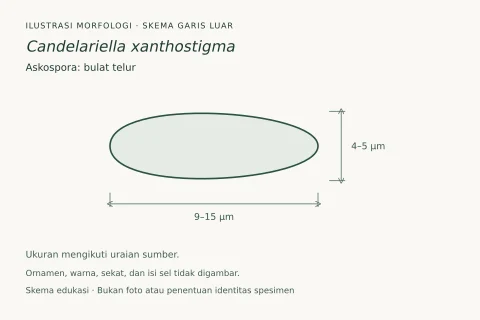
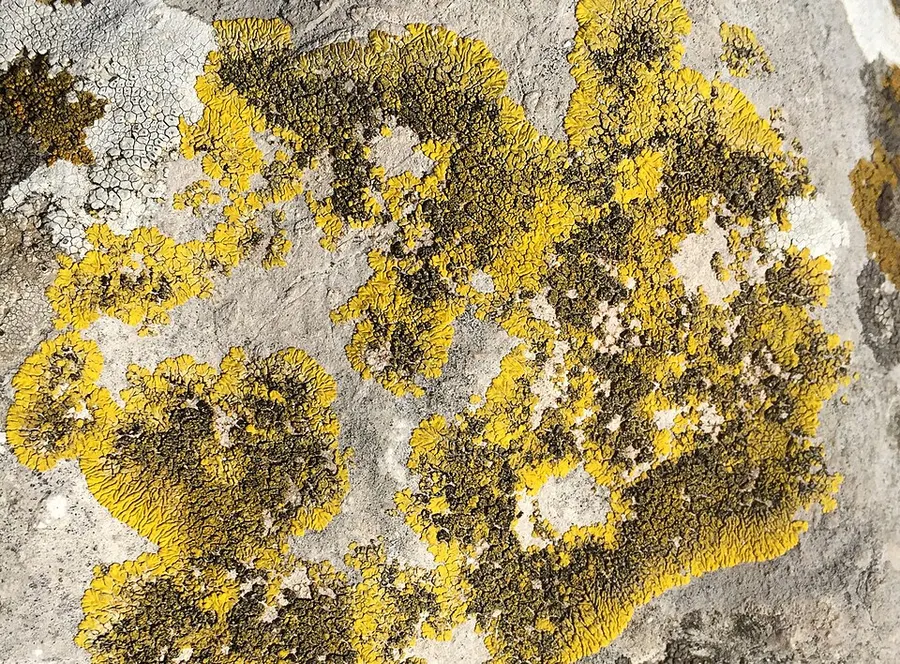
Candelariella medians forms a thallus (a crust that expands from the centre but has a fringe of small at the edge) up to about 3 cm across. It is usually round and radiating, with the marginal lobes mostly touching one another. The thallus is yellow; the surface can feel slightly rough or appear dusted with a fine, pale bloom (). Towards the centre the texture changes from granular- (broken into tiny, block-like patches) to very finely -isidiate, where minute, coral-like outgrowths function as vegetative propagules. The centre is often the same colour as the margin, but commonly turns greyish by comparison. Individual lobes are 0.3–1 mm wide and may lie flat or become gently convex; they are typically contiguous but can be separate or overlapping. The fruiting bodies (apothecia) are occasional, small (0.3–1.2 mm in diameter), dull yellow, and flat to slightly convex. Their margin is smooth to finely scalloped. Each sac (ascus) contains eight ascospores. The ascospores measure 11–17 × 4–6 micrometres, are usually non-septate (without an internal cross-wall, though a single septum may sometimes appear), and vary in outline from ellipsoidal or cylindrical to tear-drop or slipper-shaped. A citrine-green form, f. steepholmensis, resembles the typical morphology but lacks calycin and has not been seen fertile; it was described from Steep Holm, Somerset.
Habitat dan peran ekologis
Candelariella medians grows on lime-rich substrates affected by human activity, from shade to full sun. Typical sites include churchyards, village buildings and walls. It is uncommon in natural habitats, occurring mainly on nutrient-enriched rock and calcareous bird perches. It is abundant in southern and eastern England, but less common throughout other parts of Britain. In Italy, the species is typically found in mild-temperate regions on human-made calcareous surfaces such as churches, monuments, park statues and gravestones. It is most frequent above the Mediterranean belt, but also occurs in natural situations on the tops of isolated calcareous boulders, and is especially common in small villages along the eastern Apennine Mountains. In urban Britain it is characteristic of old limestone memorials and other calcareous masonry; around London it was locally abundant on eighteenth–nineteenth-century headstones and chest tombs (and, more rarely, concrete), often occurring with nitrophilous associates in the Caloplacetum heppianae community, which is maintained by bird droppings on horizontal ledges and grave-tops. In his 1967 report of the British lichen funga, Jack Laundon recorded thriving patches on the limestone walls at "The Fountain", Kensington Gardens, and treated the species as a selective, sometimes dominant, member of that community.
- Habitat atau konteks temuan
- Informasi belum tersedia pada sumber rilis ini.
- Substrat
- Informasi belum tersedia pada sumber rilis ini.
- Peran atau konteks
- Pembentuk liken
Reproduksi
Candelariella medians forms a thallus (a crust that expands from the centre but has a fringe of small at the edge) up to about 3 cm across. It is usually round and radiating, with the marginal lobes mostly touching one another. The thallus is yellow; the surface can feel slightly rough or appear dusted with a fine, pale bloom (). Towards the centre the texture changes from granular- (broken into tiny, block-like patches) to very finely -isidiate, where minute, coral-like outgrowths function as vegetative propagules. The centre is often the same colour as the margin, but commonly turns greyish by comparison. Individual lobes are 0.3–1 mm wide and may lie flat or become gently convex; they are typically contiguous but can be separate or overlapping.
Catatan identitas dan cakupan
- Nama diterima mengikuti Catalogue of Life Base2026-09-11; uraian mempertahankan konsep dan nama sumber aslinya.
- Original geographic, specimen and life-cycle scope retained; source import awaits individual editorial review.
- Impor dan terjemahan otomatis belum diperiksa editorial per profil. Struktur reproduktif yang disebutkan tidak membuktikan seluruh siklus hidup diketahui.
- Pengukuran pada uraian mengikuti spesimen, kultur, dan metode sumber; angka tidak diperluas ke semua populasi.
Catatan distribusi dalam narasi mengikuti sumbernya. Dokumentasi spesimen atau foto mengikuti catatan sumber. Bukti wilayah Indonesia dan penilaian konservasi tidak disimpulkan dari gambar.
Melihat dengan konteks
Dokumentasi Candelariella medians dari Wikimedia Commons. The crustose rock-dwelling lichen Candelariella medians; location: Italy, Friuli Venezia Giulia, Trieste, Trieste Karst, Val Rosandra, San Lorenzo near Belvedere Identifikasi mengikuti record berkas sumber.
- Jenis
- Fotografi
- Kredit
- Pier Luigi Nimis; Owner: Department of Life Sciences, University of Trieste
- Lisensi
- CC BY-SA 4.0
- Sumber media
- Buka entri sumber
Sumber profil
- [1] Candelariella medians — Wikipedia (en)
- [2] Catalogue of Life Base2026-09-11 — Candelariella medians
- [3] Dokumentasi visual — Candelariella medians
Rujukan halaman ini
Fungi. Candelariella medians. Rilis data fungi-2026-10-12-expansion-2. https://fungi-atlas.mgadib.chatgpt.site/jamur/candelariella-medians/.
Status: impor sumber; pemeriksaan editorial per profil belum selesai. Untuk klaim biologis, gunakan rujukan pada bagian terkait dan periksa konteks sumber aslinya.