01 / Morfologi

Ciri dan struktur

Epiphytic on the leaf surface of Ficus sp., forming a sooty coating on adaxial surface. Thallus composed of brown, septate, ellipsoidal, smooth-walled hyphae. Asexual morph. Conidiomata (158–292 μm, x̄ = 254 μm, n = 10) long, pycnidial, elongate, superficial, stipitate, sessile or with short stalk (29–48 × 25–37 μm, x̄ = 40 × 27 μm, n = 10), black, rigid, long neck (45–137 μm, x̄ = 111 μm, n = 10), and a distinctive ovoid-swollen conidiogenous region located at the lower middle part of the conidiomata, the swollen area producing conidia inside. Conidiomata apex gradually light brown to hyaline, with a circular ostiole (7–10 µm, x̄ = 9 µm, n = 10), consisting of rectangular, compact cells, surrounded by hyaline hyphae. Conidiogenous region (23–37 µm, x̄ = 31 µm, n = 10) wide, brown, composed of cylindrical, thin-walled cells. Conidia (3.5–5.2 × 1.6–2.3 μm, x̄ = 4.2 × 1.9 μm, n = 30), hyaline, single-celled, ellipsoidal, smooth-walled, guttulate with 1–2 distinct refractive oil droplets, exuding in creamy masses from the ostiole. Sexual morph. Undetermined. Colonies slow-growing, reaching 16.22 mm in diam after 14 days on PDA in darkness, colony superficial to erumpent, sometimes hyphae growing downwards and immersed into media. Margin black, center olive green, surface velvety with verrucose patches, hyphal branches evident at the margin.

Sebagian uraian ditampilkan dalam bahasa sumber; terjemahannya belum tersedia atau belum lolos pemeriksaan.

Rujukan: [1]

Pengukuran mengikuti objek, spesimen atau kultur, dan metode yang disebutkan sumber. Baca uraian asli untuk konteks lengkap.

02 / Kehidupan

Habitat dan peran ekologis

Epiphytic on the leaf surface of Ficus sp., forming a sooty coating on adaxial surface. Thallus composed of brown, septate, ellipsoidal, smooth-walled hyphae. Asexual morph. Conidiomata (158–292 μm, x̄ = 254 μm, n = 10) long, pycnidial, elongate, superficial, stipitate, sessile or with short stalk (29–48 × 25–37 μm, x̄ = 40 × 27 μm, n = 10), black, rigid, long neck (45–137 μm, x̄ = 111 μm, n = 10), and a distinctive ovoid-swollen conidiogenous region located at the lower middle part of the conidiomata, the swollen area producing conidia inside. Conidiomata apex gradually light brown to hyaline, with a circular ostiole (7–10 µm, x̄ = 9 µm, n = 10), consisting of rectangular, compact cells, surrounded by hyaline hyphae. Conidiogenous region (23–37 µm, x̄ = 31 µm, n = 10) wide, brown, composed of cylindrical, thin-walled cells. Conidia (3.5–5.2 × 1.6–2.3 μm, x̄ = 4.2 × 1.9 μm, n = 30), hyaline, single-celled, ellipsoidal, smooth-walled, guttulate with 1–2 distinct refractive oil droplets, exuding in creamy masses from the ostiole. Sexual morph. Undetermined. Colonies slow-growing, reaching 16.22 mm in diam after 14 days on PDA in darkness, colony superficial to erumpent, sometimes hyphae growing downwards and immersed into media.

Sebagian uraian ditampilkan dalam bahasa sumber; terjemahannya belum tersedia atau belum lolos pemeriksaan.

Rujukan: [1]

Habitat atau konteks temuan
kultur yang didokumentasikan
Substrat
Informasi belum tersedia pada sumber rilis ini.
Peran atau konteks
Pembentuk liken
Temukan hubungan serupa
03 / Siklus hidup

Reproduksi

Epiphytic on the leaf surface of Ficus sp., forming a sooty coating on adaxial surface. Thallus composed of brown, septate, ellipsoidal, smooth-walled hyphae. Asexual morph. Conidiomata (158–292 μm, x̄ = 254 μm, n = 10) long, pycnidial, elongate, superficial, stipitate, sessile or with short stalk (29–48 × 25–37 μm, x̄ = 40 × 27 μm, n = 10), black, rigid, long neck (45–137 μm, x̄ = 111 μm, n = 10), and a distinctive ovoid-swollen conidiogenous region located at the lower middle part of the conidiomata, the swollen area producing conidia inside. Conidiomata apex gradually light brown to hyaline, with a circular ostiole (7–10 µm, x̄ = 9 µm, n = 10), consisting of rectangular, compact cells, surrounded by hyaline hyphae.

Sebagian uraian ditampilkan dalam bahasa sumber; terjemahannya belum tersedia atau belum lolos pemeriksaan.

Rujukan: [1]

04 / Batas informasi

Catatan identitas dan cakupan

  • Nama diterima mengikuti Catalogue of Life Base2026-09-11; uraian mempertahankan konsep dan nama sumber aslinya.
  • Preserve original treatment localities, hosts and substrate scope. Materials examined describe documented specimens, not the full global range.
  • Impor dan terjemahan otomatis belum diperiksa editorial per profil. Struktur reproduktif yang disebutkan tidak membuktikan seluruh siklus hidup diketahui.
  • Pengukuran pada uraian mengikuti spesimen, kultur, dan metode sumber; angka tidak diperluas ke semua populasi.

Catatan distribusi dalam narasi mengikuti sumbernya. Dokumentasi spesimen atau foto mengikuti catatan sumber. Bukti wilayah Indonesia dan penilaian konservasi tidak disimpulkan dari gambar.

05 / Dokumentasi

Melihat dengan konteks

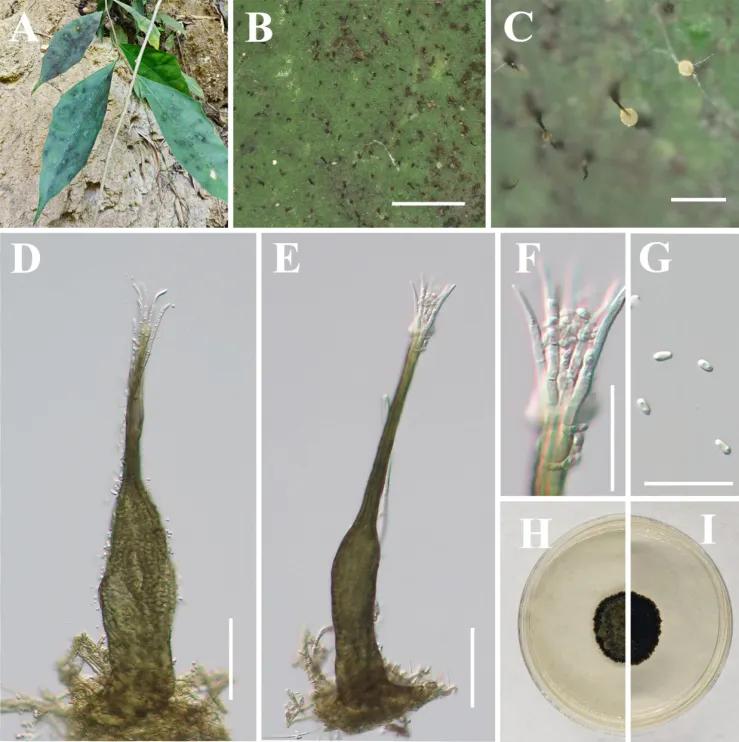
Capnodium neocoffeicola (IFRDCC 19-1201). A Black mycelium covering the leaf surface; B, C Conidiomata on host; D, E Conidioma; F Ostiole; G Conidia; H Front view of the colony on PDA; I Reverse view of the colony on PDA. Scale bars: 1000 μm (B), 200 μm (C), 50 μm (D–F), 20 μm (G).

Jenis
Pelat ilmiah
Kredit
Jipeng Sun, Yuwei Liu, Tao Chen, Entaj Tarafder, Sinang Hongsanan, Shengxi Chen, Chada Norphanphoun, Xiaolu Deng, Yuzhe Feng, Tian Yang, Samantha C. Karunarathna, Xiangyu Zeng
Lisensi
CC BY 4.0
Sumber media
Buka entri sumber

Gambar menunjukkan objek menurut identifikasi sumber, bukan verifikasi independen spesimen oleh Fungi. Tidak ada skala baru yang ditambahkan.

06 / Rujukan

Sumber profil

  1. [1] Morphology and multilocus phylogeny illuminate novel taxa in Capnodiaceae (Ascomycota, Dothideomycetes, Capnodiales) — Capnodium neocoffeicolaBagian sumber: PMC13241920_section_85
    Tanggal penghimpunan sumber: 2026-10-12
    Teks sumber: CC BY 4.0 · Sun J, Liu Y, Chen T, Tarafder E, Hongsanan S, Chen S, Norphanphoun C, Deng X, Feng Y, Yang T, Karunarathna SC, Zeng X.
  2. [2] Catalogue of Life Base2026-09-11 — Capnodium neocoffeicolaBagian sumber: ColDP NameUsage.tsv ID 9Z2HW; accepted species; source 2073
    Tanggal penghimpunan sumber: 2026-10-12
  3. [3] Dokumentasi visual — Capnodium neocoffeicolaBagian sumber: Individual media record; identification follows the source, not independent determination
    Tanggal penghimpunan sumber: 2026-10-12
    Media sumber: CC BY 4.0 · Jipeng Sun, Yuwei Liu, Tao Chen, Entaj Tarafder, Sinang Hongsanan, Shengxi Chen, Chada Norphanphoun, Xiaolu Deng, Yuzhe Feng, Tian Yang, Samantha C. Karunarathna, Xiangyu Zeng

Adaptasi teks: CC BY 4.0. Sun J, Liu Y, Chen T, Tarafder E, Hongsanan S, Chen S, Norphanphoun C, Deng X, Feng Y, Yang T, Karunarathna SC, Zeng X. — Morphology and multilocus phylogeny illuminate novel taxa in Capnodiaceae (Ascomycota, Dothideomycetes, Capnodiales) — Capnodium neocoffeicola

Uraian asli dan riwayat sumber

Riwayat atau halaman sumber

Ringkasan sumber

Epiphytic on the leaf surface of Ficus sp., forming a sooty coating on adaxial surface. Thallus composed of brown, septate, ellipsoidal, smooth-walled hyphae. Asexual morph. Conidiomata (158–292 μm, x̄ = 254 μm, n = 10) long, pycnidial, elongate, superficial, stipitate, sessile or with short stalk (29–48 × 25–37 μm, x̄ = 40 × 27 μm, n = 10), black, rigid, long neck (45–137 μm, x̄ = 111 μm, n = 10), and a distinctive ovoid-swollen conidiogenous region located at the lower middle part of the conidiomata, the swollen area producing conidia inside.

Revisi sumber

Morfologi sumber

Epiphytic on the leaf surface of Ficus sp., forming a sooty coating on adaxial surface. Thallus composed of brown, septate, ellipsoidal, smooth-walled hyphae. Asexual morph. Conidiomata (158–292 μm, x̄ = 254 μm, n = 10) long, pycnidial, elongate, superficial, stipitate, sessile or with short stalk (29–48 × 25–37 μm, x̄ = 40 × 27 μm, n = 10), black, rigid, long neck (45–137 μm, x̄ = 111 μm, n = 10), and a distinctive ovoid-swollen conidiogenous region located at the lower middle part of the conidiomata, the swollen area producing conidia inside. Conidiomata apex gradually light brown to hyaline, with a circular ostiole (7–10 µm, x̄ = 9 µm, n = 10), consisting of rectangular, compact cells, surrounded by hyaline hyphae. Conidiogenous region (23–37 µm, x̄ = 31 µm, n = 10) wide, brown, composed of cylindrical, thin-walled cells. Conidia (3.5–5.2 × 1.6–2.3 μm, x̄ = 4.2 × 1.9 μm, n = 30), hyaline, single-celled, ellipsoidal, smooth-walled, guttulate with 1–2 distinct refractive oil droplets, exuding in creamy masses from the ostiole. Sexual morph. Undetermined. Colonies slow-growing, reaching 16.22 mm in diam after 14 days on PDA in darkness, colony superficial to erumpent, sometimes hyphae growing downwards and immersed into media. Margin black, center olive green, surface velvety with verrucose patches, hyphal branches evident at the margin.

Revisi sumber

Ekologi sumber

Epiphytic on the leaf surface of Ficus sp., forming a sooty coating on adaxial surface. Thallus composed of brown, septate, ellipsoidal, smooth-walled hyphae. Asexual morph. Conidiomata (158–292 μm, x̄ = 254 μm, n = 10) long, pycnidial, elongate, superficial, stipitate, sessile or with short stalk (29–48 × 25–37 μm, x̄ = 40 × 27 μm, n = 10), black, rigid, long neck (45–137 μm, x̄ = 111 μm, n = 10), and a distinctive ovoid-swollen conidiogenous region located at the lower middle part of the conidiomata, the swollen area producing conidia inside. Conidiomata apex gradually light brown to hyaline, with a circular ostiole (7–10 µm, x̄ = 9 µm, n = 10), consisting of rectangular, compact cells, surrounded by hyaline hyphae. Conidiogenous region (23–37 µm, x̄ = 31 µm, n = 10) wide, brown, composed of cylindrical, thin-walled cells. Conidia (3.5–5.2 × 1.6–2.3 μm, x̄ = 4.2 × 1.9 μm, n = 30), hyaline, single-celled, ellipsoidal, smooth-walled, guttulate with 1–2 distinct refractive oil droplets, exuding in creamy masses from the ostiole. Sexual morph. Undetermined. Colonies slow-growing, reaching 16.22 mm in diam after 14 days on PDA in darkness, colony superficial to erumpent, sometimes hyphae growing downwards and immersed into media.

Revisi sumber

Struktur reproduksi sumber

Epiphytic on the leaf surface of Ficus sp., forming a sooty coating on adaxial surface. Thallus composed of brown, septate, ellipsoidal, smooth-walled hyphae. Asexual morph. Conidiomata (158–292 μm, x̄ = 254 μm, n = 10) long, pycnidial, elongate, superficial, stipitate, sessile or with short stalk (29–48 × 25–37 μm, x̄ = 40 × 27 μm, n = 10), black, rigid, long neck (45–137 μm, x̄ = 111 μm, n = 10), and a distinctive ovoid-swollen conidiogenous region located at the lower middle part of the conidiomata, the swollen area producing conidia inside. Conidiomata apex gradually light brown to hyaline, with a circular ostiole (7–10 µm, x̄ = 9 µm, n = 10), consisting of rectangular, compact cells, surrounded by hyaline hyphae.

Revisi sumber

Rujukan halaman ini

Fungi. Capnodium neocoffeicola. Rilis data fungi-2026-10-12-expansion-2. https://fungi-atlas.mgadib.chatgpt.site/jamur/capnodium-neocoffeicola/.

Status: impor sumber; pemeriksaan editorial per profil belum selesai. Untuk klaim biologis, gunakan rujukan pada bagian terkait dan periksa konteks sumber aslinya.