Ciri dan struktur
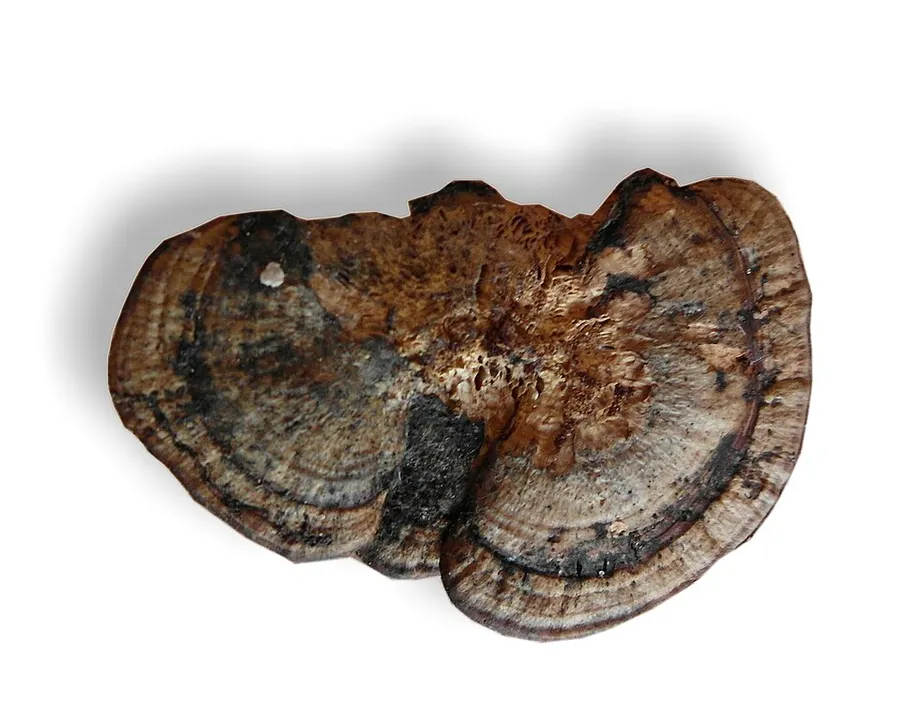
The fruit body of Lenzites warnieri is a flattened, semicircular or two-part cap divided through a small recess. It is resupinate (crust-like), lacks a stipe, and sits directly on the host tree. The cap is 5 – 20 cm wide (very rarely up to 45 cm), 3 – 8 cm wide from the top to the edge and 1 – 2 cm high. The surface of the young fruit bodies has a velvet texture, but it becomes bald and smooth in maturity and produces small humps or warts. The colour is light cream in young fungi and grey in old fungi. The surface is distinctly zoned; the zone edges are furrowed and dark brown to black. The trama has a tough leathery and corky consistency, but is relatively thin and does not show a definite transition to the gills. The gills are ochre or parchment-coloured, bifurcated, and its body is comparatively deep, up to 1 cm. Below the top of the cap, they move maze-like into each other. When stained with cresyl blue, the hyphae turn dark blue, indicating an orthochromatic reaction. The mycelium, which grows in the host tree, is heterothallic and tetrapolar. Lenzites warnieri has a trimitic trama, meaning a tissue comprising generative hyphae, binding hyphae, and skeletal hyphae. While the generative hyphae are responsible for growth, the hardened skeletal hyphae and the thick-walled binding hyphae maintain the stability of the fruit body and provide its corky consistency. The generative hyphae are thin-walled, hyaline, measure 2–3 μm in diameter and have a clamp connection. The binding hyphae are tough, spiral and heavily branched. They are 3–5 μm in diameter and pass over to the skeletal hyphae in the same size.
Habitat dan peran ekologis
Lenzites warnieri populates a large area of the Palaearctic, but is not distributed locally. Early finds were at times not confirmed in later years. Most recent recorded occurrences are in the temperate to sub-mediterranean climatic zones. Because the host spectrum of L. warnieri is broad, its habitat is not determined by the appearance of host plants, but by climatic conditions. Their primary habitat is the southern Central and Northern Europe. They have been rarely found on the 48th latitude, such as on the Upper Rhine Plain. The northern border of their range may be the 18 °C July-isotherm. The southern habitat border comprises the African Atlas Mountains and the bordering regions, and in Asia it proceeds to the 36th latitude. While low temperature on the northern border does not affect its habitat, the fungus may also populate the dry southern border. The southernmost finds were in the High Atlas and the offshore Algeria. Only two finds were detected on the Iberian Peninsula, one from Barcelona and the other from Guadalajara. In France it is distributed in the south, southeast and in the Yonne region. There were two collections on the Upper Rhine in Germany, and towards northwest in Leudelange, Luxembourg.
- Habitat atau konteks temuan
- Informasi belum tersedia pada sumber rilis ini.
- Substrat
- Informasi belum tersedia pada sumber rilis ini.
- Peran atau konteks
- Belum dikategorikan pada rilis ini.
Reproduksi
Cystidia, large cells found on the hymenium, have not been found in this species. Microscopic cell structures of the fungus, which while showing similarities with the cystidia are smaller and thinner, may represent cystidiolae (immature cystidia). The club-shaped basidia each have four 4 μm-long, spore-bearing sterigmata. The basidia have clamps on their bases; they become 15–25 × 5–6 μm large. The hyaline spores are constant or crooked cylindrically. They have thin walls, do not react with Melzer's reagent and measure 7–9 × 3–4 μm.
Catatan identitas dan cakupan
- Nama diterima mengikuti Catalogue of Life Base2026-09-11; uraian mempertahankan konsep dan nama sumber aslinya.
- Original geographic, specimen and life-cycle scope retained; source import awaits individual editorial review.
- Impor dan terjemahan otomatis belum diperiksa editorial per profil. Struktur reproduktif yang disebutkan tidak membuktikan seluruh siklus hidup diketahui.
- Pengukuran pada uraian mengikuti spesimen, kultur, dan metode sumber; angka tidak diperluas ke semua populasi.
Catatan distribusi dalam narasi mengikuti sumbernya. Dokumentasi spesimen atau foto mengikuti catatan sumber. Bukti wilayah Indonesia dan penilaian konservasi tidak disimpulkan dari gambar.
Melihat dengan konteks
Dokumentasi Lenzites warnieri dari Wikimedia Commons. Lenzites warnieri , upper surface. Collected June 4th 2011 from a White Willow ( Salix alba ) at the Danube riverside near Pilismarót, Hungary. Maximum width 7.6 cm, maximum depth 5.0 cm, maximum height 1.4 cm. Identifikasi mengikuti record berkas sumber.
- Jenis
- Fotografi
- Kredit
- Lenzites_warnieri_upper_surface.JPG : Toter Alter Mann derivative work: Regi51 ( talk )
- Lisensi
- CC BY-SA 3.0
- Sumber media
- Buka entri sumber
Sumber profil
- [1] Lenzites warnieri — Wikipedia (en)
- [2] Catalogue of Life Base2026-09-11 — Cellulariella warnieri
- [3] Dokumentasi visual — Lenzites warnieri
Rujukan halaman ini
Fungi. Cellulariella warnieri. Rilis data fungi-2026-10-12-expansion-2. https://fungi-atlas.mgadib.chatgpt.site/jamur/cellulariella-warnieri/.
Status: impor sumber; pemeriksaan editorial per profil belum selesai. Untuk klaim biologis, gunakan rujukan pada bagian terkait dan periksa konteks sumber aslinya.