01 / Morfologi

Ciri dan struktur

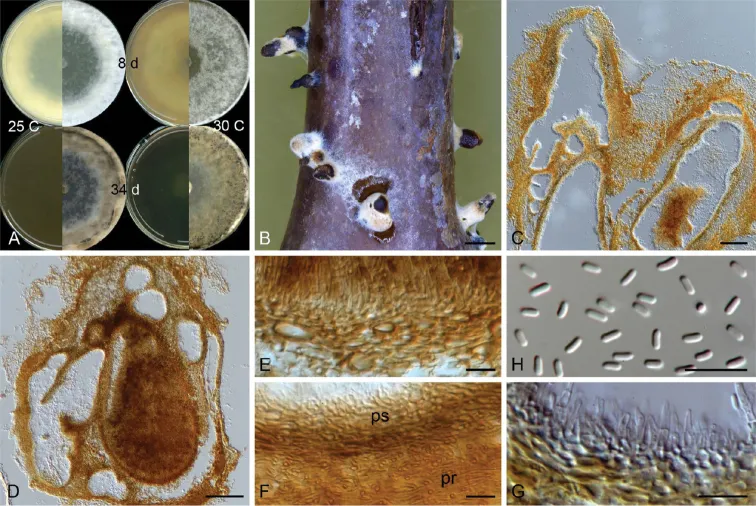
Colonies on 2% MEA, when young, showing circular growth with smooth edges, above white, reverse pale to dark brown (30 °C) and yellow (25 °C); with age, above becoming brown and reverse dark yellow; optimal growth at 30 °C (7.7 mm/d), followed by 25 °C (7.0 mm/d) and 20 °C (4.6 mm/d), minimal growth at 35 °C (0.1 mm/d), no growth at 5 °C; mycelia fluffy, density-sparse in centre, becoming thicker towards the edge, aerial hyphae more abundant at 25 °C than at 30 °C when young.

Sebagian uraian ditampilkan dalam bahasa sumber; terjemahannya belum tersedia atau belum lolos pemeriksaan.

Rujukan: [1]

Pengukuran mengikuti objek, spesimen atau kultur, dan metode yang disebutkan sumber. Baca uraian asli untuk konteks lengkap.

02 / Kehidupan

Habitat dan peran ekologis

Holotype: USA, Hawaii, O’ahu Island, Ho’omaluhia, isolated from bark of Psidium cattleianum, 24 July 2012, J. Roux (PREM 63205; Ex-type culture CMW38360 = CBS 147169); GenBank accession numbers KJ027498 (ITS), KJ027474 (BT1), KJ027483 (TEF1). Paratype: Hawaii, O’ahu Island, Waimea Valley Botanical Gardens, isolated from bark of Syzygium jambos, 23 July 2012, J. Roux (PREM 63206; living culture CMW38368 = CBS 147170).

Sebagian uraian ditampilkan dalam bahasa sumber; terjemahannya belum tersedia atau belum lolos pemeriksaan.

Rujukan: [1]

Habitat atau konteks temuan
kultur yang didokumentasikan
Substrat
Informasi belum tersedia pada sumber rilis ini.
Peran atau konteks
Belum dikategorikan pada rilis ini.
Temukan hubungan serupa
03 / Siklus hidup

Reproduksi

Produced after two months on Eucalyptus stem sections placed on water agar. Conidiomata superficial or with base embedded, singular or gregarious, pulvinate or conical with or without necks, often covered with mycelia, unilocular or multilocular, convoluted, 354–841 µm long, 185–654 µm wide. Conidiomatal wall outer or inter-locular stratum prosenchymatous; inner fertile layers pseudoparenchymatous, composed of several layers of flattened, thick-walled, pigmented cells, 8–19 µm thick. Paraphyses present, rarely observed. Conidiophores produced along inner layer of locule, simple or scarcely branched from basal cell, 8–11 µm long. Conidiogenous cells enteroblastic, lageniform, tapering towards apex, 5–11 × 1–2 µm.

Sebagian uraian ditampilkan dalam bahasa sumber; terjemahannya belum tersedia atau belum lolos pemeriksaan.

Rujukan: [1]

04 / Batas informasi

Catatan identitas dan cakupan

  • Nama diterima mengikuti Catalogue of Life Base2026-09-11; uraian mempertahankan konsep dan nama sumber aslinya.
  • Preserve original treatment localities, hosts and substrate scope. Materials examined describe documented specimens, not the full global range.
  • Impor dan terjemahan otomatis belum diperiksa editorial per profil. Struktur reproduktif yang disebutkan tidak membuktikan seluruh siklus hidup diketahui.
  • Pengukuran pada uraian mengikuti spesimen, kultur, dan metode sumber; angka tidak diperluas ke semua populasi.

Catatan distribusi dalam narasi mengikuti sumbernya. Dokumentasi spesimen atau foto mengikuti catatan sumber. Bukti wilayah Indonesia dan penilaian konservasi tidak disimpulkan dari gambar.

05 / Dokumentasi

Melihat dengan konteks

Micrographs of Celoporthe paradisiaca sp. nov. (holotype: PREM 63205, ex-holotype CBS 147169 = CMW38360) A culture morphology on 2% MEA at 25 °C and 30 °C at 8 and 34 days B conidiomata produced on Eucalytpus stem sections on water agar C, D vertical section of conidioma E inner wall of conidioma F conidiomatal walls (ps, pseudoparenchymatous inner wall; pr, prosenchymatous outer or interlocular wall) G conidiogenous cells H conidia. Scale bars: 1 mm (B); 100 µm (C, D); 10 µm (E–H).

Jenis
Pelat ilmiah
Kredit
Jolanda Roux, Gilbert Kamgan Nkuekam, Seonju Marincowitz, Nicolaas A. van der Merwe, Janice Uchida, Michael J. Wingfield, ShuaiFei Chen
Lisensi
CC BY 4.0
Sumber media
Buka entri sumber

Gambar menunjukkan objek menurut identifikasi sumber, bukan verifikasi independen spesimen oleh Fungi. Tidak ada skala baru yang ditambahkan.

06 / Rujukan

Sumber profil

  1. [1] Cryphonectriaceae associated with rust-infected Syzygium jambos in Hawaii — Celoporthe paradisiacaBagian sumber: PMC7790811_section_31
    Tanggal penghimpunan sumber: 2026-10-12
    Teks sumber: CC BY 4.0 · Roux J, Kamgan Nkuekam G, Marincowitz S, van der Merwe NA, Uchida J, Wingfield MJ, Chen S.
  2. [2] Catalogue of Life Base2026-09-11 — Celoporthe paradisiacaBagian sumber: ColDP NameUsage.tsv ID B2MG9; accepted species; source 2073
    Tanggal penghimpunan sumber: 2026-10-12
  3. [3] Dokumentasi visual — Celoporthe paradisiacaBagian sumber: Individual media record; identification follows the source, not independent determination
    Tanggal penghimpunan sumber: 2026-10-12
    Media sumber: CC BY 4.0 · Jolanda Roux, Gilbert Kamgan Nkuekam, Seonju Marincowitz, Nicolaas A. van der Merwe, Janice Uchida, Michael J. Wingfield, ShuaiFei Chen

Adaptasi teks: CC BY 4.0. Roux J, Kamgan Nkuekam G, Marincowitz S, van der Merwe NA, Uchida J, Wingfield MJ, Chen S. — Cryphonectriaceae associated with rust-infected Syzygium jambos in Hawaii — Celoporthe paradisiaca

Uraian asli dan riwayat sumber

Riwayat atau halaman sumber

Ringkasan sumber

Colonies on 2% MEA, when young, showing circular growth with smooth edges, above white, reverse pale to dark brown (30 °C) and yellow (25 °C); with age, above becoming brown and reverse dark yellow; optimal growth at 30 °C (7.7 mm/d), followed by 25 °C (7.0 mm/d) and 20 °C (4.6 mm/d), minimal growth at 35 °C (0.1 mm/d), no growth at 5 °C; mycelia fluffy, density-sparse in centre, becoming thicker towards the edge, aerial hyphae more abundant at 25 °C than at 30 °C when young.

Revisi sumber

Morfologi sumber

Colonies on 2% MEA, when young, showing circular growth with smooth edges, above white, reverse pale to dark brown (30 °C) and yellow (25 °C); with age, above becoming brown and reverse dark yellow; optimal growth at 30 °C (7.7 mm/d), followed by 25 °C (7.0 mm/d) and 20 °C (4.6 mm/d), minimal growth at 35 °C (0.1 mm/d), no growth at 5 °C; mycelia fluffy, density-sparse in centre, becoming thicker towards the edge, aerial hyphae more abundant at 25 °C than at 30 °C when young.

Revisi sumber

Ekologi sumber

Holotype: USA, Hawaii, O’ahu Island, Ho’omaluhia, isolated from bark of Psidium cattleianum, 24 July 2012, J. Roux (PREM 63205; Ex-type culture CMW38360 = CBS 147169); GenBank accession numbers KJ027498 (ITS), KJ027474 (BT1), KJ027483 (TEF1). Paratype: Hawaii, O’ahu Island, Waimea Valley Botanical Gardens, isolated from bark of Syzygium jambos, 23 July 2012, J. Roux (PREM 63206; living culture CMW38368 = CBS 147170).

Revisi sumber

Struktur reproduksi sumber

Produced after two months on Eucalyptus stem sections placed on water agar. Conidiomata superficial or with base embedded, singular or gregarious, pulvinate or conical with or without necks, often covered with mycelia, unilocular or multilocular, convoluted, 354–841 µm long, 185–654 µm wide. Conidiomatal wall outer or inter-locular stratum prosenchymatous; inner fertile layers pseudoparenchymatous, composed of several layers of flattened, thick-walled, pigmented cells, 8–19 µm thick. Paraphyses present, rarely observed. Conidiophores produced along inner layer of locule, simple or scarcely branched from basal cell, 8–11 µm long. Conidiogenous cells enteroblastic, lageniform, tapering towards apex, 5–11 × 1–2 µm.

Revisi sumber

Rujukan halaman ini

Fungi. Celoporthe paradisiaca. Rilis data fungi-2026-10-12-expansion-2. https://fungi-atlas.mgadib.chatgpt.site/jamur/celoporthe-paradisiaca/.

Status: impor sumber; pemeriksaan editorial per profil belum selesai. Untuk klaim biologis, gunakan rujukan pada bagian terkait dan periksa konteks sumber aslinya.