Ciri dan struktur
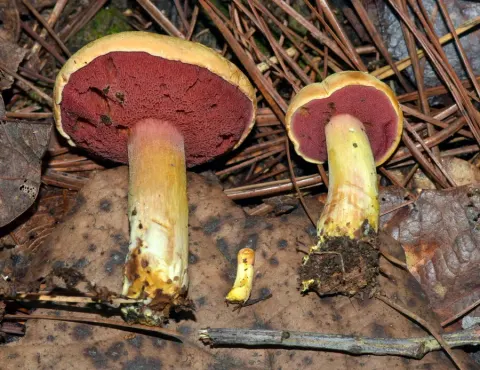
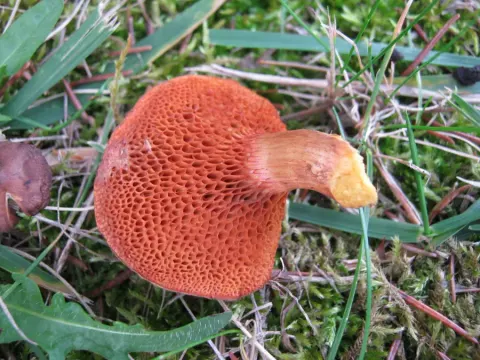
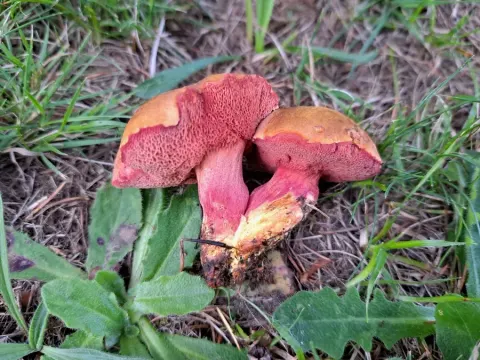
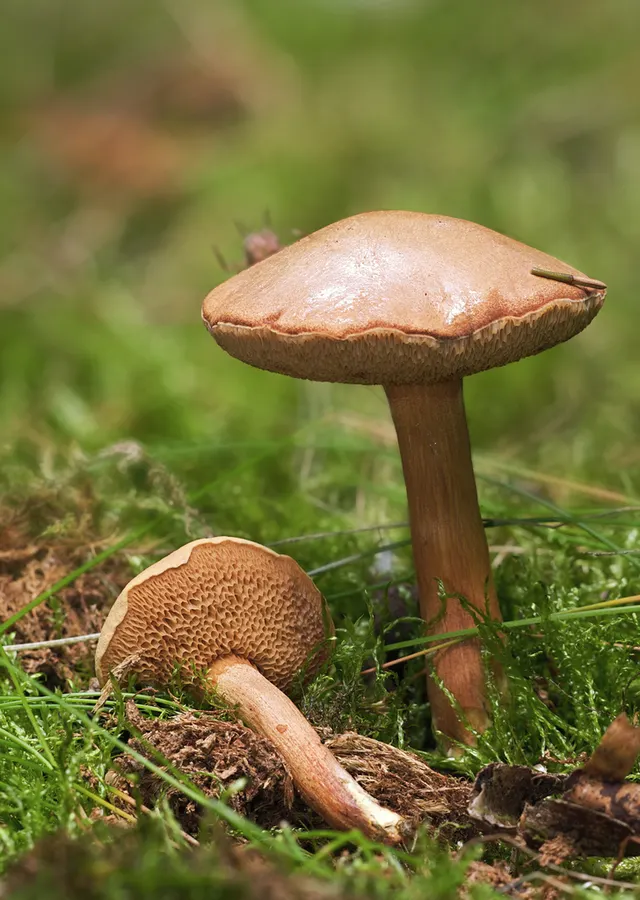
PILEUS: convex to plano-convex, 2-6 cm diam., slightly mucilaginous under wet conditions, otherwise dry, glabrous to subglabrous, brownish orange, yellowish brown, or cinnamon brown; cuticle a thin and rather fragmentary trichodermium overlying interwoven, repent, gelatinised hyphae; margin entire. HYMENOPHORE: tubes to 6mm long, adnate to subdecurrent, yellowish brown to reddish brown at maturity; pores concolorous with tubes or darker reddish brown angular to irregularly angular, often radially elongated near apex of stipe, 0.5-1 mm diam., often toothed. STIPE: 2.5-6 cm long, more or less equal, 3-7 mm diam., solid, dry, subpruinose to subglabrous, sometimes finely reticulate apically, concolorous with or paler than pileus, golden yellow basally; glandulae absent; flesh yellow, often with red tints apically; basal mycelium golden yellow; annulus absent. SPORES: spore print brown (between Prout's Brown and Snuff Brown); spores melleous, elliptic-subfusiform, 7.7-10.5-(14) X 3.1-4.2-(4.8) µm, smooth. HYMENIUM: basidia hyaline, clavate 18-27 X 6-9.5 µm., 4-spored; cystidia sparse, hyaline or encrusted with brown, resinous material, subclavate to ventricose-rostrate, occasionally strangulated, 30-60 X 4.5-7.5 µm. HYMENOPHORAL TRAMA: bilateral, of the Boletus subtype; clamp connections absent. CONTEXT OF PILEUS: sordid white to sordid cream, usually with red tints, unchanging on exposure to air. TASTE: acrid, peppery. SMELL: not distinctive. CHEMICAL REACTIONS: KOH and NH4OH on pileus and context of pileus—no definite or constant reaction.
Habitat dan peran ekologis
Suillus piperatus is an introduced species indigenous to temperate regions of the northern hemisphere. Of the two commonly recognised varieties of this species, var. piperatus and var. amarellus (Quel.) Singer, New Zealand collections agree with the type variety. The possession of a reddish hymenophore is an unusual character among the Suilli. This character, together with the absence of both glandulae and an annulus, led Singer (1938) to erect the section Piperati to accommodate Suillus piperatus. Two further species were later transferred to this section by Singer. Smith and Thiers (1964) excluded sect. Piperati from Suillus on the grounds of a number of features correlated with the reddish hymenophore, but did not suggest an alternative disposition of the section. Suillus piperatus also differs physiologically from other Suillus. Tyler, Benedict, and Stuntz (1965) showed that of the 17 species of Boletaceae tested for urea accumulation, including nine species of Suillus, only S. piperatus showed a moderate level of urea; the remainder were urea-negative. It would be of interest to see whether tests on S. rubinus (W. G. Smith) O. Kuntze and S. rubinellus (Peck) Singer, the remaining two species included in sect.
- Habitat atau konteks temuan
- Informasi belum tersedia pada sumber rilis ini.
- Substrat
- Informasi belum tersedia pada sumber rilis ini.
- Peran atau konteks
- Belum dikategorikan pada rilis ini.
Reproduksi
PILEUS: convex to plano-convex, 2-6 cm diam., slightly mucilaginous under wet conditions, otherwise dry, glabrous to subglabrous, brownish orange, yellowish brown, or cinnamon brown; cuticle a thin and rather fragmentary trichodermium overlying interwoven, repent, gelatinised hyphae; margin entire. HYMENOPHORE: tubes to 6mm long, adnate to subdecurrent, yellowish brown to reddish brown at maturity; pores concolorous with tubes or darker reddish brown angular to irregularly angular, often radially elongated near apex of stipe, 0.5-1 mm diam., often toothed. STIPE: 2.5-6 cm long, more or less equal, 3-7 mm diam., solid, dry, subpruinose to subglabrous, sometimes finely reticulate apically, concolorous with or paler than pileus, golden yellow basally; glandulae absent; flesh yellow, often with red tints apically; basal mycelium golden yellow; annulus absent.
Catatan identitas dan cakupan
- Nama diterima mengikuti Catalogue of Life Base2026-09-11; uraian mempertahankan konsep dan nama sumber aslinya.
- Historical description as cited by BiotaNZ. Preserve explicit New Zealand/locality, host and specimen qualifiers. Distribution is the cited source scope, not a current global range.
- Impor dan terjemahan otomatis belum diperiksa editorial per profil. Struktur reproduktif yang disebutkan tidak membuktikan seluruh siklus hidup diketahui.
- Pengukuran pada uraian mengikuti spesimen, kultur, dan metode sumber; angka tidak diperluas ke semua populasi.
Catatan distribusi dalam narasi mengikuti sumbernya. Dokumentasi spesimen atau foto mengikuti catatan sumber. Bukti wilayah Indonesia dan penilaian konservasi tidak disimpulkan dari gambar.
Melihat dengan konteks
Dokumentasi Chalciporus piperatus menurut asosiasi foto pada record takson iNaturalist. Kredit: Jörg Hempel. Identitas mengikuti sumber; bukan penentuan spesimen independen.
- Jenis
- Fotografi
- Kredit
- (c) Jörg Hempel, some rights reserved (CC BY-SA)
- Lisensi
- CC BY-SA 4.0
- Sumber media
- Buka entri sumber
Dokumentasi tambahan
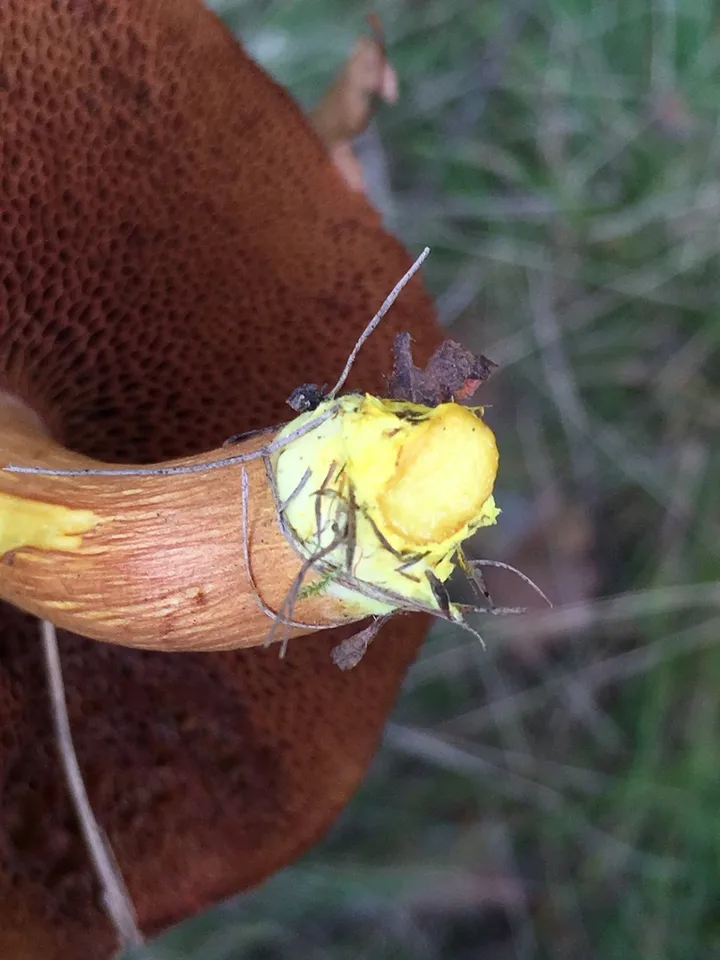
Foto yang diasosiasikan dengan Chalciporus piperatus pada iNaturalist. Identifikasi mengikuti sumber; bukan penentuan spesimen independen.
Kredit dan penggunaan
(c) Paul Cook, some rights reserved (CC BY), uploaded by Paul Cook
Ukuran dan format gambar disesuaikan tanpa pemotongan, retus, atau penambahan skala. Lisensi sumber dipertahankan.
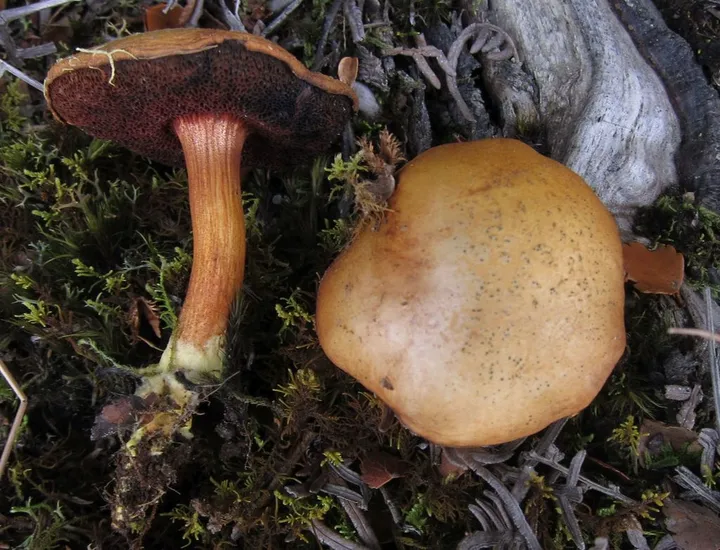
Foto yang diasosiasikan dengan Chalciporus piperatus pada iNaturalist. Identifikasi mengikuti sumber; bukan penentuan spesimen independen.
Kredit dan penggunaan
(c) John Steel, some rights reserved (CC BY), uploaded by John Steel
Ukuran dan format gambar disesuaikan tanpa pemotongan, retus, atau penambahan skala. Lisensi sumber dipertahankan.
Sumber profil
- [1] McNabb, R.F.R. 1968: The Boletaceae of New Zealand. New Zealand Journal of Botany 6(2): 137-176. — Suillus piperatus
- [2] Catalogue of Life Base2026-09-11 — Chalciporus piperatus
- [3] Dokumentasi visual — Chalciporus piperatus
- [4] Dokumentasi visual — Chalciporus piperatus
- [5] Dokumentasi visual — Chalciporus piperatus
Rujukan halaman ini
Fungi. Chalciporus piperatus. Rilis data fungi-2026-10-12-expansion-2. https://fungi-atlas.mgadib.chatgpt.site/jamur/chalciporus-piperatus/.
Status: impor sumber; pemeriksaan editorial per profil belum selesai. Untuk klaim biologis, gunakan rujukan pada bagian terkait dan periksa konteks sumber aslinya.