01 / Morfologi

Ciri dan struktur

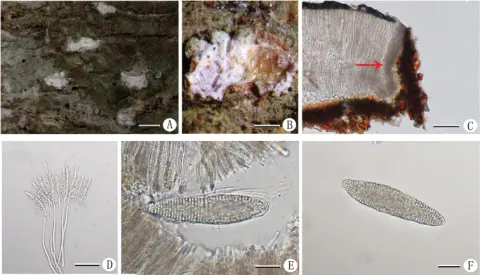
The lichen forms a grey-olive crust (thallus) that can exceed 7 cm across and is only 30–70 micrometre (μm) thick. Its surface is smooth to slightly uneven, underlain by a dense, tissue-like whose layers have begun to split internally. Numerous discrete soralia, each 1–2 mm wide, erupt through the surface; they are cap-shaped, finely powdery and white to bluish-white or yellowish-white, standing out sharply against the darker background. Microscopic sections show clusters of calcium oxalate crystals scattered through the or medulla. The is a filamentous green alga of the genus Trentepohlia. Fruiting bodies are rounded to angular apothecia that break through the thallus () and reach up to 5 mm across, though most are 1–3 mm. Their are exposed, flesh-coloured to pink-purple, and surrounded by a lobed, sometimes layered margin that is pale beige when young. The supporting consists of colourless, brick-like cells, and short sterile filaments () line the ostiole. The hymenium is 150–200 μm tall; within it run simple, unbranched paraphyses. Each ascus contains two to four large ascospores that are cylindrical, colourless and divided by 15–19 internal cross-walls; they measure 60–120 × 10–15 μm and stain violet-blue with iodine, indicating an amyloid wall layer. Thin-layer chromatography detects stictic acid and related compounds, which produce a yellow reaction with potassium hydroxide solution (K+ yellow).

Sebagian uraian ditampilkan dalam bahasa sumber; terjemahannya belum tersedia atau belum lolos pemeriksaan.

Rujukan: [1]

Pengukuran mengikuti objek, spesimen atau kultur, dan metode yang disebutkan sumber. Baca uraian asli untuk konteks lengkap.

02 / Kehidupan

Habitat dan peran ekologis

Chapsa thallotrema appears to be widespread across the Neotropical realm, with confirmed collections from Panamá, Costa Rica, Brazil, Venezuela, and Bolivia, and earlier, unpublished records from the wider Caribbean. Specimens come from the shaded trunks of large trees in lowland to lower-montane rainforest, between about 500 and 800 m elevation.

Sebagian uraian ditampilkan dalam bahasa sumber; terjemahannya belum tersedia atau belum lolos pemeriksaan.

Rujukan: [1]

Habitat atau konteks temuan
Informasi belum tersedia pada sumber rilis ini.
Substrat
Informasi belum tersedia pada sumber rilis ini.
Peran atau konteks
Pembentuk liken
Temukan hubungan serupa
03 / Siklus hidup

Reproduksi

Fruiting bodies are rounded to angular apothecia that break through the thallus () and reach up to 5 mm across, though most are 1–3 mm. Their are exposed, flesh-coloured to pink-purple, and surrounded by a lobed, sometimes layered margin that is pale beige when young. The supporting consists of colourless, brick-like cells, and short sterile filaments () line the ostiole. The hymenium is 150–200 μm tall; within it run simple, unbranched paraphyses. Each ascus contains two to four large ascospores that are cylindrical, colourless and divided by 15–19 internal cross-walls; they measure 60–120 × 10–15 μm and stain violet-blue with iodine, indicating an amyloid wall layer. Thin-layer chromatography detects stictic acid and related compounds, which produce a yellow reaction with potassium hydroxide solution (K+ yellow).

Sebagian uraian ditampilkan dalam bahasa sumber; terjemahannya belum tersedia atau belum lolos pemeriksaan.

Rujukan: [1]

04 / Batas informasi

Catatan identitas dan cakupan

  • Nama diterima mengikuti Catalogue of Life Base2026-09-11; uraian mempertahankan konsep dan nama sumber aslinya.
  • Original geographic, specimen and life-cycle scope retained; source import awaits individual editorial review.
  • Impor dan terjemahan otomatis belum diperiksa editorial per profil. Struktur reproduktif yang disebutkan tidak membuktikan seluruh siklus hidup diketahui.
  • Pengukuran pada uraian mengikuti spesimen, kultur, dan metode sumber; angka tidak diperluas ke semua populasi.

Catatan distribusi dalam narasi mengikuti sumbernya. Dokumentasi spesimen atau foto mengikuti catatan sumber. Bukti wilayah Indonesia dan penilaian konservasi tidak disimpulkan dari gambar.

05 / Dokumentasi

Melihat dengan konteks

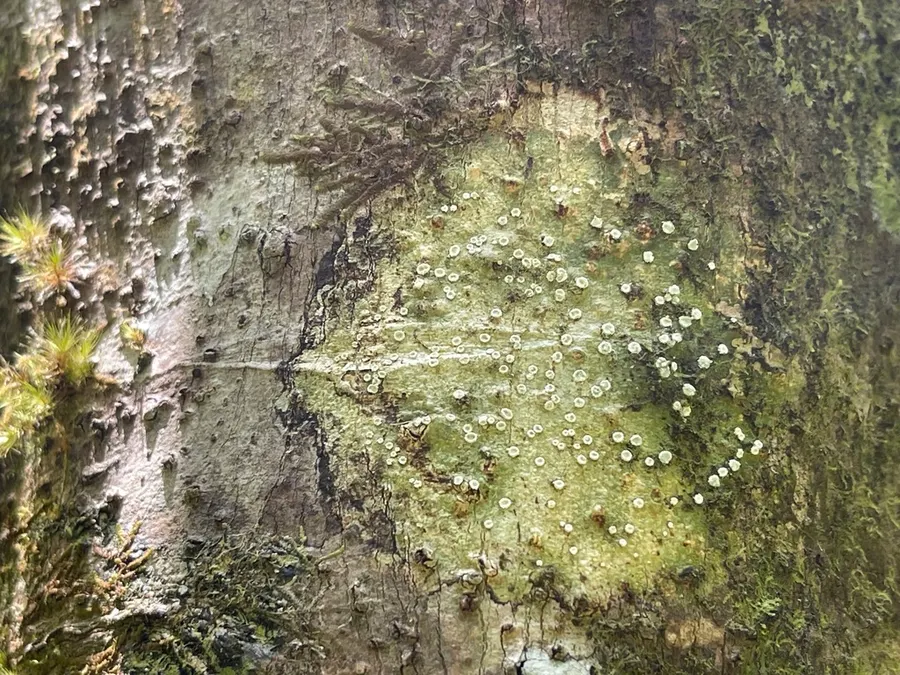
Dokumentasi Chapsa thallotrema menurut asosiasi foto pada record takson iNaturalist. Kredit: Serenella Linares. Identitas mengikuti sumber; bukan penentuan spesimen independen.

Jenis
Fotografi
Kredit
(c) Serenella Linares, some rights reserved (CC BY), uploaded by Serenella Linares
Lisensi
CC BY 4.0
Sumber media
Buka entri sumber

Gambar menunjukkan objek menurut identifikasi sumber, bukan verifikasi independen spesimen oleh Fungi. Tidak ada skala baru yang ditambahkan.

06 / Rujukan

Sumber profil

  1. [1] Chapsa thallotrema — Wikipedia (en)Bagian sumber: Frozen revision 1305107763
    Tanggal penghimpunan sumber: 2026-10-12
    Teks sumber: CC BY-SA4.0 · Wikipedia contributors
  2. [2] Catalogue of Life Base2026-09-11 — Chapsa thallotremaBagian sumber: ColDP NameUsage.tsv ID TMJY; accepted species; source 2073
    Tanggal penghimpunan sumber: 2026-10-12
  3. [3] Dokumentasi visual — Chapsa thallotremaBagian sumber: Individual media record; identification follows the source, not independent determination
    Tanggal penghimpunan sumber: 2026-10-12
    Media sumber: CC BY 4.0 · (c) Serenella Linares, some rights reserved (CC BY), uploaded by Serenella Linares

Adaptasi teks: CC BY-SA 4.0. Wikipedia contributors — Chapsa thallotrema — Wikipedia (en)

Uraian asli dan riwayat sumber

Riwayat atau halaman sumber

Ringkasan sumber

Chapsa thallotrema is a species of lichen in the family Graphidaceae. The lichen forms grey-olive crusts on tree bark marked by distinctive white to bluish-white powdery patches that stand out against the darker background. It appears to be widespread across the Neotropics, with confirmed records from Panama, Costa Rica, Brazil, Venezuela, and Bolivia.

Revisi sumber

Morfologi sumber

The lichen forms a grey-olive crust (thallus) that can exceed 7 cm across and is only 30–70 micrometre (μm) thick. Its surface is smooth to slightly uneven, underlain by a dense, tissue-like whose layers have begun to split internally. Numerous discrete soralia, each 1–2 mm wide, erupt through the surface; they are cap-shaped, finely powdery and white to bluish-white or yellowish-white, standing out sharply against the darker background. Microscopic sections show clusters of calcium oxalate crystals scattered through the or medulla. The is a filamentous green alga of the genus Trentepohlia. Fruiting bodies are rounded to angular apothecia that break through the thallus () and reach up to 5 mm across, though most are 1–3 mm. Their are exposed, flesh-coloured to pink-purple, and surrounded by a lobed, sometimes layered margin that is pale beige when young. The supporting consists of colourless, brick-like cells, and short sterile filaments () line the ostiole. The hymenium is 150–200 μm tall; within it run simple, unbranched paraphyses. Each ascus contains two to four large ascospores that are cylindrical, colourless and divided by 15–19 internal cross-walls; they measure 60–120 × 10–15 μm and stain violet-blue with iodine, indicating an amyloid wall layer. Thin-layer chromatography detects stictic acid and related compounds, which produce a yellow reaction with potassium hydroxide solution (K+ yellow).

Revisi sumber

Ekologi sumber

Chapsa thallotrema appears to be widespread across the Neotropical realm, with confirmed collections from Panamá, Costa Rica, Brazil, Venezuela, and Bolivia, and earlier, unpublished records from the wider Caribbean. Specimens come from the shaded trunks of large trees in lowland to lower-montane rainforest, between about 500 and 800 m elevation.

Revisi sumber

Struktur reproduksi sumber

Fruiting bodies are rounded to angular apothecia that break through the thallus () and reach up to 5 mm across, though most are 1–3 mm. Their are exposed, flesh-coloured to pink-purple, and surrounded by a lobed, sometimes layered margin that is pale beige when young. The supporting consists of colourless, brick-like cells, and short sterile filaments () line the ostiole. The hymenium is 150–200 μm tall; within it run simple, unbranched paraphyses. Each ascus contains two to four large ascospores that are cylindrical, colourless and divided by 15–19 internal cross-walls; they measure 60–120 × 10–15 μm and stain violet-blue with iodine, indicating an amyloid wall layer. Thin-layer chromatography detects stictic acid and related compounds, which produce a yellow reaction with potassium hydroxide solution (K+ yellow).

Revisi sumber

Rujukan halaman ini

Fungi. Chapsa thallotrema. Rilis data fungi-2026-10-12-expansion-2. https://fungi-atlas.mgadib.chatgpt.site/jamur/chapsa-thallotrema/.

Status: impor sumber; pemeriksaan editorial per profil belum selesai. Untuk klaim biologis, gunakan rujukan pada bagian terkait dan periksa konteks sumber aslinya.