Ciri dan struktur
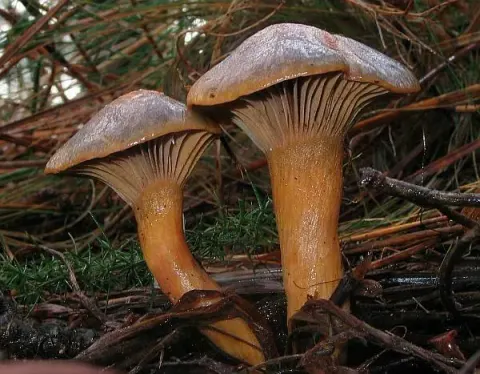
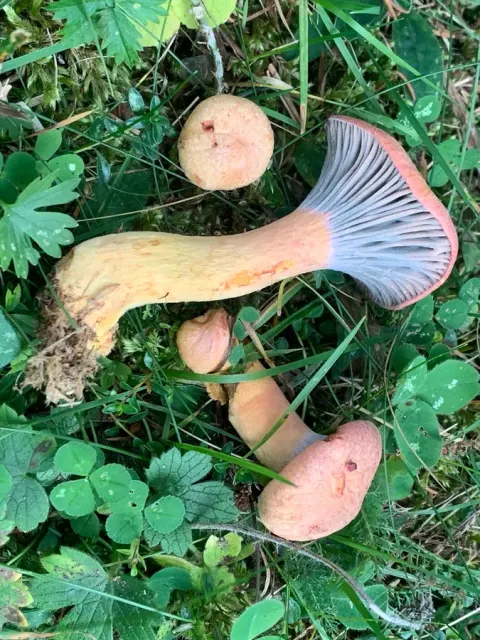
Differs from Chroogomphus roseolus by the pileal trama that is inamyloid in Melzer’s reagent and by the presence of pileocystidia and caulocystidia. Basidiomata small to medium-sized, Pileus 0.5–3.5 cm in diameter, hemispherical, obtusely conic when young, expanding convex to broadly convex with maturity, margin inrolled initially becoming decurved, surface rough, pruinose, yellowish-orange to reddish-brown (7.5YR8/8–2.5YR4/8). Lamellae decurrent, sub-distant to distant, regular, broad up to 0.5 cm, forked near margin, light yellowish-orange (10YR,8/3), gill margins even, smooth, lamellulae in 2 tiers, alternating with lamellae. Stipe up to 4 cm long, central, pruinose, yellowish-orange to reddish-brown (7.5YR8/8–2.5YR4/8) in colour, rough, with tawny basal mycelium, more or less equal to broader towards base, universal and partial veil absent. Odour and taste not recorded. Basidiospores [60/3/3], (11–)15–19(–21) × (4–)4.5–8(–8.5) µm, avl × avw = 16.5 × 6.5 µm, Q = (2.2–)2.3–3.4(–3.5), avQ = 2.64±0.43 µm, pale yellow to pale grey-brown in KOH, elongate to somewhat ellipsoid, slightly thick–walled, apiculate, dextrinoid, mostly mono-guttulate, germ pore absent. Basidia 37–53 × 7–13 µm, avl × avw = 41 × 11 µm, hyaline in 5% KOH, clavate, clamped at base, four-spored. Lamellar trama made up of hyphae, 3–6 µm, yellowish in KOH, encrusted, hyphae inamyloid with no or slightly amyloid encrustations, non-dextrenoid. Pleurocystidia 87–112 × 15–23 µm, avl × avw = 93 × 18 µm, hyaline with pale yellow walls in KOH, abundant, encrusted. Cheilocystidia similar to pleurocystidia but slightly smaller.
Habitat dan peran ekologis
Chroogomphus pruinosus differs from all other members of the genus in having pileocystidia. This new species is phylogenetically most closely related to C. roseolus, a species that has been reported from China and Pakistan (Li et al. 2009; Razaq et al. 2016). The macro- and micro-morphology of C. pruinosus is different from C. roseolus in the following characters: C. pruinosus possesses an obtusely conic to broadly convex, yellowish-orange, pruinose, larger pileus; presence of pileocystidia and caulocystidia in C. pruinosus; and the pileal and lamellar trama and stipitipellis of C. pruinosus are inamyloid, whereas those of C. roseolus are amyloid or partially amyloid (Li et al. 2009; Razaq et al. 2016). Chroogomphus helveticus is another close relative of C. pruinosus and has also been reported from China and Pakistan (Li et al. 2009; Razaq et al. 2016). However, no herbarium specimens are available for the Pakistani reports of C. helveticus (Ahmad et al. 1997) and it is likely that these collections represent C. roseolus, as discussed by Razaq et al. (2016). Chroogomphus roseolus is an Asian native species, whereas reports of C. heleveticus have so far only been confirmed in Europe, generally in association with 5-needle pines – mostly Pinus cembra (Li et al. 2009), which does not occur in Pakistan.
- Habitat atau konteks temuan
- Informasi belum tersedia pada sumber rilis ini.
- Substrat
- Informasi belum tersedia pada sumber rilis ini.
- Peran atau konteks
- Belum dikategorikan pada rilis ini.
Reproduksi
Basidiomata small to medium-sized, Pileus 0.5–3.5 cm in diameter, hemispherical, obtusely conic when young, expanding convex to broadly convex with maturity, margin inrolled initially becoming decurved, surface rough, pruinose, yellowish-orange to reddish-brown (7.5YR8/8–2.5YR4/8). Lamellae decurrent, sub-distant to distant, regular, broad up to 0.5 cm, forked near margin, light yellowish-orange (10YR,8/3), gill margins even, smooth, lamellulae in 2 tiers, alternating with lamellae. Stipe up to 4 cm long, central, pruinose, yellowish-orange to reddish-brown (7.5YR8/8–2.5YR4/8) in colour, rough, with tawny basal mycelium, more or less equal to broader towards base, universal and partial veil absent.
Catatan identitas dan cakupan
- Nama diterima mengikuti Catalogue of Life Base2026-09-11; uraian mempertahankan konsep dan nama sumber aslinya.
- Preserve original treatment localities, hosts and substrate scope. Materials examined describe documented specimens, not the full global range.
- Impor dan terjemahan otomatis belum diperiksa editorial per profil. Struktur reproduktif yang disebutkan tidak membuktikan seluruh siklus hidup diketahui.
- Pengukuran pada uraian mengikuti spesimen, kultur, dan metode sumber; angka tidak diperluas ke semua populasi.
Catatan distribusi dalam narasi mengikuti sumbernya. Dokumentasi spesimen atau foto mengikuti catatan sumber. Bukti wilayah Indonesia dan penilaian konservasi tidak disimpulkan dari gambar.
Melihat dengan konteks
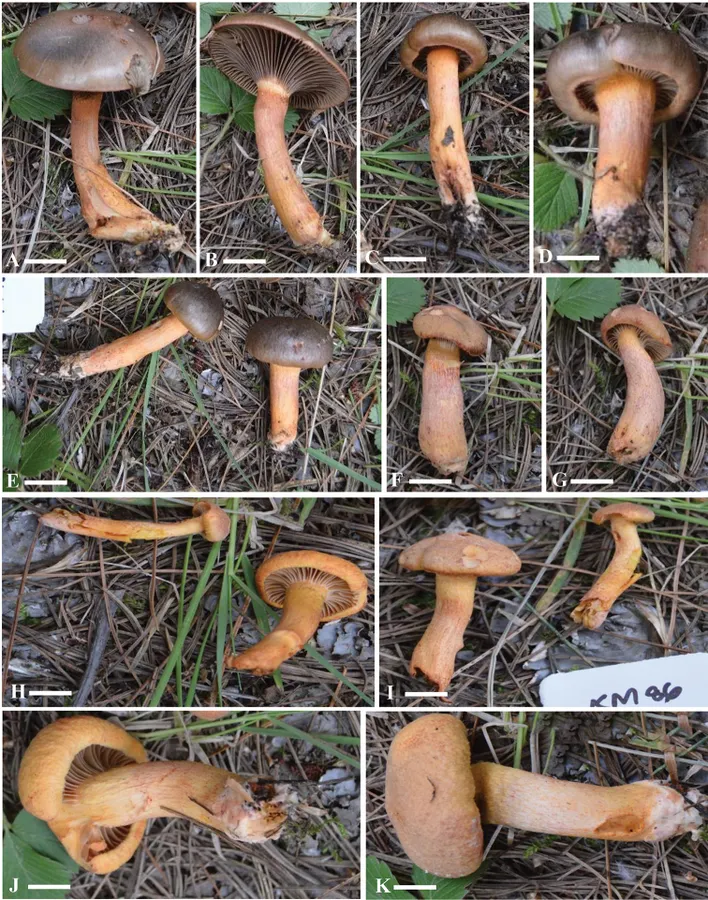
Basidiomata of Chroogomphus spp. A–E Chroogomphus pakistanicus A, B LAH35889, holotype C–E LAH35890 F–K Chroogomphus pruinosus F, G LAH35887 H, I LAH35888; J, K LAH35886, holotype. Scale bars: 1 cm.
- Jenis
- Pelat ilmiah
- Kredit
- Munazza Kiran, Ammara Sattar, Khushbakht Zamir, Danny Haelewaters, Abdul Nasir Khalid
- Lisensi
- CC BY 4.0
- Sumber media
- Buka entri sumber
Dokumentasi tambahan
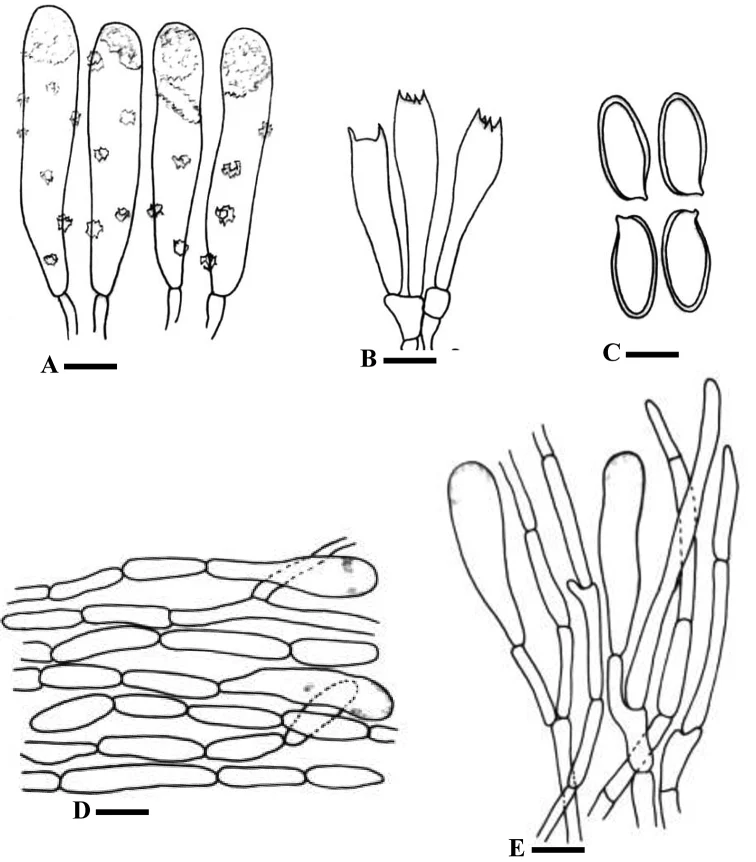
Line drawings of Chroogomphus pruinosus. A Basidia B Cystidia C Basidiospores D Pileipellis hyphae E Stipitipellis hyphae. Scale bars: 17.5 µm (A), 12 µm (B), 8 µm (C), 26.5 µm (D), 45 µm (E).
Kredit dan penggunaan
Munazza Kiran, Ammara Sattar, Khushbakht Zamir, Danny Haelewaters, Abdul Nasir Khalid
Ukuran dan format gambar disesuaikan tanpa pemotongan, retus, atau penambahan skala. Lisensi sumber dipertahankan.
Sumber profil
- [1] Additions to the genus Chroogomphus (Boletales, Gomphidiaceae) from Pakistan — Chroogomphus pruinosus
- [2] Catalogue of Life Base2026-09-11 — Chroogomphus pruinosus
- [3] Dokumentasi visual — Chroogomphus pruinosus
- [4] Dokumentasi visual — Chroogomphus pruinosus
Rujukan halaman ini
Fungi. Chroogomphus pruinosus. Rilis data fungi-2026-10-12-expansion-2. https://fungi-atlas.mgadib.chatgpt.site/jamur/chroogomphus-pruinosus/.
Status: impor sumber; pemeriksaan editorial per profil belum selesai. Untuk klaim biologis, gunakan rujukan pada bagian terkait dan periksa konteks sumber aslinya.