01 / Morfologi

Ciri dan struktur

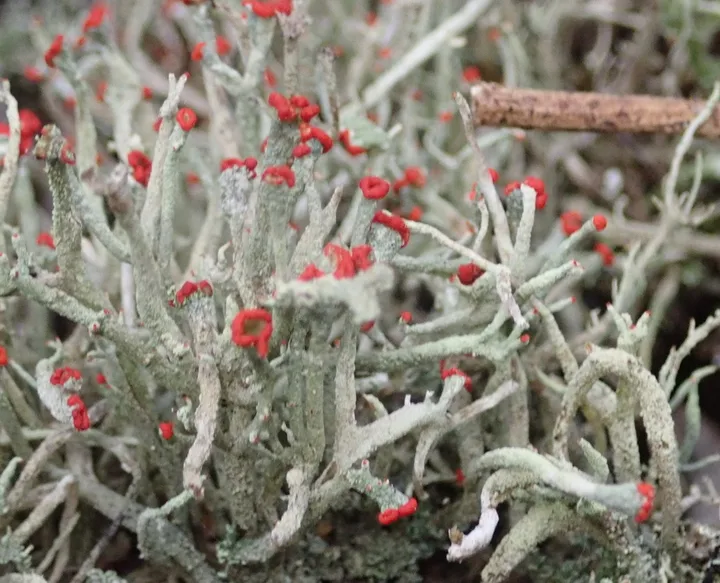
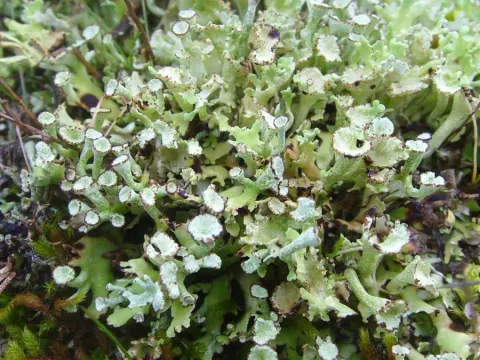
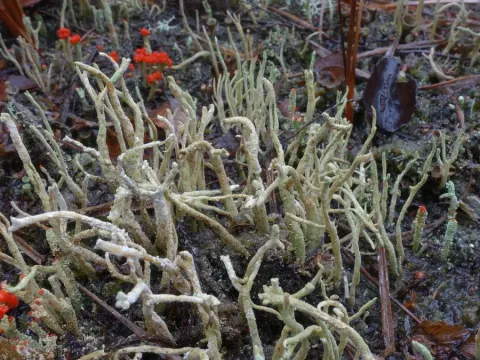
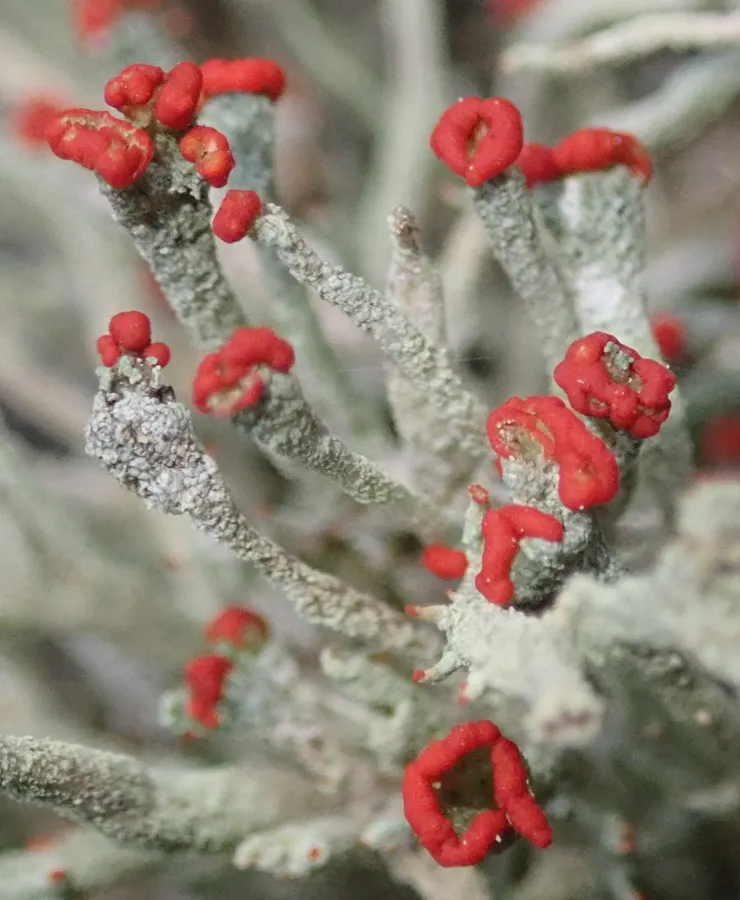
The of Cladonia floerkeana is persistent, made up of small, lobed (scales) that measure 1–3 mm in length and 1–2 mm in width. These squamules are esorediate, meaning they lack powdery reproductive structures known as soredia. The basal squamules are small, persistent, and often inconspicuous, with an orange tinge toward the base of the lower surface. The secondary structures, or podetia, are frequent and grow up to 2 cm tall but are often shorter. They are pale to dark grey, with a brownish tinge in exposed sites. The podetia may remain unbranched or branch sparingly near the apices. Their surface is highly variable: they may be entirely corticate, partially decorticate (especially toward the apices), granular-sorediate in patches, or densely squamulose throughout. They have been described as resembling "scraggly white fingers with lumpy surfaces". The surface of the podetia is usually (covered in a thin fungal layer), with occasional or small scales. Microscopically, the podetial wall has several distinct layers: an upper of densely packed hyphae, an containing round or shriveled algal cells loosely associated with hyphae, and a medullary layer made up of loosely interwoven hyphal threads forming a fibrous network. The development of soredia, non-corticated clumps of algae and hyphae, begins in the medulla and algal layers and proceeds through cracks in the cortex, providing a common method of vegetative propagation. Cladonia floerkeana produces conidiomata (small asexual reproductive structures) typically on the primary squamules and occasionally at the tips of podetia. These structures are black, often with red areas around the opening (ostiole), and contain a characteristic red slime.

Sebagian uraian ditampilkan dalam bahasa sumber; terjemahannya belum tersedia atau belum lolos pemeriksaan.

Rujukan: [1]

Pengukuran mengikuti objek, spesimen atau kultur, dan metode yang disebutkan sumber. Baca uraian asli untuk konteks lengkap.

02 / Kehidupan

Habitat dan peran ekologis

Cladonia floerkeana has a broad but patchy distribution, with records from multiple continents. In Honduras, it is rare and has been observed growing on wooden fences, suggesting it may be frequently overlooked in this region. The species is also found in Chile, where it is considered very rare, and in eastern North America, ranging from Florida (very rare) to Newfoundland. In Europe and Australasia, its presence has been confirmed, though the full extent of its distribution is poorly understood, partly due to confusion with the similar species Cladonia macilenta. Additional records indicate its presence in Melanesia, including Papua New Guinea, as well as in regions of North and South America, Europe, Africa, Asia (e.g., Japan and Taiwan), and Oceania, including New Caledonia, Australia, and New Zealand. The species grows in nutrient-poor acidic soils and is commonly found in habitats such as heathlands, boreal forests, and areas recovering from disturbance, including post-fire landscapes. It grows on a variety of , including soil, humus, rocks, and sand, and is occasionally found on decaying wood. It has been observed in geothermal vent areas in Japan, where it tolerates extreme conditions, including high surface temperatures (above 40°C), root-zone temperatures exceeding 70°C, and soil pH levels between 5 and 5.5.

Sebagian uraian ditampilkan dalam bahasa sumber; terjemahannya belum tersedia atau belum lolos pemeriksaan.

Rujukan: [1]

Habitat atau konteks temuan
hutan
Substrat
kayu
Peran atau konteks
Pembentuk liken
Temukan hubungan serupa
03 / Siklus hidup

Reproduksi

The of Cladonia floerkeana is persistent, made up of small, lobed (scales) that measure 1–3 mm in length and 1–2 mm in width. These squamules are esorediate, meaning they lack powdery reproductive structures known as soredia. The basal squamules are small, persistent, and often inconspicuous, with an orange tinge toward the base of the lower surface. The secondary structures, or podetia, are frequent and grow up to 2 cm tall but are often shorter. They are pale to dark grey, with a brownish tinge in exposed sites. The podetia may remain unbranched or branch sparingly near the apices. Their surface is highly variable: they may be entirely corticate, partially decorticate (especially toward the apices), granular-sorediate in patches, or densely squamulose throughout.

Sebagian uraian ditampilkan dalam bahasa sumber; terjemahannya belum tersedia atau belum lolos pemeriksaan.

Rujukan: [1]

Sinonim menurut acuan taksonomi rilis: Cenomyce bacillaris f. carcata; Cenomyce carcata; Cladonia bacillaris var. carcata; Cladonia bellidiflora var. floerkeana; Cladonia carcata; Cladonia digitata f. carcata; Cladonia floerkeana f. carcata; Cladonia floerkeana f. intermedia; Cladonia floerkeana var. carcata; Cladonia floerkeana var. intermedia; Cladonia floerkeana var. trachypoda; Cladonia macilenta f. carcata; Cladonia macilenta f. intermedia; Cladonia macilenta subf. trachypoda; Cladonia macilenta subsp. floerkeana; Cladonia macilenta var. carcata; Cladonia macilenta var. floerkeana; Patellaria floerkeana
04 / Batas informasi

Catatan identitas dan cakupan

  • Nama diterima mengikuti Catalogue of Life Base2026-09-11; uraian mempertahankan konsep dan nama sumber aslinya.
  • Original geographic, specimen and life-cycle scope retained; source import awaits individual editorial review.
  • Impor dan terjemahan otomatis belum diperiksa editorial per profil. Struktur reproduktif yang disebutkan tidak membuktikan seluruh siklus hidup diketahui.
  • Pengukuran pada uraian mengikuti spesimen, kultur, dan metode sumber; angka tidak diperluas ke semua populasi.

Catatan distribusi dalam narasi mengikuti sumbernya. Dokumentasi spesimen atau foto mengikuti catatan sumber. Bukti wilayah Indonesia dan penilaian konservasi tidak disimpulkan dari gambar.

05 / Dokumentasi

Melihat dengan konteks

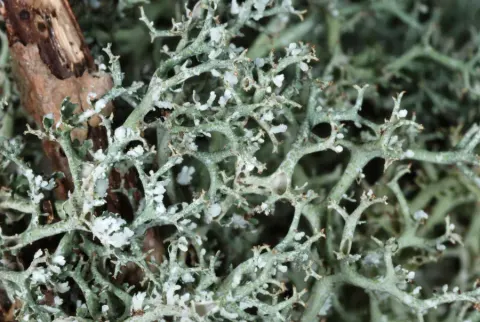
Dokumentasi Cladonia floerkeana menurut asosiasi foto pada record takson iNaturalist. Kredit: Nicola van Berkel. Identitas mengikuti sumber; bukan penentuan spesimen independen.

Jenis
Fotografi
Kredit
(c) Nicola van Berkel, some rights reserved (CC BY-SA), uploaded by Nicola van Berkel
Sumber media
Buka entri sumber

Gambar menunjukkan objek menurut identifikasi sumber, bukan verifikasi independen spesimen oleh Fungi. Tidak ada skala baru yang ditambahkan.

Dokumentasi tambahan

06 / Rujukan

Sumber profil

  1. [1] Cladonia floerkeana — Wikipedia (en)Bagian sumber: Frozen revision 1364547964
    Tanggal penghimpunan sumber: 2026-10-12
    Teks sumber: CC BY-SA4.0 · Wikipedia contributors
  2. [2] Catalogue of Life Base2026-09-11 — Cladonia floerkeanaBagian sumber: ColDP NameUsage.tsv ID VPFF; accepted species; source 2073
    Tanggal penghimpunan sumber: 2026-10-12
  3. [3] Dokumentasi visual — Cladonia floerkeanaBagian sumber: Identitas mengikuti sumber dokumentasi; bukan penentuan spesimen independen.
    Tanggal penghimpunan sumber: 2026-10-17
    Media sumber: CC BY-SA 4.0 · (c) Nicola van Berkel, some rights reserved (CC BY-SA), uploaded by Nicola van Berkel
  4. [4] Dokumentasi visual — Cladonia floerkeanaBagian sumber: Identitas mengikuti sumber dokumentasi; bukan penentuan spesimen independen.
    Tanggal penghimpunan sumber: 2026-10-17
    Teks sumber: CC BY-SA 4.0 · (c) Nicola van Berkel, some rights reserved (CC BY-SA), uploaded by Nicola van Berkel

Adaptasi teks: CC BY-SA 4.0. Wikipedia contributors — Cladonia floerkeana — Wikipedia (en)

Uraian asli dan riwayat sumber

Riwayat atau halaman sumber

Ringkasan sumber

Cladonia floerkeana is a species of fruticose lichen in the family Cladoniaceae. The species produces distinctive bright red spore-bearing structures (apothecia) on thin, upright stalks (podetia) that can be variably branched. These stalks may be smooth, rough, or covered in tiny scales. The species was first described by Elias Magnus Fries in 1824 as Cenomyce floerkeana and later transferred to the genus Cladonia by Heinrich Gustav Flörke in 1828. C. floerkeana is closely related to Cladonia macilenta, from which it is distinguished by its lack of soredia and its chemical properties.

Revisi sumber

Morfologi sumber

The of Cladonia floerkeana is persistent, made up of small, lobed (scales) that measure 1–3 mm in length and 1–2 mm in width. These squamules are esorediate, meaning they lack powdery reproductive structures known as soredia. The basal squamules are small, persistent, and often inconspicuous, with an orange tinge toward the base of the lower surface. The secondary structures, or podetia, are frequent and grow up to 2 cm tall but are often shorter. They are pale to dark grey, with a brownish tinge in exposed sites. The podetia may remain unbranched or branch sparingly near the apices. Their surface is highly variable: they may be entirely corticate, partially decorticate (especially toward the apices), granular-sorediate in patches, or densely squamulose throughout. They have been described as resembling "scraggly white fingers with lumpy surfaces". The surface of the podetia is usually (covered in a thin fungal layer), with occasional or small scales. Microscopically, the podetial wall has several distinct layers: an upper of densely packed hyphae, an containing round or shriveled algal cells loosely associated with hyphae, and a medullary layer made up of loosely interwoven hyphal threads forming a fibrous network. The development of soredia, non-corticated clumps of algae and hyphae, begins in the medulla and algal layers and proceeds through cracks in the cortex, providing a common method of vegetative propagation. Cladonia floerkeana produces conidiomata (small asexual reproductive structures) typically on the primary squamules and occasionally at the tips of podetia. These structures are black, often with red areas around the opening (ostiole), and contain a characteristic red slime.

Revisi sumber

Ekologi sumber

Cladonia floerkeana has a broad but patchy distribution, with records from multiple continents. In Honduras, it is rare and has been observed growing on wooden fences, suggesting it may be frequently overlooked in this region. The species is also found in Chile, where it is considered very rare, and in eastern North America, ranging from Florida (very rare) to Newfoundland. In Europe and Australasia, its presence has been confirmed, though the full extent of its distribution is poorly understood, partly due to confusion with the similar species Cladonia macilenta. Additional records indicate its presence in Melanesia, including Papua New Guinea, as well as in regions of North and South America, Europe, Africa, Asia (e.g., Japan and Taiwan), and Oceania, including New Caledonia, Australia, and New Zealand. The species grows in nutrient-poor acidic soils and is commonly found in habitats such as heathlands, boreal forests, and areas recovering from disturbance, including post-fire landscapes. It grows on a variety of , including soil, humus, rocks, and sand, and is occasionally found on decaying wood. It has been observed in geothermal vent areas in Japan, where it tolerates extreme conditions, including high surface temperatures (above 40°C), root-zone temperatures exceeding 70°C, and soil pH levels between 5 and 5.5.

Revisi sumber

Struktur reproduksi sumber

The of Cladonia floerkeana is persistent, made up of small, lobed (scales) that measure 1–3 mm in length and 1–2 mm in width. These squamules are esorediate, meaning they lack powdery reproductive structures known as soredia. The basal squamules are small, persistent, and often inconspicuous, with an orange tinge toward the base of the lower surface. The secondary structures, or podetia, are frequent and grow up to 2 cm tall but are often shorter. They are pale to dark grey, with a brownish tinge in exposed sites. The podetia may remain unbranched or branch sparingly near the apices. Their surface is highly variable: they may be entirely corticate, partially decorticate (especially toward the apices), granular-sorediate in patches, or densely squamulose throughout.

Revisi sumber

Rujukan halaman ini

Fungi. Cladonia floerkeana. Rilis data fungi-2026-10-12-expansion-2. https://fungi-atlas.mgadib.chatgpt.site/jamur/cladonia-floerkeana/.

Status: impor sumber; pemeriksaan editorial per profil belum selesai. Untuk klaim biologis, gunakan rujukan pada bagian terkait dan periksa konteks sumber aslinya.