Ciri dan struktur
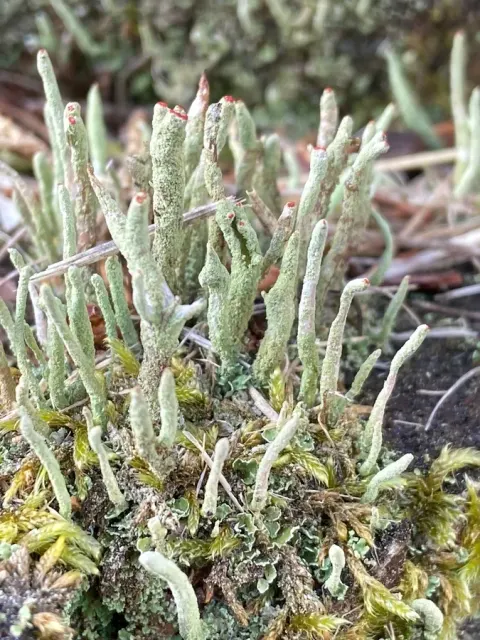
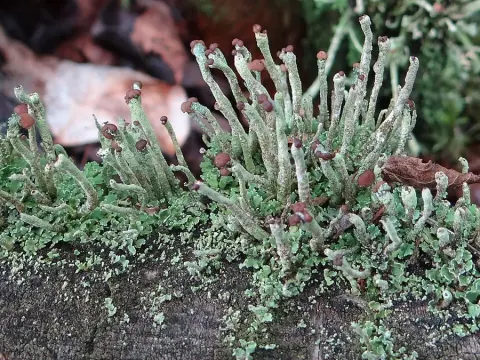
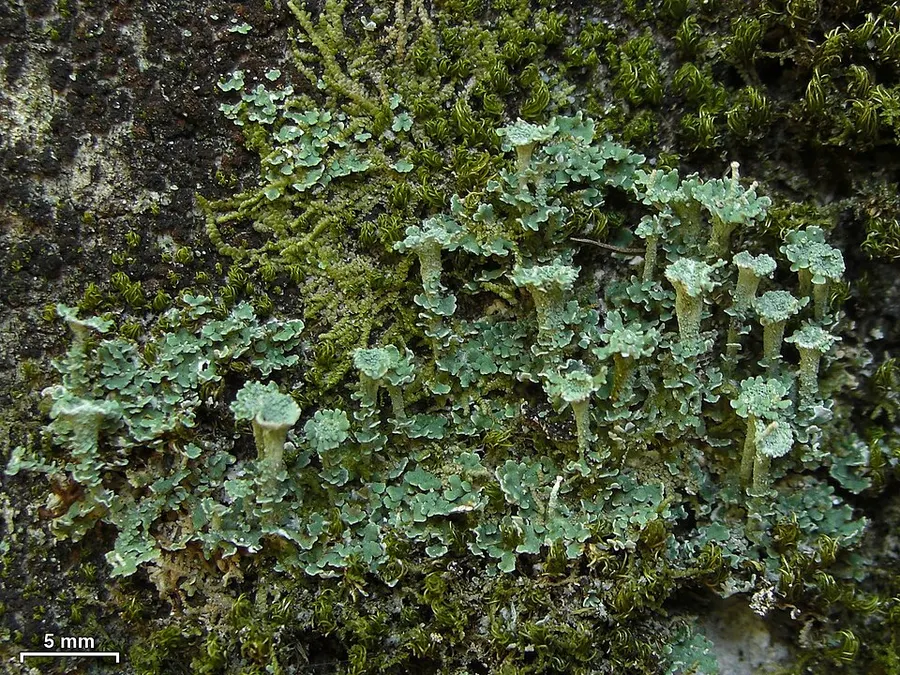
Cladonia grayi is characterised by two main parts: a consisting of small, persistent leaf-like structures (), and a secondary thallus comprising upright stalks called podetia. The squamules, which form a crusty layer on the , are small (1 mm long and 1–2 mm wide) with wavy edges and tend to grow upward. The podetia, which are the most distinctive feature of the species, grow 5–15 mm tall and 2–7 mm wide. They are shaped like goblets () with long, narrow stalks expanding into round, globe-like cups at the top. These structures are typically light greyish-green but can appear dark or somewhat brownish. The surface of the podetia is covered with a protective layer () that can be bumpy and may peel off in patches as the lichen ages. The upper portions develop powdery areas (soralia) and measuring 40–130 micrometres in diameter, or they may produce small flaking squamules. The granules are thought to play a play in propagation of the species. The species' reproductive structures include dark brown spore-producing (apothecia) that appear uncommonly along the cup margins, and more frequent smaller structures called pycnidia that produce a clear fluid.
Habitat dan peran ekologis
Cladonia grayi is a widespread lichen species that demonstrates considerable adaptability in its choice of growing surfaces. It can be found on multiple substrates, including rotting wood, organic soil layers (humus), and bare ground, showing a strong preference for highly acidic conditions. While the species has a nearly cosmopolitan distribution, it is most abundant in the Northern Hemisphere, particularly in Arctic and temperate regions. In Mediterranean areas, it is relatively uncommon, occurring in scattered populations primarily in meso- to supramediterranean zones, and showing a preference for Eurosiberian regions from colline to montane elevations. The species is also present in the Southern Hemisphere, with documented occurrences in both Neotropical regions and Australasia, though these populations tend to be more dispersed and are typically found at higher altitudes. Cladonia grayi appears to be the most common member of the C. chlorophaea group in Belarus, where it represents approximately 40% of specimens examined in a comprehensive survey. Two chemotypes have been documented in Belarus with roughly equal frequency: one containing only grayanic acid and 4-O-demethylgrayanic acid, and another that additionally contains substances of the fumarprotocetraric acid complex.
- Habitat atau konteks temuan
- Informasi belum tersedia pada sumber rilis ini.
- Substrat
- Informasi belum tersedia pada sumber rilis ini.
- Peran atau konteks
- Pembentuk liken
Reproduksi
The species' reproductive structures include dark brown spore-producing (apothecia) that appear uncommonly along the cup margins, and more frequent smaller structures called pycnidia that produce a clear fluid.
Catatan identitas dan cakupan
- Nama diterima mengikuti Catalogue of Life Base2026-09-11; uraian mempertahankan konsep dan nama sumber aslinya.
- Original geographic, specimen and life-cycle scope retained; source import awaits individual editorial review.
- Impor dan terjemahan otomatis belum diperiksa editorial per profil. Struktur reproduktif yang disebutkan tidak membuktikan seluruh siklus hidup diketahui.
- Pengukuran pada uraian mengikuti spesimen, kultur, dan metode sumber; angka tidak diperluas ke semua populasi.
Catatan distribusi dalam narasi mengikuti sumbernya. Dokumentasi spesimen atau foto mengikuti catatan sumber. Bukti wilayah Indonesia dan penilaian konservasi tidak disimpulkan dari gambar.
Melihat dengan konteks
Dokumentasi Cladonia grayi dari Wikimedia Commons. Fakahatchee Strand, Florida, 20131217 Identifikasi mengikuti record berkas sumber.
- Jenis
- Fotografi
- Kredit
- Jason Hollinger
- Lisensi
- CC BY 2.0
- Sumber media
- Buka entri sumber
Sumber profil
- [1] Cladonia grayi — Wikipedia (en)
- [2] Catalogue of Life Base2026-09-11 — Cladonia grayi
- [3] Dokumentasi visual — Cladonia grayi
Rujukan halaman ini
Fungi. Cladonia grayi. Rilis data fungi-2026-10-12-expansion-2. https://fungi-atlas.mgadib.chatgpt.site/jamur/cladonia-grayi/.
Status: impor sumber; pemeriksaan editorial per profil belum selesai. Untuk klaim biologis, gunakan rujukan pada bagian terkait dan periksa konteks sumber aslinya.