Ciri dan struktur
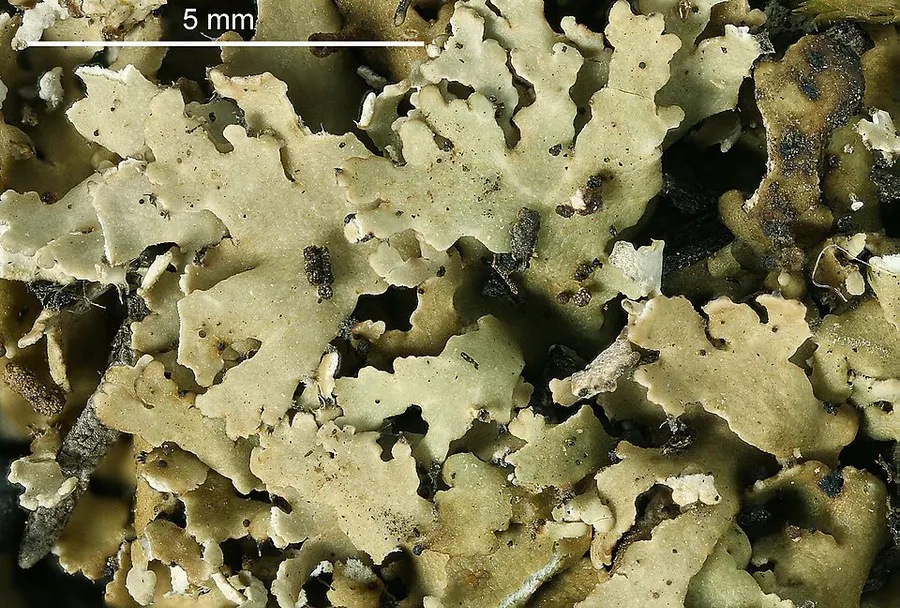
Cladonia subcervicornis is characterised by both a and (podetia), with the primary thallus being dominant and considerably well-developed. The persistent primary thallus is , consisting of small, scale-like structures. The squamules, which measure 6–10 mm by 2–5 mm, grow erectly and coalesce into cushion-like formations. Their margins are divided into finger-like lobes and have a greyish-green to bluish colouration on their upper surface, contrasting with a white underside. The base of the squamules is blackened, sometimes extending almost to their middle, and their surface has a very fine, cobweb-like texture. Podetia, the secondary, upright structures, occur infrequently. When present, they are (cup-shaped), typically measuring 5–6 mm by 1–2 mm. They have an irregular shape, gradually opening and sometimes proliferating from the margins or centres. They display a greyish-green to olive-green colouration. The surface is (having an outer layer) and varies from smooth to or slightly warty, with a bright appearance and occasional squamules on the scyphal margins. The species frequently produces both sexual and asexual reproductive structures. Dark brown apothecia (fruiting bodies) commonly occur at the margins of the scyphi, sometimes forming groups. Pycnidia (asexual reproductive structures) are also frequent along the scyphal margins, appearing either sessile or prominent, and produce a hyaline (translucent) slime. Standard chemical spot tests yield characteristic reactions: Pd+ (red), K+ (yellow), KC−, C−, UV−. Its main secondary metabolites are fumarprotocetraric acid complex and atranorin.
Habitat dan peran ekologis
Cladonia subcervicornis occurs in oceanic parts of northern and western Europe—from the British Isles to northern Norway. It typically inhabits coastal heath environments, forming compact cushions over thin humus layers in rock crevices. The species shows a particular affinity for exposed rock surfaces in these coastal areas, where it can become locally abundant and may even dominate the vegetation of suitable habitats. In Norway, it is frequently found between 400 and 600 metres elevation in areas close to the coast. The species has a strongly Atlantic distribution pattern, being especially abundant in the colline and montane belts of Western European countries. While historical records suggested a broader range, all North American reports of the species have been determined to be incorrect. While primarily distributed throughout Western Europe and the Macaronesian Islands, it occurs very rarely in Eastern European countries, extending from temperate to boreal zones. In Macaronesia, it is present across all three main archipelagos, occurring at elevations from around 300 to over 900 metres. It has also been recorded from Mediterranean countries including France, Italy, Portugal, Spain and Turkey.
- Habitat atau konteks temuan
- Informasi belum tersedia pada sumber rilis ini.
- Substrat
- Informasi belum tersedia pada sumber rilis ini.
- Peran atau konteks
- Pembentuk liken
Reproduksi
The species frequently produces both sexual and asexual reproductive structures. Dark brown apothecia (fruiting bodies) commonly occur at the margins of the scyphi, sometimes forming groups. Pycnidia (asexual reproductive structures) are also frequent along the scyphal margins, appearing either sessile or prominent, and produce a hyaline (translucent) slime. Standard chemical spot tests yield characteristic reactions: Pd+ (red), K+ (yellow), KC−, C−, UV−. Its main secondary metabolites are fumarprotocetraric acid complex and atranorin.
Catatan identitas dan cakupan
- Nama diterima mengikuti Catalogue of Life Base2026-09-11; uraian mempertahankan konsep dan nama sumber aslinya.
- Original geographic, specimen and life-cycle scope retained; source import awaits individual editorial review.
- Impor dan terjemahan otomatis belum diperiksa editorial per profil. Struktur reproduktif yang disebutkan tidak membuktikan seluruh siklus hidup diketahui.
- Pengukuran pada uraian mengikuti spesimen, kultur, dan metode sumber; angka tidak diperluas ke semua populasi.
Catatan distribusi dalam narasi mengikuti sumbernya. Dokumentasi spesimen atau foto mengikuti catatan sumber. Bukti wilayah Indonesia dan penilaian konservasi tidak disimpulkan dari gambar.
Melihat dengan konteks
Dokumentasi Cladonia subcervicornis dari Wikimedia Commons. A closeup of the lobes of the fruticose European lichen Cladonia subcervicornis . Specimen from the Canary Islands. Identifikasi mengikuti record berkas sumber.
- Jenis
- Fotografi
- Kredit
- Felix Schumm
- Lisensi
- CC BY-SA 4.0
- Sumber media
- Buka entri sumber
Sumber profil
- [1] Cladonia subcervicornis — Wikipedia (en)
- [2] Catalogue of Life Base2026-09-11 — Cladonia subcervicornis
- [3] Dokumentasi visual — Cladonia subcervicornis
Rujukan halaman ini
Fungi. Cladonia subcervicornis. Rilis data fungi-2026-10-12-expansion-2. https://fungi-atlas.mgadib.chatgpt.site/jamur/cladonia-subcervicornis/.
Status: impor sumber; pemeriksaan editorial per profil belum selesai. Untuk klaim biologis, gunakan rujukan pada bagian terkait dan periksa konteks sumber aslinya.