Ciri dan struktur
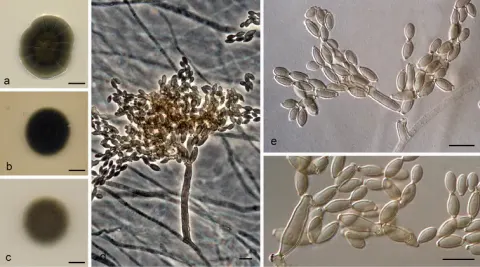
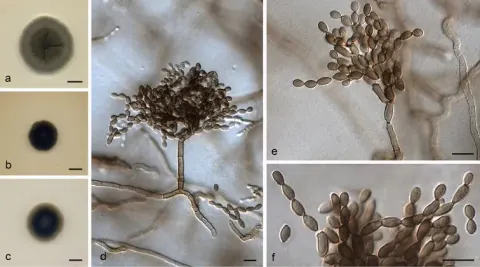
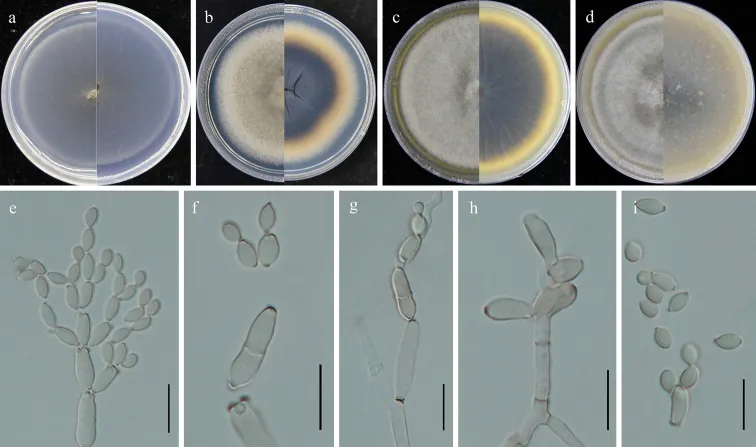
Saprobic on fallen leaves of Eucommia ulmoides. Sexual morph: Not developed. Asexual morph: Hyphomycetous. Mycelium abundant, superficial and submerged, overgrowing whole culture dishes, hyphae straight to slightly sinuous, septate, branching, light olive-green to olive-brown, smooth-walled, 1.5–6 µm wide. Conidiophores 13–100 × 2.5–4.5 µm (x̄ = 60.8 × 3.6 µm; n = 10), erect, branching, light olive-green, smooth and thin walled. Conidia 2.5–7.5 × 2–4 µm (x̄ = 4.9 × 3.2 µm; n = 30), in simple and branched acropetal chains, mostly light olive-green, aseptate, mostly smooth- and thin-walled, variable in size and shape, subglobose, ellipsoid-ovoid, obovoid, fusiform. Secondary ramoconidia 5.5–23 × 2.5–5.5 µm (x̄ = 0.9 × 3.8 µm; n = 30), pale olive-green, narrowly ellipsoid to cylindrical-oblong or subcylindrical, sometimes septate and sometimes aspetate (1-septate appear at maturity), smooth- and thin-walled. Colonies on SNA 50–55 mm diam, after 2 weeks at 25 °C, pale olive to pale white, flat, velvety, with a regular edge, reverse light olive to light white. Colonies on PDA 40–55 mm diam, after 2 weeks at 25 °C, smoke-gray to light olive-gray or olive to light olive-gray, reverse leaden-gray, gray-olive at edge both surface and reverse, woolly or felty, broad edge, regular, growth low convex, without protuberant exudates, occasionally reverse formed a sunflower like shape in the middle. Colonies on MEA 40–50 mm diam, after 2 weeks at 25 °C, olive-gray or gray, fluffy; reverse olive-green to dark olive, with an olive-yellow to gray-white edge, radially furrowed. Colonies on OA 40–60 mm diam, after 2 weeks at 25 °C, gray-white or iron-gray to gray-olive, fluffy to felty; reverse olive-brown to olive.
Habitat dan peran ekologis
Saprobic on fallen leaves of Eucommia ulmoides. Sexual morph: Not developed. Asexual morph: Hyphomycetous. Mycelium abundant, superficial and submerged, overgrowing whole culture dishes, hyphae straight to slightly sinuous, septate, branching, light olive-green to olive-brown, smooth-walled, 1.5–6 µm wide. Conidiophores 13–100 × 2.5–4.5 µm (x̄ = 60.8 × 3.6 µm; n = 10), erect, branching, light olive-green, smooth and thin walled. Conidia 2.5–7.5 × 2–4 µm (x̄ = 4.9 × 3.2 µm; n = 30), in simple and branched acropetal chains, mostly light olive-green, aseptate, mostly smooth- and thin-walled, variable in size and shape, subglobose, ellipsoid-ovoid, obovoid, fusiform. Secondary ramoconidia 5.5–23 × 2.5–5.5 µm (x̄ = 0.9 × 3.8 µm; n = 30), pale olive-green, narrowly ellipsoid to cylindrical-oblong or subcylindrical, sometimes septate and sometimes aspetate (1-septate appear at maturity), smooth- and thin-walled. Colonies on SNA 50–55 mm diam, after 2 weeks at 25 °C, pale olive to pale white, flat, velvety, with a regular edge, reverse light olive to light white. Colonies on PDA 40–55 mm diam, after 2 weeks at 25 °C, smoke-gray to light olive-gray or olive to light olive-gray, reverse leaden-gray, gray-olive at edge both surface and reverse, woolly or felty, broad edge, regular, growth low convex, without protuberant exudates, occasionally reverse formed a sunflower like shape in the middle.
- Habitat atau konteks temuan
- kultur yang didokumentasikan
- Substrat
- Informasi belum tersedia pada sumber rilis ini.
- Peran atau konteks
- Pengurai
Reproduksi
Saprobic on fallen leaves of Eucommia ulmoides. Sexual morph: Not developed. Asexual morph: Hyphomycetous. Mycelium abundant, superficial and submerged, overgrowing whole culture dishes, hyphae straight to slightly sinuous, septate, branching, light olive-green to olive-brown, smooth-walled, 1.5–6 µm wide. Conidiophores 13–100 × 2.5–4.5 µm (x̄ = 60.8 × 3.6 µm; n = 10), erect, branching, light olive-green, smooth and thin walled. Conidia 2.5–7.5 × 2–4 µm (x̄ = 4.9 × 3.2 µm; n = 30), in simple and branched acropetal chains, mostly light olive-green, aseptate, mostly smooth- and thin-walled, variable in size and shape, subglobose, ellipsoid-ovoid, obovoid, fusiform. Secondary ramoconidia 5.5–23 × 2.5–5.5 µm (x̄ = 0.9 × 3.8 µm; n = 30), pale olive-green, narrowly ellipsoid to cylindrical-oblong or subcylindrical, sometimes septate and sometimes aspetate (1-septate appear at maturity), smooth- and thin-walled.
Catatan identitas dan cakupan
- Nama diterima mengikuti Catalogue of Life Base2026-09-11; uraian mempertahankan konsep dan nama sumber aslinya.
- Preserve original treatment localities, hosts and substrate scope. Materials examined describe documented specimens, not the full global range.
- Impor dan terjemahan otomatis belum diperiksa editorial per profil. Struktur reproduktif yang disebutkan tidak membuktikan seluruh siklus hidup diketahui.
- Pengukuran pada uraian mengikuti spesimen, kultur, dan metode sumber; angka tidak diperluas ke semua populasi.
Catatan distribusi dalam narasi mengikuti sumbernya. Dokumentasi spesimen atau foto mengikuti catatan sumber. Bukti wilayah Indonesia dan penilaian konservasi tidak disimpulkan dari gambar.
Melihat dengan konteks
Cladosporium tenuissimum (GUCC 401.2, new substrate record from Guizhou Province). a–d colonies on SNA, PDA, MEA and OA (left: above, right: reverse) e–h secondary ramoconidia and conidia on SNA i conidia on SNA. Scale bars: 10 µm (e–i).
- Jenis
- Pelat ilmiah
- Kredit
- Si-Yao Wang, Yong Wang, Yan Li
- Lisensi
- CC BY 4.0
- Sumber media
- Buka entri sumber
Sumber profil
- [1] Cladosporium spp. (Cladosporiaceae) isolated from Eucommia ulmoides in China — Cladosporium tenuissimum
- [2] Catalogue of Life Base2026-09-11 — Cladosporium tenuissimum
- [3] Dokumentasi visual — Cladosporium tenuissimum
Rujukan halaman ini
Fungi. Cladosporium tenuissimum. Rilis data fungi-2026-10-12-expansion-2. https://fungi-atlas.mgadib.chatgpt.site/jamur/cladosporium-tenuissimum/.
Status: impor sumber; pemeriksaan editorial per profil belum selesai. Untuk klaim biologis, gunakan rujukan pada bagian terkait dan periksa konteks sumber aslinya.