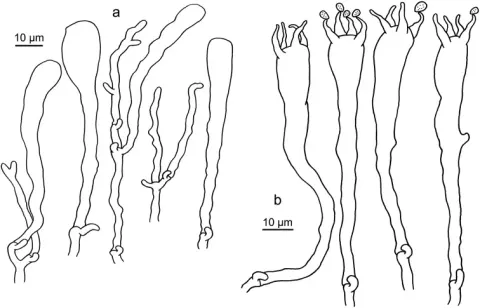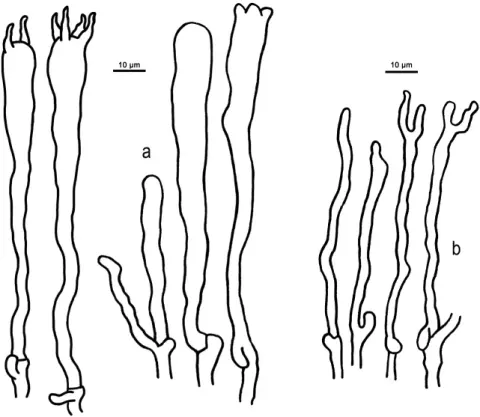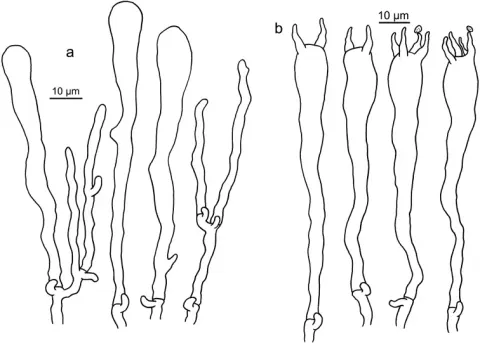
Ciri dan struktur
Basidiomes up to 8 cm high, 0.3–0.6 cm diam. basally, slightly enlarged upwards 0.8–1.2 cm diam., simple, initially cylindrical to subcylindrical, then narrowly clavate to clavate; hymenium longitudinally rugose in age, tawny or light walnut-brown to light brown at maturity; apex subacute, obtuse to broadly rounded, surface smooth to slightly rugulose, concolorous with the hymenium; surface slowly staining, brown or dark brown where cut or bruised, staining more conspicuously; base terete, pubescent to tomentose, initially pale yellow to light yellow, then brownish-orange to light brown; mycelial hyphae greyish to pallid; flesh initially solid, becoming soft and spongy upwards, white to pallid, staining on exposure. Odour and taste not distinctive. Spore deposit yellowish-white to light buff. Hymenium extending over the apex of basidiomata, composed of basidia and leptocystidia. Basidia 65–105 × 8–12.5 μm, clavate, hyaline, thin-walled, (2–) 4-spored, sterigmata 8–10 μm in length. Basidiospores 21–24 × 4–6 μm, Q = 3.5–5.0, Q m = 4.2, narrowly ellipsoid, boletoid or sway-backed in profile, with a small apiculus, inamyloid, thin-walled, hyaline in KOH, smooth. Leptocystidia 50–70 × 2.5–5 μm, scattered amongst and scarcely projecting beyond the basidia, cylindrical to narrowly clavate, thin-walled, smooth, hyaline, non-pigmented, clamped, inflated apically at maturity, at times with apical or subapical branches. Mycelial hyphae 2–8 μm diam., interwoven or aggregated into rhizomorphic strands, branched, clamped; hyphal walls smooth with light microscopy and SEM.
Habitat dan peran ekologis
N China (in this study) and SW China (Methven 1990). Gregarious habit on fallen needles and other debris under conifers, especially pine at elevations ranging from 2000–3600 m.
- Habitat atau konteks temuan
- Informasi belum tersedia pada sumber rilis ini.
- Substrat
- Informasi belum tersedia pada sumber rilis ini.
- Peran atau konteks
- Belum dikategorikan pada rilis ini.
Reproduksi
Basidiomes up to 8 cm high, 0.3–0.6 cm diam. basally, slightly enlarged upwards 0.8–1.2 cm diam., simple, initially cylindrical to subcylindrical, then narrowly clavate to clavate; hymenium longitudinally rugose in age, tawny or light walnut-brown to light brown at maturity; apex subacute, obtuse to broadly rounded, surface smooth to slightly rugulose, concolorous with the hymenium; surface slowly staining, brown or dark brown where cut or bruised, staining more conspicuously; base terete, pubescent to tomentose, initially pale yellow to light yellow, then brownish-orange to light brown; mycelial hyphae greyish to pallid; flesh initially solid, becoming soft and spongy upwards, white to pallid, staining on exposure.
Catatan identitas dan cakupan
- Nama diterima mengikuti Catalogue of Life Base2026-09-11; uraian mempertahankan konsep dan nama sumber aslinya.
- Preserve original treatment localities, hosts and substrate scope. Materials examined describe documented specimens, not the full global range.
- Impor dan terjemahan otomatis belum diperiksa editorial per profil. Struktur reproduktif yang disebutkan tidak membuktikan seluruh siklus hidup diketahui.
- Pengukuran pada uraian mengikuti spesimen, kultur, dan metode sumber; angka tidak diperluas ke semua populasi.
Catatan distribusi dalam narasi mengikuti sumbernya. Dokumentasi spesimen atau foto mengikuti catatan sumber. Bukti wilayah Indonesia dan penilaian konservasi tidak disimpulkan dari gambar.
Melihat dengan konteks
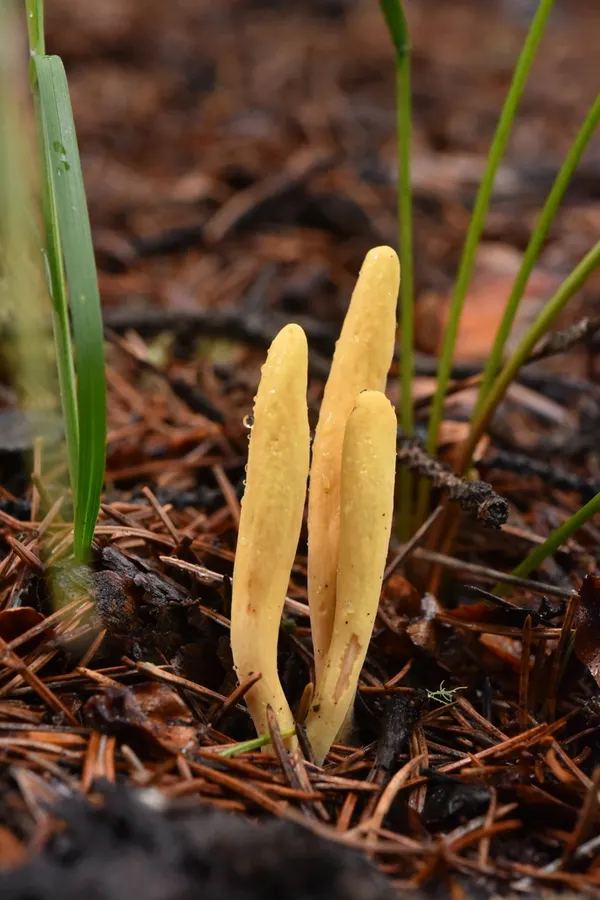
Dokumentasi Clavariadelphus sachalinensis menurut asosiasi foto pada record takson iNaturalist. Kredit: Alan Rockefeller. Identitas mengikuti sumber; bukan penentuan spesimen independen.
- Jenis
- Fotografi
- Kredit
- (c) Alan Rockefeller, some rights reserved (CC BY), uploaded by Alan Rockefeller
- Lisensi
- CC BY 4.0
- Sumber media
- Buka entri sumber
Dokumentasi tambahan
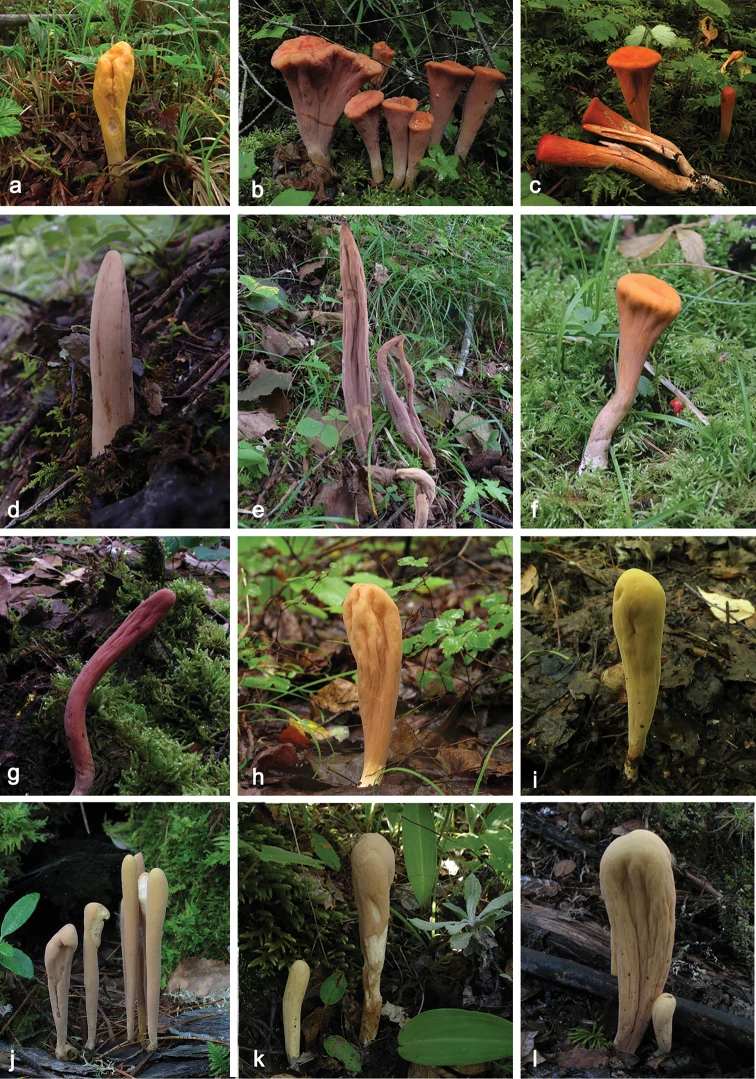
Clavariadelphus species in China. a C. alpinus (HKAS 57396, holotype) b, c C. amplus (HKAS 54876, holotype) d, e C. elongatus (d from HKAS 50742 e from HKAS 76589) f C. gansuensis (HKAS 76487, holotype) g C. himalayensis (HKAS 58811) h, i C. khinganensis (h from MHHNU 7789, holotype i from MHKMU H.Y. Huang 368) j C. sachalinensis (MHHNU 7816) k, l C. yunnanensis (k from HKAS 49398 l from HKAS 58789).
Kredit dan penggunaan
Hong-Yan Huang, Jie Zhao, Ping Zhang, Zai-Wei Ge, Xian Li, Li-Ping Tang
Ukuran dan format gambar disesuaikan tanpa pemotongan, retus, atau penambahan skala. Lisensi sumber dipertahankan.
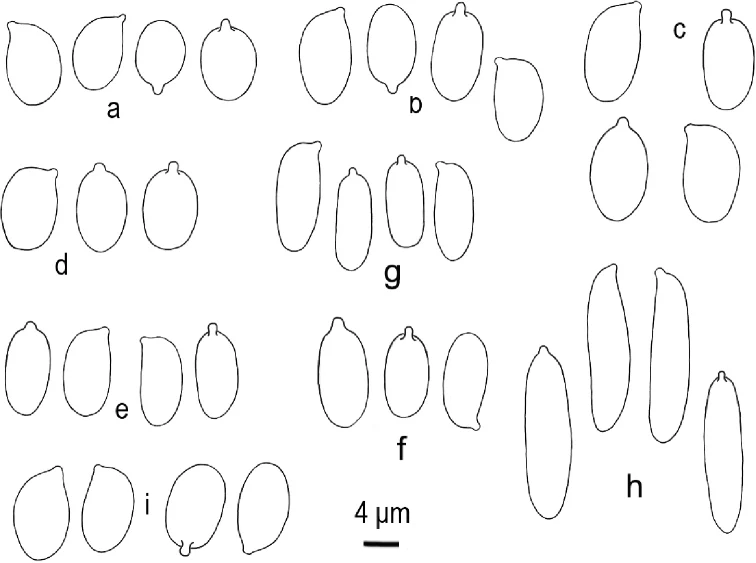
Basidiospores of Clavariadelphus under light microscope. a C. alpinus (HKAS 57396, holotype) b C. amplus (HKAS 54876, holotype) c C. elongatus (HKAS 76589) d C. gansuensis (HKAS 76487, holotype) e C. himalayensis (HKAS 58811) f C. khinganensis (MHHNU 7789, holotype) g C. ligula (HKAS 35954) h C. sachalinensis (MHHNU 7816) i C. yunnanensis (HKAS 57659).
Kredit dan penggunaan
Hong-Yan Huang, Jie Zhao, Ping Zhang, Zai-Wei Ge, Xian Li, Li-Ping Tang
Ukuran dan format gambar disesuaikan tanpa pemotongan, retus, atau penambahan skala. Lisensi sumber dipertahankan.
Sumber profil
- [1] The genus Clavariadelphus (Clavariadelphaceae, Gomphales) in China — Clavariadelphus sachalinensis
- [2] Catalogue of Life Base2026-09-11 — Clavariadelphus sachalinensis
- [3] Dokumentasi visual — Clavariadelphus sachalinensis
- [4] Dokumentasi visual — Clavariadelphus sachalinensis
- [5] Dokumentasi visual — Clavariadelphus sachalinensis
Rujukan halaman ini
Fungi. Clavariadelphus sachalinensis. Rilis data fungi-2026-10-12-expansion-2. https://fungi-atlas.mgadib.chatgpt.site/jamur/clavariadelphus-sachalinensis/.
Status: impor sumber; pemeriksaan editorial per profil belum selesai. Untuk klaim biologis, gunakan rujukan pada bagian terkait dan periksa konteks sumber aslinya.