Ciri dan struktur
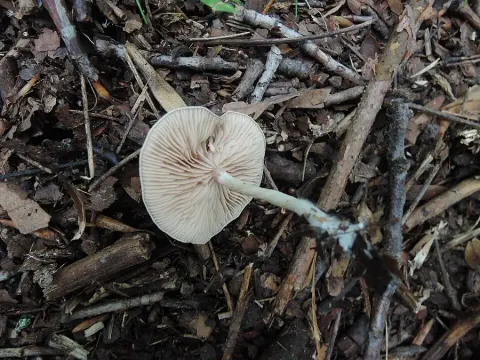
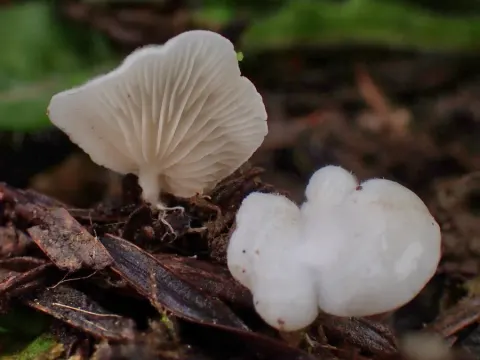
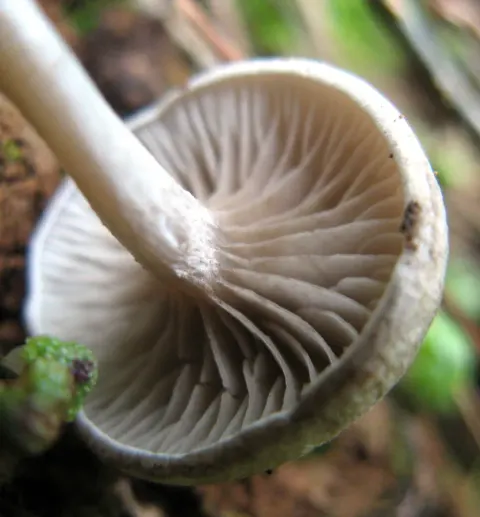
Clitocella borealichinensis is characterized by its clitocyboid basidiomata, globose to subglobose, occasionally broadly ellipsoid basidiospores, the absence of hymenial cystidia and clamp connection, and usually growing in broad-leaved forests. It is most similar to C. orientalis but differs from it by the slightly smaller basidiospores, non-gelatinized hyphae of pileipellis and stipitipellis with pale brown to brown intracellular or parietal pigment. Basidiomata clitocyboid, small to medium-sized. Pileus 13–50 mm wide, low convex to plane convex when young, then slightly depressed at center; surface smooth, grayish white (#f2f2f2) to pale white (#ffffff), yellowish white (#ffcd9a); margin incurved, non-striate; context thin pale white, 1.0–1.2 mm thick. Lamellae decurrent, grayish white (#f2f2f2), pale yellow (#fff3e7), crowded, edges smooth, thin and fragile, lamellulae numerous and concolorous with lamellae. Stipe 20–32 × 2–8 mm, central to eccentric, occasionally lateral, cylindrical to subcylindrical, equal or sometimes slightly tapering at base, pale white (#ffffff), smooth or tomentose, usually with white rhizomorphs. Odor unrecorded. Taste not recorded. Chemical color reaction: not reacting with KOH 3% at pileus of dried specimens. Basidiospores [60/2/2] (3.8–)4–5(–5.5) × 3.8–4.5 μm, L m × W m = 4.61 (± 0.42) × 4.06 (± 0.18), Q = 0.95–1.25 (Q av = 1.13 ± 0.10), hyaline, globose to subglobose, occasionally broadly ellipsoid in profile view, slightly angled in polar or face view with obscure minute pustules or bumps. Basidia 17–25 × 5–6(–7) μm, clavate, hyaline, four spored, rarely two spored; sterigmata 2–4 μm long.
Habitat dan peran ekologis
Scattered or in groups on soil in broad-leaved (Quercus) forest, Shanxi province, China.
- Habitat atau konteks temuan
- hutan
- Substrat
- tanah
- Peran atau konteks
- Belum dikategorikan pada rilis ini.
Reproduksi
Clitocella borealichinensis is characterized by its clitocyboid basidiomata, globose to subglobose, occasionally broadly ellipsoid basidiospores, the absence of hymenial cystidia and clamp connection, and usually growing in broad-leaved forests. It is most similar to C. orientalis but differs from it by the slightly smaller basidiospores, non-gelatinized hyphae of pileipellis and stipitipellis with pale brown to brown intracellular or parietal pigment. Basidiomata clitocyboid, small to medium-sized. Pileus 13–50 mm wide, low convex to plane convex when young, then slightly depressed at center; surface smooth, grayish white (#f2f2f2) to pale white (#ffffff), yellowish white (#ffcd9a); margin incurved, non-striate; context thin pale white, 1.0–1.2 mm thick.
Catatan identitas dan cakupan
- Nama diterima mengikuti Catalogue of Life Base2026-09-11; uraian mempertahankan konsep dan nama sumber aslinya.
- Preserve original treatment localities, hosts and substrate scope. Materials examined describe documented specimens, not the full global range.
- Impor dan terjemahan otomatis belum diperiksa editorial per profil. Struktur reproduktif yang disebutkan tidak membuktikan seluruh siklus hidup diketahui.
- Pengukuran pada uraian mengikuti spesimen, kultur, dan metode sumber; angka tidak diperluas ke semua populasi.
Catatan distribusi dalam narasi mengikuti sumbernya. Dokumentasi spesimen atau foto mengikuti catatan sumber. Bukti wilayah Indonesia dan penilaian konservasi tidak disimpulkan dari gambar.
Melihat dengan konteks
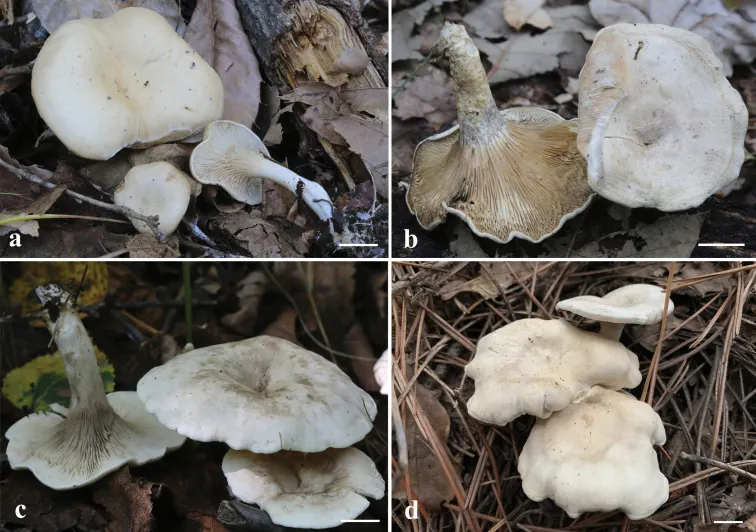
Basidiomata of Clitocella a Clitocella borealichinensis (BJTC FM1781, holotype) b-d Clitocella colorata (b BJTC FM1593 c BJTC FM1952 d BJTC FM1891, holotype) Scale bars: 10 mm (a–d). Photos by JingZhong Cao
- Jenis
- Pelat ilmiah
- Kredit
- Ning Mao, Jing-Chong Lv, Yu-Yan Xu, Tao-Yu Zhao, Li Fan
- Lisensi
- CC BY 4.0
- Sumber media
- Buka entri sumber
Dokumentasi tambahan
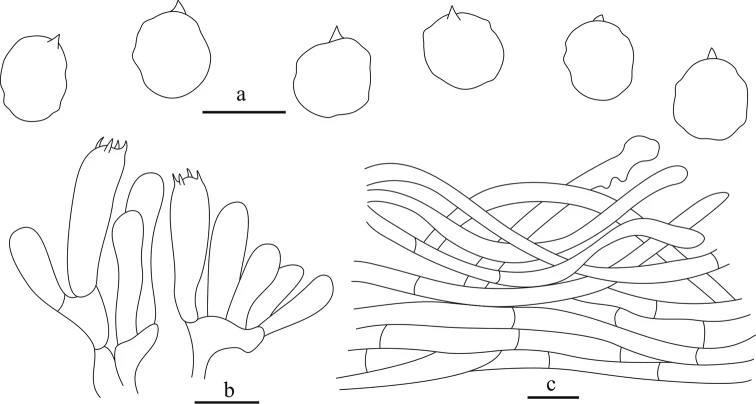
Microscopy of Clitocella borealichinensis a basidiospores b basidia c pileipellis. Scale bars: 5 μm (a); 10 μm (b, c). Drawings by Ning Mao.
Kredit dan penggunaan
Ning Mao, Jing-Chong Lv, Yu-Yan Xu, Tao-Yu Zhao, Li Fan
Ukuran dan format gambar disesuaikan tanpa pemotongan, retus, atau penambahan skala. Lisensi sumber dipertahankan.
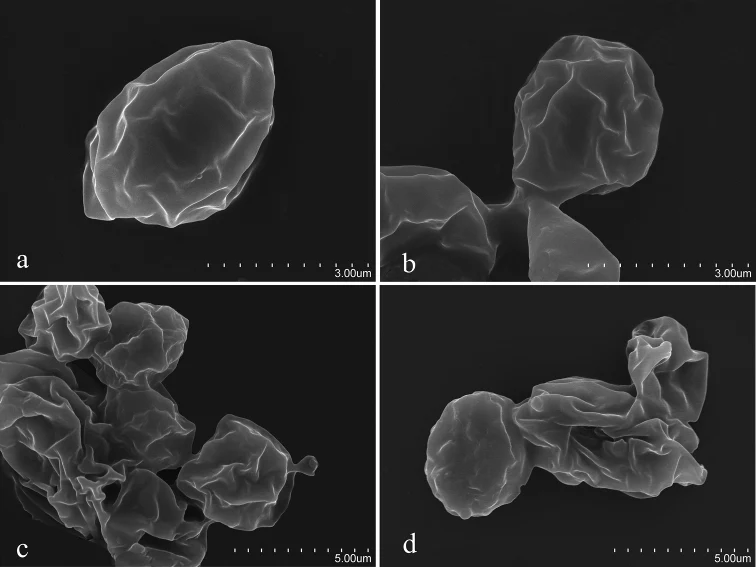
Basidiospores of species in Clitocella. Clitocella revealed by SEM a, b Clitocella borealichinensis c, d Clitocella colorata Scale bars: 3 μm (a, b); 5 μm (c, d). Photos by Li Fan.
Kredit dan penggunaan
Ning Mao, Jing-Chong Lv, Yu-Yan Xu, Tao-Yu Zhao, Li Fan
Ukuran dan format gambar disesuaikan tanpa pemotongan, retus, atau penambahan skala. Lisensi sumber dipertahankan.
Sumber profil
- [1] Two new Clitocella species from North China revealed by phylogenetic analyses and morphological characters — Clitocella borealichinensis
- [2] Catalogue of Life Base2026-09-11 — Clitocella borealichinensis
- [3] Dokumentasi visual — Clitocella borealichinensis
- [4] Dokumentasi visual — Clitocella borealichinensis
- [5] Dokumentasi visual — Clitocella borealichinensis
Rujukan halaman ini
Fungi. Clitocella borealichinensis. Rilis data fungi-2026-10-12-expansion-2. https://fungi-atlas.mgadib.chatgpt.site/jamur/clitocella-borealichinensis/.
Status: impor sumber; pemeriksaan editorial per profil belum selesai. Untuk klaim biologis, gunakan rujukan pada bagian terkait dan periksa konteks sumber aslinya.