Ciri dan struktur
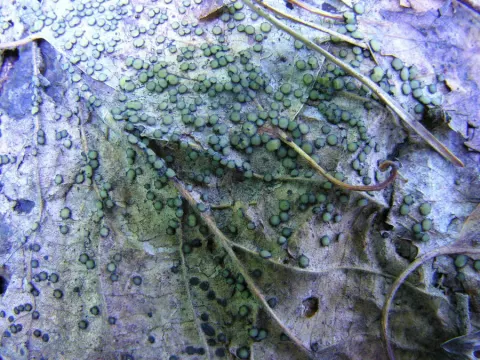
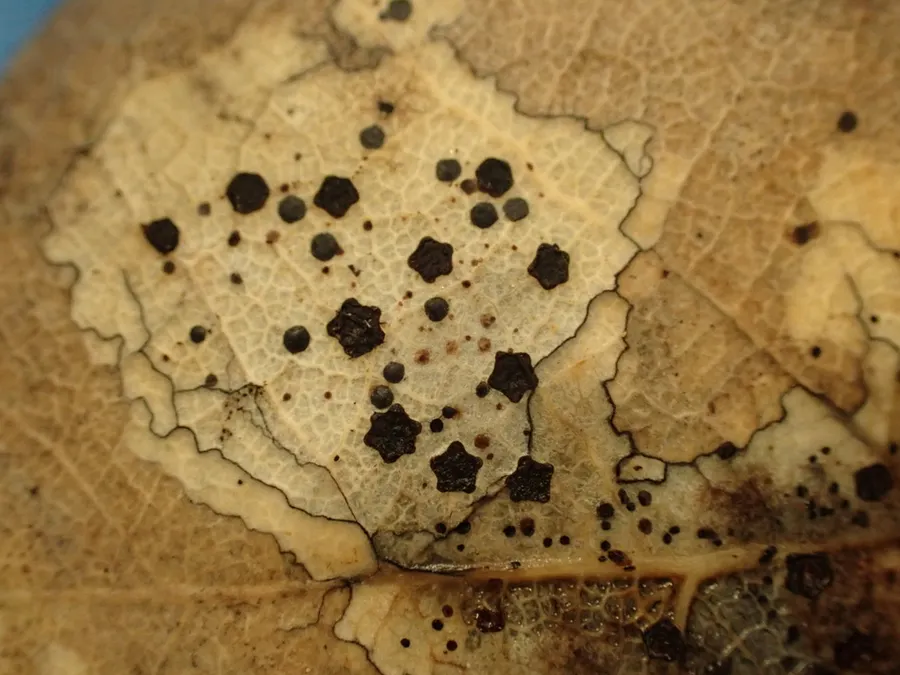
The apothecia of Coccomyces dentatus are distributed in bleached spots that are bounded by a black lines inside the outer cell layer of the leaf (intraepidermal). The black lines—often referred to as zone lines—are the result of an antagonistic interactions between individuals of different genotypes that colonize the leaf surface. Apothecia are usually accompanied by pycnidia (asexual fruit bodies) measuring 0.5–1.0 mm in diameter. The apothecia are black, and shiny, with four to six sides. They have a star-shaped pattern of grooves formed by lighter colored cells. When the spores are mature, these open (dehisce) by triangular "teeth" to expose the dull yellow hymenium (spore-bearing surface). The layer covering the apothecia is about 30 μm thick, and made of blackened (carbonized) cells measuring 5–6 μm in diameter. At the base of the apothecia is carbonized supportive tissue about 5 μm thick. The paraphyses (sterile filamentous hyphal cells) are unbranched, threadlike (filiform), gradually enlarge to a width of 2.0 μm at the tip, and have granular contents. The thin-walled cylindrical to club-shaped asci (spore-bearing cells) are on a short stalk, and measure 70–105 by 8–10 μm; each ascus contains eight ascospores. Ascospores, which measure 45–65 by 3.0 μm, have a thin but distinct sheath, and lack septa (cross-walls). Pycnidia (which appear before the apothecia mature) are intraepidermal, lenticular (having the shape of a double-convex lens) in cross section, 0.1–0.3 mm in diameter, and covered with a dark brown layer of cells. The phialides are arranged in a basal layer, and borne on short conidiophores.
Habitat dan peran ekologis
Coccomyces dentatus is a saprobic species, and grows on dead leaves of a wide variety of angiosperms. It is frequently encountered on members of the heather (family Ericaceae), and the beech family (Fagaceae), such as oak (red, white, and live oak) and chestnut, and also on the Castanea sativa from Chile. Other common substrates include leaves of trees in the genera Rhododendron, Lithocarpus, Berberis, Arbutus, Gaultheria, and Myrica. Widely distributed and common, the fungus occurs predominantly in warm temperate areas. It has been found in Africa (Tunisia), Europe, and the Americas. In the northern part of its range, it occurs in the summer and autumn, but in subtropical areas it can be found year-round. Because of its wide geographical distribution, abundance, and conspicuousness, Coccomyces dentatus is the most often collected species of Coccomyces.
- Habitat atau konteks temuan
- Informasi belum tersedia pada sumber rilis ini.
- Substrat
- Informasi belum tersedia pada sumber rilis ini.
- Peran atau konteks
- Pengurai
Reproduksi
The apothecia of Coccomyces dentatus are distributed in bleached spots that are bounded by a black lines inside the outer cell layer of the leaf (intraepidermal). The black lines—often referred to as zone lines—are the result of an antagonistic interactions between individuals of different genotypes that colonize the leaf surface. Apothecia are usually accompanied by pycnidia (asexual fruit bodies) measuring 0.5–1.0 mm in diameter. The apothecia are black, and shiny, with four to six sides. They have a star-shaped pattern of grooves formed by lighter colored cells. When the spores are mature, these open (dehisce) by triangular "teeth" to expose the dull yellow hymenium (spore-bearing surface).
Catatan identitas dan cakupan
- Nama diterima mengikuti Catalogue of Life Base2026-09-11; uraian mempertahankan konsep dan nama sumber aslinya.
- Original geographic, specimen and life-cycle scope retained; source import awaits individual editorial review.
- Impor dan terjemahan otomatis belum diperiksa editorial per profil. Struktur reproduktif yang disebutkan tidak membuktikan seluruh siklus hidup diketahui.
- Pengukuran pada uraian mengikuti spesimen, kultur, dan metode sumber; angka tidak diperluas ke semua populasi.
Catatan distribusi dalam narasi mengikuti sumbernya. Dokumentasi spesimen atau foto mengikuti catatan sumber. Bukti wilayah Indonesia dan penilaian konservasi tidak disimpulkan dari gambar.
Melihat dengan konteks
Dokumentasi Coccomyces dentatus menurut asosiasi foto pada record takson iNaturalist. Kredit: reagan peschke. Identitas mengikuti sumber; bukan penentuan spesimen independen.
- Jenis
- Fotografi
- Kredit
- (c) reagan peschke, some rights reserved (CC BY), uploaded by reagan peschke
- Lisensi
- CC BY 4.0
- Sumber media
- Buka entri sumber
Dokumentasi tambahan
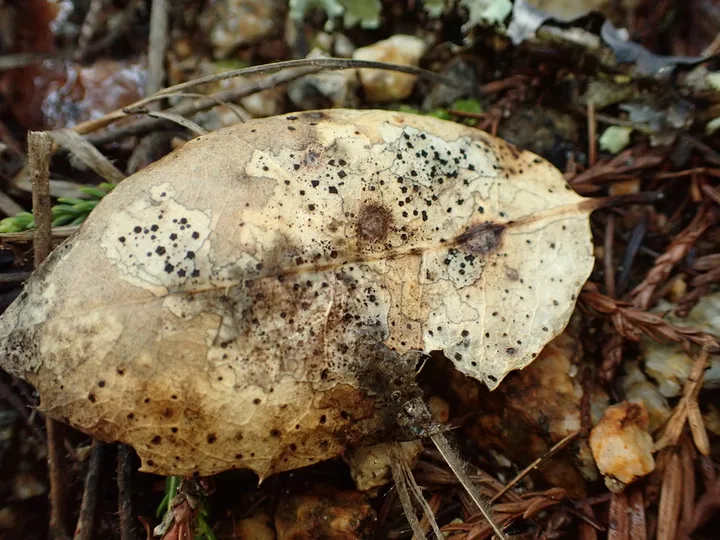
Foto yang diasosiasikan dengan Coccomyces dentatus pada iNaturalist. Identifikasi mengikuti sumber; bukan penentuan spesimen independen.
Kredit dan penggunaan
(c) reagan peschke, some rights reserved (CC BY), uploaded by reagan peschke
Ukuran dan format gambar disesuaikan tanpa pemotongan, retus, atau penambahan skala. Lisensi sumber dipertahankan.
Sumber profil
- [1] Coccomyces dentatus — Wikipedia (en)
- [2] Catalogue of Life Base2026-09-11 — Coccomyces dentatus
- [3] Dokumentasi visual — Coccomyces dentatus
- [4] Dokumentasi visual — Coccomyces dentatus
Rujukan halaman ini
Fungi. Coccomyces dentatus. Rilis data fungi-2026-10-12-expansion-2. https://fungi-atlas.mgadib.chatgpt.site/jamur/coccomyces-dentatus/.
Status: impor sumber; pemeriksaan editorial per profil belum selesai. Untuk klaim biologis, gunakan rujukan pada bagian terkait dan periksa konteks sumber aslinya.