Ciri dan struktur
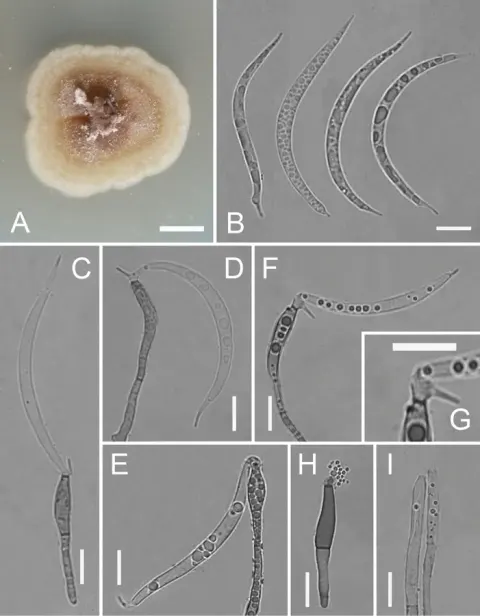
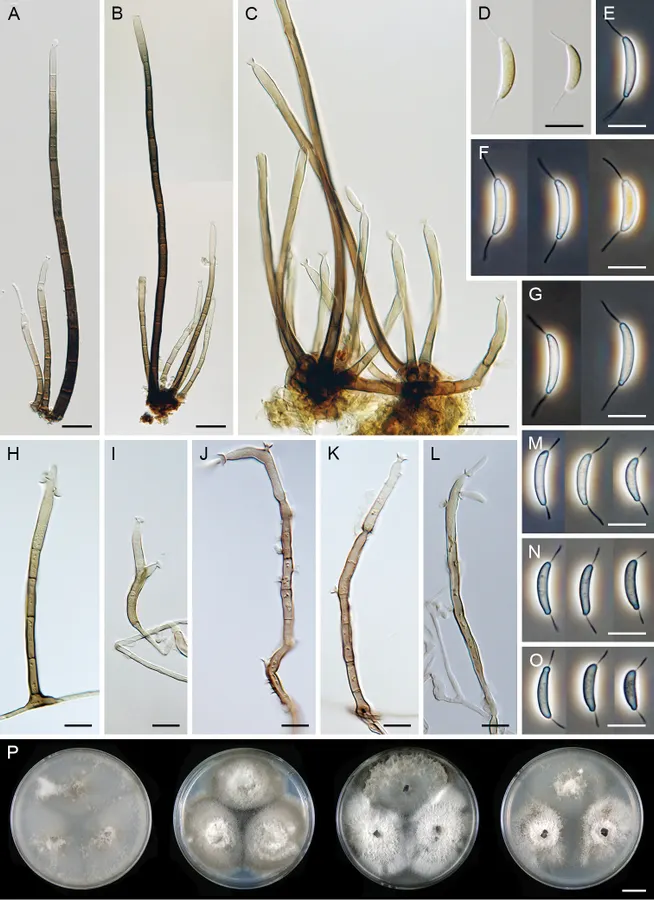
Colonies on the nature substrate effuse, hairy, greyish-brown. Setae erect, straight or slightly flexuous, smooth-walled, dark brown and thick-walled, becoming pale brown to subhyaline and thin-walled towards the apex, 230–290 μm long, 6–7.5 μm wide above the base, tapering gradually towards the apex which almost always develops into a monophialide. Conidiophores macronematous, mononematous, 62–127 × 3.5–4.5 µm, septate, erect, straight or flexuous, arising singly or in groups of 4–6 from hyphal cells associated with the bases of setae, septate, mid-brown to pale brown becoming gradually paler towards the apex. Conidiogenous cells 16.5–30(–38) × 3.5–5 μm, tapering to 1.5–2 μm just below the collarette, integrated, terminal, monophialidic, cylindrical to cylindrical-lageniform, subhyaline or pale brown at the base becoming hyaline to subhyaline towards the apex, smooth-walled; collarettes funnel-shaped, 3.5–4.5 μm wide, 1.5–2.5 μm deep. Conidia in slimy droplets, hyaline in mass, (11.5–)12–17 × (2–)2.5–3(–3.5) µm (mean ± SD = 14.7 ± 1.5 × 2.5 ± 0.3 µm), of two types, narrower and longer, 13.5–17(–17.5) × 2.5–3.5 μm (mean ± SD = 15.2 ± 1.0 × 2.8 ± 0.3 µm), and shorter and usually wider, 11.5–13.5(–14) × 3–3.5(–4) μm, falcate, asymmetrical, rounded at the apical end, with an inconspicuous scar at the basal end, hyaline, aseptate, smooth-walled, with simple, straight or gently curved setulae at both ends, 5–8 μm long; setulae inserted on the concave sides of the conidia. Vegetative hyphae hyaline to pale brown. Setae absent. Conidiophores 95–150(–195) μm long, 3.5–4.5 μm wide, conidiogenous cells 25–35 × 3.5–4(–4.5) μm, tapering to 1.5 µm just below the collarette, integrated, terminal, polyphialidic, usually cylindrical, pale brown to subhyaline, smooth-walled; collarette funnel-shaped, 3.5–4(–4.5) μm wide, 1.5–2 μm deep.
Habitat dan peran ekologis
Colonies on the nature substrate effuse, hairy, greyish-brown. Setae erect, straight or slightly flexuous, smooth-walled, dark brown and thick-walled, becoming pale brown to subhyaline and thin-walled towards the apex, 230–290 μm long, 6–7.5 μm wide above the base, tapering gradually towards the apex which almost always develops into a monophialide. Conidiophores macronematous, mononematous, 62–127 × 3.5–4.5 µm, septate, erect, straight or flexuous, arising singly or in groups of 4–6 from hyphal cells associated with the bases of setae, septate, mid-brown to pale brown becoming gradually paler towards the apex. Conidiogenous cells 16.5–30(–38) × 3.5–5 μm, tapering to 1.5–2 μm just below the collarette, integrated, terminal, monophialidic, cylindrical to cylindrical-lageniform, subhyaline or pale brown at the base becoming hyaline to subhyaline towards the apex, smooth-walled; collarettes funnel-shaped, 3.5–4.5 μm wide, 1.5–2.5 μm deep. Conidia in slimy droplets, hyaline in mass, (11.5–)12–17 × (2–)2.5–3(–3.5) µm (mean ± SD = 14.7 ± 1.5 × 2.5 ± 0.3 µm), of two types, narrower and longer, 13.5–17(–17.5) × 2.5–3.5 μm (mean ± SD = 15.2 ± 1.0 × 2.8 ± 0.3 µm), and shorter and usually wider, 11.5–13.5(–14) × 3–3.5(–4) μm, falcate, asymmetrical, rounded at the apical end, with an inconspicuous scar at the basal end, hyaline, aseptate, smooth-walled, with simple, straight or gently curved setulae at both ends, 5–8 μm long; setulae inserted on the concave sides of the conidia.
- Habitat atau konteks temuan
- Informasi belum tersedia pada sumber rilis ini.
- Substrat
- Informasi belum tersedia pada sumber rilis ini.
- Peran atau konteks
- Belum dikategorikan pada rilis ini.
Reproduksi
Colonies on the nature substrate effuse, hairy, greyish-brown. Setae erect, straight or slightly flexuous, smooth-walled, dark brown and thick-walled, becoming pale brown to subhyaline and thin-walled towards the apex, 230–290 μm long, 6–7.5 μm wide above the base, tapering gradually towards the apex which almost always develops into a monophialide. Conidiophores macronematous, mononematous, 62–127 × 3.5–4.5 µm, septate, erect, straight or flexuous, arising singly or in groups of 4–6 from hyphal cells associated with the bases of setae, septate, mid-brown to pale brown becoming gradually paler towards the apex. Conidiogenous cells 16.5–30(–38) × 3.5–5 μm, tapering to 1.5–2 μm just below the collarette, integrated, terminal, monophialidic, cylindrical to cylindrical-lageniform, subhyaline or pale brown at the base becoming hyaline to subhyaline towards the apex, smooth-walled; collarettes funnel-shaped, 3.5–4.5 μm wide, 1.5–2.5 μm deep.
Catatan identitas dan cakupan
- Nama diterima mengikuti Catalogue of Life Base2026-09-11; uraian mempertahankan konsep dan nama sumber aslinya.
- Preserve original treatment localities, hosts and substrate scope. Materials examined describe documented specimens, not the full global range.
- Impor dan terjemahan otomatis belum diperiksa editorial per profil. Struktur reproduktif yang disebutkan tidak membuktikan seluruh siklus hidup diketahui.
- Pengukuran pada uraian mengikuti spesimen, kultur, dan metode sumber; angka tidak diperluas ke semua populasi.
Catatan distribusi dalam narasi mengikuti sumbernya. Dokumentasi spesimen atau foto mengikuti catatan sumber. Bukti wilayah Indonesia dan penilaian konservasi tidak disimpulkan dari gambar.
Melihat dengan konteks
Codinaea paniculata. A–C setae and conidiophores on nature substrate D–G conidia on nature substrate H–L conidiophores in MLA culture (6 wk) M–O conidia in MLA culture (6 wk) P colonies on CMD, MLA, OA and PCA after 4 wk (from left to right). Images: CBS 145098 (A, B, G–O); CBS 126573 (C); CBS 127692 (D–F). Scale bars: 20 μm (A–C); 10 μm (D–O); 1 cm (P).
- Jenis
- Pelat ilmiah
- Kredit
- Martina Réblová, Jana Nekvindová, Jacques Fournier, Andrew N. Miller
- Lisensi
- CC BY 4.0
- Sumber media
- Buka entri sumber
Sumber profil
- [1] Delimitation, new species and teleomorph-anamorph relationships in Codinaea, Dendrophoma, Paragaeumannomyces and Striatosphaeria (Chaetosphaeriaceae) — Codinaea paniculata
- [2] Catalogue of Life Base2026-09-11 — Codinaea paniculata
- [3] Dokumentasi visual — Codinaea paniculata
Rujukan halaman ini
Fungi. Codinaea paniculata. Rilis data fungi-2026-10-12-expansion-2. https://fungi-atlas.mgadib.chatgpt.site/jamur/codinaea-paniculata/.
Status: impor sumber; pemeriksaan editorial per profil belum selesai. Untuk klaim biologis, gunakan rujukan pada bagian terkait dan periksa konteks sumber aslinya.