Ciri dan struktur
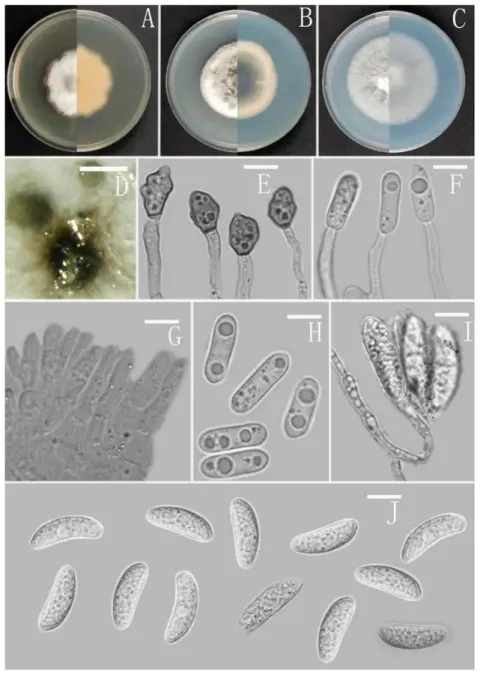
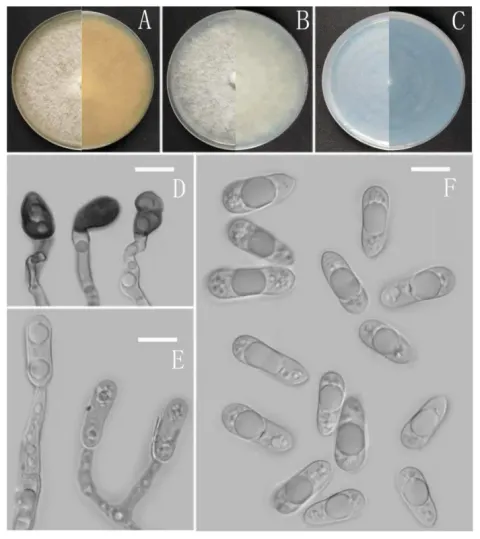
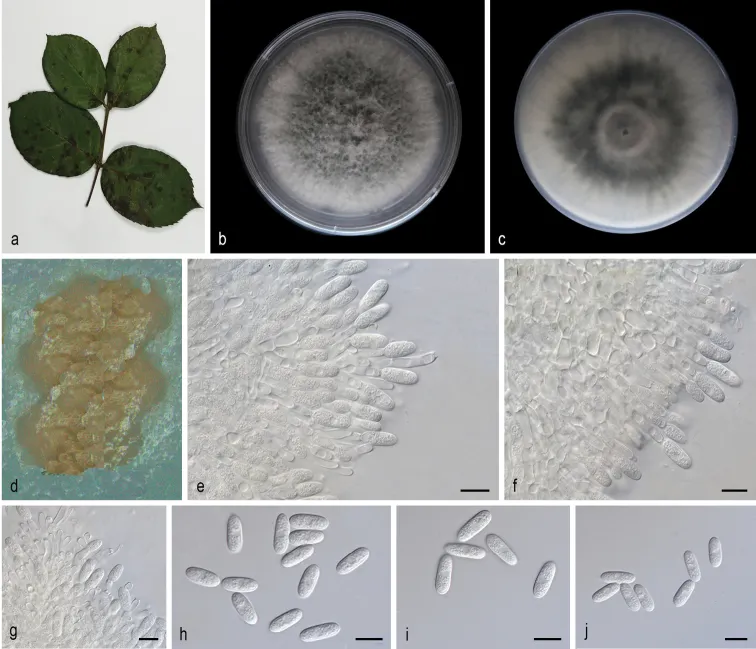
Colletotrichum mengyinense can be distinguished from the phylogenetically most closely related species C. fructicola (MFLU 090228) by its large conidia (12.5–15.7 × 4.8–6.1 vs. 9.7–14.0 × 3.0–4.3 μm), and five loci (2/509 in the ITS region, 1/139 GAPDH, 9/237 ACT, 8/410 TUB2 and 20/727 GS). Leaf spots discoid to irregular, brown or tanned. Asexual morph developed on SNA. A yellowish or orange mass appearing just as accumulations of conidia on the surface of the medium of SNA after 14 days in light at 25 °C. Conidia one-celled, hyaline, smooth-walled, subcylindrical, both ends round, contents granular. Conidia on SNA (12.5–15.7 × 4.8–6.1 µm, mean ± SD = 14.3 ± 1.1 × 5.3 ± 0.4 μm, L/W ratio = 2.7, n = 40). Sexual morph not observed. Conidiogenous cells subcylindrical, hyaline, 5.3–15.5 × 2.9–4.9 μm, opening 1.7–2.5 μm diam. Conidiophores hyaline, smooth walled, septate, branched. Colonies on PDA flat with entire margin, aerial mycelium white or gray, floccose cottony; surface and reverse gray in the center and grayish margin. PDA attaining 69.3–75.6 mm in diameter after 7 days, at 25 °C, growth rate 9.9–10.8 mm/day. Colonies on SNA sparse hyphae, slow growth.
Habitat dan peran ekologis
Colonies on PDA flat with entire margin, aerial mycelium white or gray, floccose cottony; surface and reverse gray in the center and grayish margin. PDA attaining 69.3–75.6 mm in diameter after 7 days, at 25 °C, growth rate 9.9–10.8 mm/day. Colonies on SNA sparse hyphae, slow growth.
- Habitat atau konteks temuan
- kultur yang didokumentasikan
- Substrat
- Informasi belum tersedia pada sumber rilis ini.
- Peran atau konteks
- Belum dikategorikan pada rilis ini.
Reproduksi
Colletotrichum mengyinense can be distinguished from the phylogenetically most closely related species C. fructicola (MFLU 090228) by its large conidia (12.5–15.7 × 4.8–6.1 vs. 9.7–14.0 × 3.0–4.3 μm), and five loci (2/509 in the ITS region, 1/139 GAPDH, 9/237 ACT, 8/410 TUB2 and 20/727 GS). Leaf spots discoid to irregular, brown or tanned. Asexual morph developed on SNA. A yellowish or orange mass appearing just as accumulations of conidia on the surface of the medium of SNA after 14 days in light at 25 °C. Conidia one-celled, hyaline, smooth-walled, subcylindrical, both ends round, contents granular. Conidia on SNA (12.5–15.7 × 4.8–6.1 µm, mean ± SD = 14.3 ± 1.1 × 5.3 ± 0.4 μm, L/W ratio = 2.7, n = 40).
Catatan identitas dan cakupan
- Nama diterima mengikuti Catalogue of Life Base2026-09-11; uraian mempertahankan konsep dan nama sumber aslinya.
- Preserve original treatment localities, hosts and substrate scope. Materials examined describe documented specimens, not the full global range.
- Impor dan terjemahan otomatis belum diperiksa editorial per profil. Struktur reproduktif yang disebutkan tidak membuktikan seluruh siklus hidup diketahui.
- Pengukuran pada uraian mengikuti spesimen, kultur, dan metode sumber; angka tidak diperluas ke semua populasi.
Catatan distribusi dalam narasi mengikuti sumbernya. Dokumentasi spesimen atau foto mengikuti catatan sumber. Bukti wilayah Indonesia dan penilaian konservasi tidak disimpulkan dari gambar.
Melihat dengan konteks
Colletotrichum mengyinense (SAUCC200702) a branch with leaves of host plant b, c surface (b) and reverse (c) sides of colony after incubation for 7 days on PDA d conidiomata e-g conidiophores, conidiogenous cells and conidia h–j conidia. Scale bars: 10 μm (e–j).
- Jenis
- Pelat ilmiah
- Kredit
- Taichang Mu, Zhaoxue Zhang, Rongyu Liu, Shubin Liu, Zhuang Li, Xiuguo Zhang, Jiwen Xia
- Lisensi
- CC BY 4.0
- Sumber media
- Buka entri sumber
Sumber profil
- [1] Morphological and molecular phylogenetic analyses reveal three species of Colletotrichum in Shandong province, China — Colletotrichum mengyinense
- [2] Catalogue of Life Base2026-09-11 — Colletotrichum mengyinense
- [3] Dokumentasi visual — Colletotrichum mengyinense
Rujukan halaman ini
Fungi. Colletotrichum mengyinense. Rilis data fungi-2026-10-12-expansion-2. https://fungi-atlas.mgadib.chatgpt.site/jamur/colletotrichum-mengyinense/.
Status: impor sumber; pemeriksaan editorial per profil belum selesai. Untuk klaim biologis, gunakan rujukan pada bagian terkait dan periksa konteks sumber aslinya.