01 / Morfologi

Ciri dan struktur

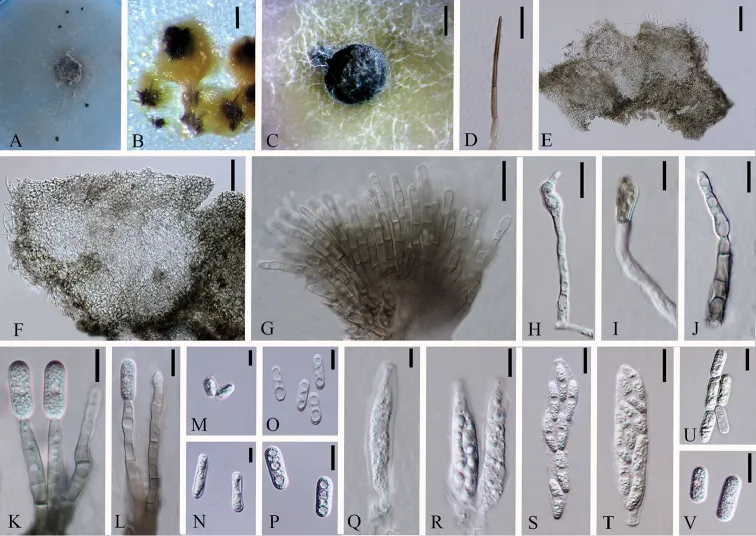
Asexual morph on CMA. Vegetative hyphae 2–4.3 µm diam (N=30), smooth-walled, septate, branched, hyaline to pale brown. Chlamydospores not observed. Conidiomata acervular, orange. Appressoria (56.7–) 60.2–79.2 (–81.2) × (2.8–) 2.9–3.7 (–3.9) µm (N=8), single, sub-globose, brown, rare. Conidiophores and setae formed on a cushion of pale brown cells (1.9–) 2.4–4 (–4.6) µm diam. Setae medium brown, smooth-walled, 2 or 3-septate; base cylindrical, constricted at the base, apex acute. Conidiophores (18.3–) 20.8–34 (–41.2) × (2.6–) 2.8–4.3 (–5.4) µm (N=20), smooth-walled, 2 to 3-septate, branched, hyaline to pale brown. Conidiophores and setae formed on a cushion of pale brown prismatic cells, sometimes with guttules. Conidia (12.1–) 13.8–16.8 (–18.9) × (3.3–) 4.4–7.5 (–7.9) µm (N=50), L/W = 2.6, hyaline, smooth-walled, with 1 to 4 guttules, cylindrical with both ends rounded. Sexual morph on CMA. Ascomata (267–) 261.4–342.3 (–346.2) × (190.4–) 173.0–272.5 (–280) µm (N=3), globose, glabrous, Ascomata isolated, scattered, irregular and asymmetrical, black. Peridium 13.6–46.4 µm thick, consist of pale to medium brown flattened angular cells. Ascogenous hyphae hyaline, smooth-walled. Asci (43.3–) 44.1–63.3 (–66.5) × (7.6–) 8.0–9.8 (–10) µm (N=7), cylindrical, straight, unitunicate, 8–spored. Ascospores (13.9–) 14.1–18 (–20.9) × (3.1–) 3.9–5.4 (–5.8) µm (N=23), L/W = 3.5, uni-to bi-seriately, aseptate, smooth-walled, ellipsoidal, single guttules in the middle, both ends rounded, hyaline. Cultures on CMA flat with entire margin. Growth rate: 0.4cm/d, with 20-days for sporulation. With fluffy, light green and white mycelia.

Sebagian uraian ditampilkan dalam bahasa sumber; terjemahannya belum tersedia atau belum lolos pemeriksaan.

Rujukan: [1]

Pengukuran mengikuti objek, spesimen atau kultur, dan metode yang disebutkan sumber. Baca uraian asli untuk konteks lengkap.

02 / Kehidupan

Habitat dan peran ekologis

Strains MFLUCC 14-0077, MFLUCC 14-0079 and MFLUCC 14-0083 had identical sequence data and they formed a single clade with MFLUCC 14-0082 and MFLUCC 14-0085. They are closely related to Colletotrichum excelsum-altitudum and C. tropicicola. MFLUCC 14-0077, MFLUCC 14-0079, MFLUCC 14-0082, MFLUCC 14-0083 and MFLUCC 14-0085 have similar morphological characteristics. Therefore, the five strains are regarded as the same species. There were totally 103bp and 101bp differences between MFLUCC 14-0083 and C. excelsum-altitudum / C. tropicicola respectively (mainly in GAPDH). Blastn researches with four-gene sequences of five strains presented 99% identity with ITS sequence of C. cordylinicola strain LC0886, 80% identity with GAPDH (GenBank JN050229), 90% identity with ACT (GenBank JN050218) and 93% identity with TUB2 (GenBank JN050246) sequences of C. tropicola strain LC0598 respectively as mentioned above. Conidia size and shape were very similar among MFLUCC 14-0083, C. excelsum-altitudum and C. tropicicola. Appressoria were rare and in strain MFLUCC –14–0083 appressoria were not variable like that in C. excelsum-altitudum and C. tropicicola. Here we introduced strains MFLUCC 14-0077, MFLUCC 14-0079, MFLUCC 14-0082 and MFLUCC 14-0083 and MFLUCC –14–0085 isolated from stems and roots of Dendrobium sp. 1 as Colletotrichum parallelophorum sp.nov.

Sebagian uraian ditampilkan dalam bahasa sumber; terjemahannya belum tersedia atau belum lolos pemeriksaan.

Rujukan: [1]

Habitat atau konteks temuan
Informasi belum tersedia pada sumber rilis ini.
Substrat
Informasi belum tersedia pada sumber rilis ini.
Peran atau konteks
Belum dikategorikan pada rilis ini.
Temukan hubungan serupa
03 / Siklus hidup

Reproduksi

Asexual morph on CMA. Vegetative hyphae 2–4.3 µm diam (N=30), smooth-walled, septate, branched, hyaline to pale brown. Chlamydospores not observed. Conidiomata acervular, orange. Appressoria (56.7–) 60.2–79.2 (–81.2) × (2.8–) 2.9–3.7 (–3.9) µm (N=8), single, sub-globose, brown, rare. Conidiophores and setae formed on a cushion of pale brown cells (1.9–) 2.4–4 (–4.6) µm diam. Setae medium brown, smooth-walled, 2 or 3-septate; base cylindrical, constricted at the base, apex acute. Conidiophores (18.3–) 20.8–34 (–41.2) × (2.6–) 2.8–4.3 (–5.4) µm (N=20), smooth-walled, 2 to 3-septate, branched, hyaline to pale brown. Conidiophores and setae formed on a cushion of pale brown prismatic cells, sometimes with guttules.

Sebagian uraian ditampilkan dalam bahasa sumber; terjemahannya belum tersedia atau belum lolos pemeriksaan.

Rujukan: [1]

04 / Batas informasi

Catatan identitas dan cakupan

  • Nama diterima mengikuti Catalogue of Life Base2026-09-11; uraian mempertahankan konsep dan nama sumber aslinya.
  • Preserve original treatment localities, hosts and substrate scope. Materials examined describe documented specimens, not the full global range.
  • Impor dan terjemahan otomatis belum diperiksa editorial per profil. Struktur reproduktif yang disebutkan tidak membuktikan seluruh siklus hidup diketahui.
  • Pengukuran pada uraian mengikuti spesimen, kultur, dan metode sumber; angka tidak diperluas ke semua populasi.

Catatan distribusi dalam narasi mengikuti sumbernya. Dokumentasi spesimen atau foto mengikuti catatan sumber. Bukti wilayah Indonesia dan penilaian konservasi tidak disimpulkan dari gambar.

05 / Dokumentasi

Melihat dengan konteks

Colletotrichum parallelophorum (holotype). A Colony B, C Fruiting body D Setae E–F Ascomata G, J–L Conidiophores I Appressoria M–P Conidia Q–T Asci U–V Ascospore. Scale bars: 50 µm (B), 500 µm (C), 20 µm (D), 100 µm (E), 50 µm (F), 20 µm (G), 10 µm (H–L), 5 µm (M, N), 10 µm (O–V).

Jenis
Pelat ilmiah
Kredit
Xiaoya Ma, Sureeporn Nontachaiyapoom, Ruvishika S. Jayawardena, Kevin D. yde, Eleni Gentekaki, Sixuan Zhou, Yixin Qian, Tingchi Wen, Jichuan Kang
Lisensi
CC BY 4.0
Sumber media
Buka entri sumber

Gambar menunjukkan objek menurut identifikasi sumber, bukan verifikasi independen spesimen oleh Fungi. Tidak ada skala baru yang ditambahkan.

06 / Rujukan

Sumber profil

  1. [1] Endophytic Colletotrichum species from Dendrobium spp. in China and Northern Thailand — Colletotrichum parallelophorumBagian sumber: PMC6290043_section_37
    Tanggal penghimpunan sumber: 2026-10-12
    Teks sumber: CC BY 4.0 · Ma X, Nontachaiyapoom S, Jayawardena RS, Yde KD, Gentekaki E, Zhou S, Qian Y, Wen T, Kang J.
  2. [2] Catalogue of Life Base2026-09-11 — Colletotrichum parallelophorumBagian sumber: ColDP NameUsage.tsv ID 9Z4LY; accepted species; source 2073
    Tanggal penghimpunan sumber: 2026-10-12
  3. [3] Dokumentasi visual — Colletotrichum parallelophorumBagian sumber: Individual media record; identification follows the source, not independent determination
    Tanggal penghimpunan sumber: 2026-10-12
    Media sumber: CC BY 4.0 · Xiaoya Ma, Sureeporn Nontachaiyapoom, Ruvishika S. Jayawardena, Kevin D. yde, Eleni Gentekaki, Sixuan Zhou, Yixin Qian, Tingchi Wen, Jichuan Kang

Adaptasi teks: CC BY 4.0. Ma X, Nontachaiyapoom S, Jayawardena RS, Yde KD, Gentekaki E, Zhou S, Qian Y, Wen T, Kang J. — Endophytic Colletotrichum species from Dendrobium spp. in China and Northern Thailand — Colletotrichum parallelophorum

Uraian asli dan riwayat sumber

Riwayat atau halaman sumber

Ringkasan sumber

Asexual morph on CMA. Vegetative hyphae 2–4.3 µm diam (N=30), smooth-walled, septate, branched, hyaline to pale brown. Chlamydospores not observed. Conidiomata acervular, orange. Appressoria (56.7–) 60.2–79.2 (–81.2) × (2.8–) 2.9–3.7 (–3.9) µm (N=8), single, sub-globose, brown, rare. Conidiophores and setae formed on a cushion of pale brown cells (1.9–) 2.4–4 (–4.6) µm diam. Setae medium brown, smooth-walled, 2 or 3-septate; base cylindrical, constricted at the base, apex acute. Conidiophores (18.3–) 20.8–34 (–41.2) × (2.6–) 2.8–4.3 (–5.4) µm (N=20), smooth-walled, 2 to 3-septate, branched, hyaline to pale brown.

Revisi sumber

Morfologi sumber

Asexual morph on CMA. Vegetative hyphae 2–4.3 µm diam (N=30), smooth-walled, septate, branched, hyaline to pale brown. Chlamydospores not observed. Conidiomata acervular, orange. Appressoria (56.7–) 60.2–79.2 (–81.2) × (2.8–) 2.9–3.7 (–3.9) µm (N=8), single, sub-globose, brown, rare. Conidiophores and setae formed on a cushion of pale brown cells (1.9–) 2.4–4 (–4.6) µm diam. Setae medium brown, smooth-walled, 2 or 3-septate; base cylindrical, constricted at the base, apex acute. Conidiophores (18.3–) 20.8–34 (–41.2) × (2.6–) 2.8–4.3 (–5.4) µm (N=20), smooth-walled, 2 to 3-septate, branched, hyaline to pale brown. Conidiophores and setae formed on a cushion of pale brown prismatic cells, sometimes with guttules. Conidia (12.1–) 13.8–16.8 (–18.9) × (3.3–) 4.4–7.5 (–7.9) µm (N=50), L/W = 2.6, hyaline, smooth-walled, with 1 to 4 guttules, cylindrical with both ends rounded. Sexual morph on CMA. Ascomata (267–) 261.4–342.3 (–346.2) × (190.4–) 173.0–272.5 (–280) µm (N=3), globose, glabrous, Ascomata isolated, scattered, irregular and asymmetrical, black. Peridium 13.6–46.4 µm thick, consist of pale to medium brown flattened angular cells. Ascogenous hyphae hyaline, smooth-walled. Asci (43.3–) 44.1–63.3 (–66.5) × (7.6–) 8.0–9.8 (–10) µm (N=7), cylindrical, straight, unitunicate, 8–spored. Ascospores (13.9–) 14.1–18 (–20.9) × (3.1–) 3.9–5.4 (–5.8) µm (N=23), L/W = 3.5, uni-to bi-seriately, aseptate, smooth-walled, ellipsoidal, single guttules in the middle, both ends rounded, hyaline. Cultures on CMA flat with entire margin. Growth rate: 0.4cm/d, with 20-days for sporulation. With fluffy, light green and white mycelia.

Revisi sumber

Ekologi sumber

Strains MFLUCC 14-0077, MFLUCC 14-0079 and MFLUCC 14-0083 had identical sequence data and they formed a single clade with MFLUCC 14-0082 and MFLUCC 14-0085. They are closely related to Colletotrichum excelsum-altitudum and C. tropicicola. MFLUCC 14-0077, MFLUCC 14-0079, MFLUCC 14-0082, MFLUCC 14-0083 and MFLUCC 14-0085 have similar morphological characteristics. Therefore, the five strains are regarded as the same species. There were totally 103bp and 101bp differences between MFLUCC 14-0083 and C. excelsum-altitudum / C. tropicicola respectively (mainly in GAPDH). Blastn researches with four-gene sequences of five strains presented 99% identity with ITS sequence of C. cordylinicola strain LC0886, 80% identity with GAPDH (GenBank JN050229), 90% identity with ACT (GenBank JN050218) and 93% identity with TUB2 (GenBank JN050246) sequences of C. tropicola strain LC0598 respectively as mentioned above. Conidia size and shape were very similar among MFLUCC 14-0083, C. excelsum-altitudum and C. tropicicola. Appressoria were rare and in strain MFLUCC –14–0083 appressoria were not variable like that in C. excelsum-altitudum and C. tropicicola. Here we introduced strains MFLUCC 14-0077, MFLUCC 14-0079, MFLUCC 14-0082 and MFLUCC 14-0083 and MFLUCC –14–0085 isolated from stems and roots of Dendrobium sp. 1 as Colletotrichum parallelophorum sp.nov.

Revisi sumber

Struktur reproduksi sumber

Asexual morph on CMA. Vegetative hyphae 2–4.3 µm diam (N=30), smooth-walled, septate, branched, hyaline to pale brown. Chlamydospores not observed. Conidiomata acervular, orange. Appressoria (56.7–) 60.2–79.2 (–81.2) × (2.8–) 2.9–3.7 (–3.9) µm (N=8), single, sub-globose, brown, rare. Conidiophores and setae formed on a cushion of pale brown cells (1.9–) 2.4–4 (–4.6) µm diam. Setae medium brown, smooth-walled, 2 or 3-septate; base cylindrical, constricted at the base, apex acute. Conidiophores (18.3–) 20.8–34 (–41.2) × (2.6–) 2.8–4.3 (–5.4) µm (N=20), smooth-walled, 2 to 3-septate, branched, hyaline to pale brown. Conidiophores and setae formed on a cushion of pale brown prismatic cells, sometimes with guttules.

Revisi sumber

Rujukan halaman ini

Fungi. Colletotrichum parallelophorum. Rilis data fungi-2026-10-12-expansion-2. https://fungi-atlas.mgadib.chatgpt.site/jamur/colletotrichum-parallelophorum/.

Status: impor sumber; pemeriksaan editorial per profil belum selesai. Untuk klaim biologis, gunakan rujukan pada bagian terkait dan periksa konteks sumber aslinya.