Ciri dan struktur
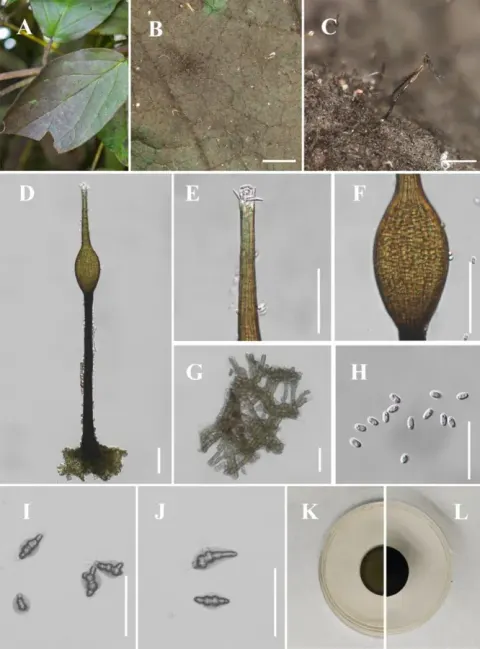
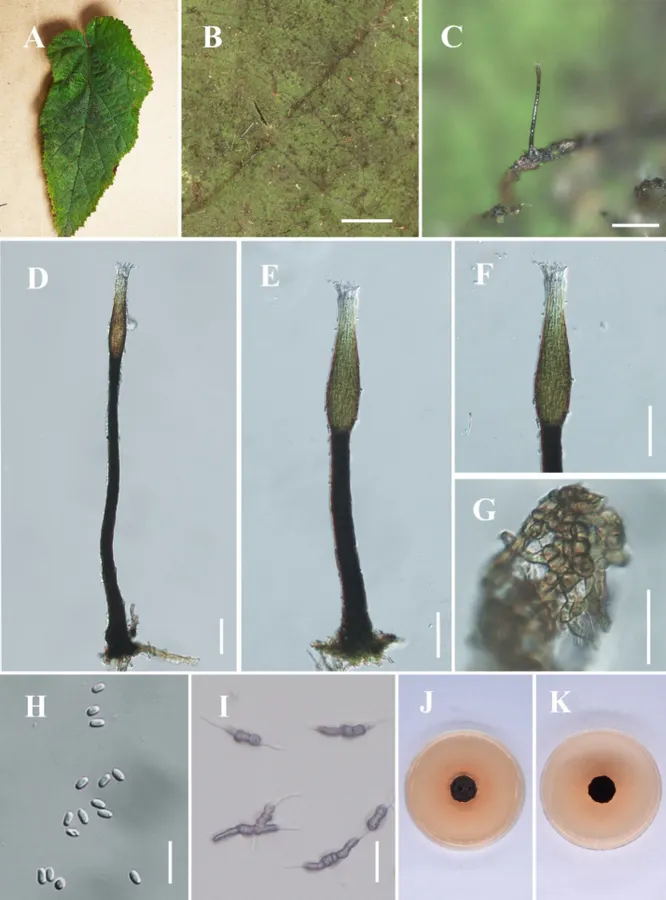
Epiphytic on the leaf surface of Rubus lambertianus, forming a sooty coating on adaxial surface. Thallus composed of brown, septate, ellipsoidal, smooth-walled hyphae. Asexual morph. Conidiomata (384–578 × 25–41 µm, x̄ = 457 × 33 µm, n = 15) long, pycnidial, elongate, superficial, stipitate, with a long - stalk (173–378 µm, x̄ = 287 µm, n = 15), black, rigid, short neck (32–62 µm, x̄ = 50 µm, n = 15), and a distinctive ovoid-swollen conidiogenous region, the swollen area producing conidia inside. Conidiomata apex gradually light brown to hyaline, with a circular ostiole (7–18 µm, x̄ = 12 µm, n = 15), consisting of rectangular, compact cells, surrounded by hyaline hyphae. Conidiogenous region (18–37 µm, x̄ = 25 µm, n = 15) wide, located in the upper-middle part of the conidiomata, brown, composed of cylindrical, thin-walled cells. Conidia (3.8–5 × 1.6–2.8 μm, x̄ = 4.4 × 2.3 μm, n = 30), hyaline, single-celled, ellipsoidal, smooth-walled, guttulate without distinct refractive oil droplet, exuding in creamy masses from the ostiole. Sexual morph. Undetermined. Colonies slow growing, reaching 14.96 mm diam after 14 days at 26 °C in darkness on PDA, colony superficial to gradually erumpent, with hyphae growing downward and immersed in medium, olivaceous. The initially hyaline PDA medium is discolored to rust-colored as the fungal pigments diffuse into the substrate and accumulate over the cultivation period.
Habitat dan peran ekologis
Epiphytic on the leaf surface of Rubus lambertianus, forming a sooty coating on adaxial surface. Thallus composed of brown, septate, ellipsoidal, smooth-walled hyphae. Asexual morph. Conidiomata (384–578 × 25–41 µm, x̄ = 457 × 33 µm, n = 15) long, pycnidial, elongate, superficial, stipitate, with a long - stalk (173–378 µm, x̄ = 287 µm, n = 15), black, rigid, short neck (32–62 µm, x̄ = 50 µm, n = 15), and a distinctive ovoid-swollen conidiogenous region, the swollen area producing conidia inside. Conidiomata apex gradually light brown to hyaline, with a circular ostiole (7–18 µm, x̄ = 12 µm, n = 15), consisting of rectangular, compact cells, surrounded by hyaline hyphae. Conidiogenous region (18–37 µm, x̄ = 25 µm, n = 15) wide, located in the upper-middle part of the conidiomata, brown, composed of cylindrical, thin-walled cells. Conidia (3.8–5 × 1.6–2.8 μm, x̄ = 4.4 × 2.3 μm, n = 30), hyaline, single-celled, ellipsoidal, smooth-walled, guttulate without distinct refractive oil droplet, exuding in creamy masses from the ostiole. Sexual morph. Undetermined. Colonies slow growing, reaching 14.96 mm diam after 14 days at 26 °C in darkness on PDA, colony superficial to gradually erumpent, with hyphae growing downward and immersed in medium, olivaceous.
- Habitat atau konteks temuan
- kultur yang didokumentasikan
- Substrat
- Informasi belum tersedia pada sumber rilis ini.
- Peran atau konteks
- Pembentuk liken
Reproduksi
Epiphytic on the leaf surface of Rubus lambertianus, forming a sooty coating on adaxial surface. Thallus composed of brown, septate, ellipsoidal, smooth-walled hyphae. Asexual morph. Conidiomata (384–578 × 25–41 µm, x̄ = 457 × 33 µm, n = 15) long, pycnidial, elongate, superficial, stipitate, with a long - stalk (173–378 µm, x̄ = 287 µm, n = 15), black, rigid, short neck (32–62 µm, x̄ = 50 µm, n = 15), and a distinctive ovoid-swollen conidiogenous region, the swollen area producing conidia inside. Conidiomata apex gradually light brown to hyaline, with a circular ostiole (7–18 µm, x̄ = 12 µm, n = 15), consisting of rectangular, compact cells, surrounded by hyaline hyphae. Conidiogenous region (18–37 µm, x̄ = 25 µm, n = 15) wide, located in the upper-middle part of the conidiomata, brown, composed of cylindrical, thin-walled cells.
Catatan identitas dan cakupan
- Nama diterima mengikuti Catalogue of Life Base2026-09-11; uraian mempertahankan konsep dan nama sumber aslinya.
- Preserve original treatment localities, hosts and substrate scope. Materials examined describe documented specimens, not the full global range.
- Impor dan terjemahan otomatis belum diperiksa editorial per profil. Struktur reproduktif yang disebutkan tidak membuktikan seluruh siklus hidup diketahui.
- Pengukuran pada uraian mengikuti spesimen, kultur, dan metode sumber; angka tidak diperluas ke semua populasi.
Catatan distribusi dalam narasi mengikuti sumbernya. Dokumentasi spesimen atau foto mengikuti catatan sumber. Bukti wilayah Indonesia dan penilaian konservasi tidak disimpulkan dari gambar.
Melihat dengan konteks
Conidiocarpus guilanensis (IFRDCC 25-0007). A Black mycelium covering the leaf surface; B, C Conidiomata on the host; D, E Conidioma; F Ostiole, neck, and a prominently ovoid-swollen conidiogenous region; G Mycelial network; H Conidia; I Germinated conidia; J Front view of the colony on PDA; K Reverse view of the colony on PDA. Scale bars: 2000 μm (B); 200 μm (C); 50 μm (D–F); 25 μm (G–I).
- Jenis
- Pelat ilmiah
- Kredit
- Jipeng Sun, Yuwei Liu, Tao Chen, Entaj Tarafder, Sinang Hongsanan, Shengxi Chen, Chada Norphanphoun, Xiaolu Deng, Yuzhe Feng, Tian Yang, Samantha C. Karunarathna, Xiangyu Zeng
- Lisensi
- CC BY 4.0
- Sumber media
- Buka entri sumber
Sumber profil
- [1] Morphology and multilocus phylogeny illuminate novel taxa in Capnodiaceae (Ascomycota, Dothideomycetes, Capnodiales) — Conidiocarpus guilanensis
- [2] Catalogue of Life Base2026-09-11 — Conidiocarpus guilanensis
- [3] Dokumentasi visual — Conidiocarpus guilanensis
Rujukan halaman ini
Fungi. Conidiocarpus guilanensis. Rilis data fungi-2026-10-12-expansion-2. https://fungi-atlas.mgadib.chatgpt.site/jamur/conidiocarpus-guilanensis/.
Status: impor sumber; pemeriksaan editorial per profil belum selesai. Untuk klaim biologis, gunakan rujukan pada bagian terkait dan periksa konteks sumber aslinya.