Ciri dan struktur
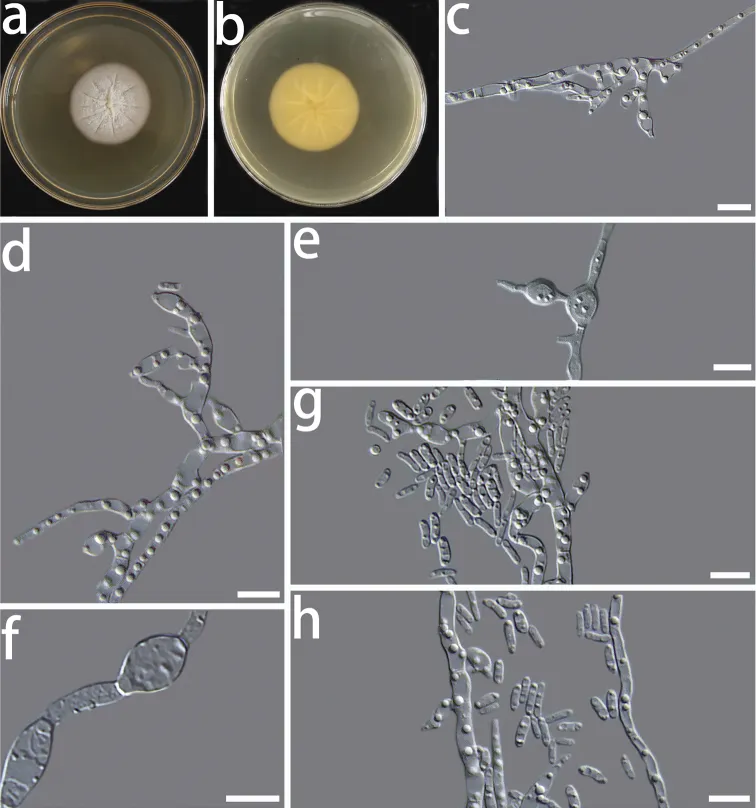
Colony on PDA after 8 d, hyphae hyaline, multi-guttulate, septate, smooth-walled, often with hyphal strands consolidating to form bundles; conidiophores short or absent; conidiogenous cells hyaline, flask or acicular in shape, measuring 3.3–12.5 × 1.6–5.1 μm (x̅ = 6.6 × 2.9 μm, n = 50) (Fig. 4c, d); conidia hyaline, smooth-walled, ellipsoidal, 3.3–8.4 × 0.6–1.9 μm (x̅ = 4.8 × 1.3 μm, n = 50) (Fig. 4g and h); chlamydospore solitary or in short chains, hyaline, thick-walled, elongate ellipsoidal or almost globose in shape, measuring 2.7–6.7 × 2.6–5.4 μm (x̅ = 4.6 × 3.8 μm, n = 50) (Fig. 4e, f). Sexual morph unknown. The optimal temperature for growth is 25 °C. No growth was detected at 5 °C and 35 °C. Colonies on PDA after 8 d at 25 °C were white to light pink in colour, circular, flat, dense, partially immersed in the medium, the centre of the colony is rough, forming radial grooves.
Habitat dan peran ekologis
China, the Inner Mongolia Autonomous Region, Chifeng City, 44°13'46"N, 118°44'57"E, ca. 1500 m elev., isolated from the medulla of Ramalina sinensis, 11 Oct 2019, H. L. Si, CS-09 (HMAS 350270, holotype), ex-type living culture, CGMCC 3.20250. Colony on PDA after 8 d, hyphae hyaline, multi-guttulate, septate, smooth-walled, often with hyphal strands consolidating to form bundles; conidiophores short or absent; conidiogenous cells hyaline, flask or acicular in shape, measuring 3.3–12.5 × 1.6–5.1 μm (x̅ = 6.6 × 2.9 μm, n = 50) (Fig. 4c, d); conidia hyaline, smooth-walled, ellipsoidal, 3.3–8.4 × 0.6–1.9 μm (x̅ = 4.8 × 1.3 μm, n = 50) (Fig. 4g and h); chlamydospore solitary or in short chains, hyaline, thick-walled, elongate ellipsoidal or almost globose in shape, measuring 2.7–6.7 × 2.6–5.4 μm (x̅ = 4.6 × 3.8 μm, n = 50) (Fig. 4e, f). Sexual morph unknown. The optimal temperature for growth is 25 °C. No growth was detected at 5 °C and 35 °C. Colonies on PDA after 8 d at 25 °C were white to light pink in colour, circular, flat, dense, partially immersed in the medium, the centre of the colony is rough, forming radial grooves.
- Habitat atau konteks temuan
- kultur yang didokumentasikan
- Substrat
- Informasi belum tersedia pada sumber rilis ini.
- Peran atau konteks
- Belum dikategorikan pada rilis ini.
Reproduksi
Colony on PDA after 8 d, hyphae hyaline, multi-guttulate, septate, smooth-walled, often with hyphal strands consolidating to form bundles; conidiophores short or absent; conidiogenous cells hyaline, flask or acicular in shape, measuring 3.3–12.5 × 1.6–5.1 μm (x̅ = 6.6 × 2.9 μm, n = 50) (Fig. 4c, d); conidia hyaline, smooth-walled, ellipsoidal, 3.3–8.4 × 0.6–1.9 μm (x̅ = 4.8 × 1.3 μm, n = 50) (Fig. 4g and h); chlamydospore solitary or in short chains, hyaline, thick-walled, elongate ellipsoidal or almost globose in shape, measuring 2.7–6.7 × 2.6–5.4 μm (x̅ = 4.6 × 3.8 μm, n = 50) (Fig. 4e, f). Sexual morph unknown.
Catatan identitas dan cakupan
- Nama diterima mengikuti Catalogue of Life Base2026-09-11; uraian mempertahankan konsep dan nama sumber aslinya.
- Preserve original treatment localities, hosts and substrate scope. Materials examined describe documented specimens, not the full global range.
- Impor dan terjemahan otomatis belum diperiksa editorial per profil. Struktur reproduktif yang disebutkan tidak membuktikan seluruh siklus hidup diketahui.
- Pengukuran pada uraian mengikuti spesimen, kultur, dan metode sumber; angka tidak diperluas ke semua populasi.
Catatan distribusi dalam narasi mengikuti sumbernya. Dokumentasi spesimen atau foto mengikuti catatan sumber. Bukti wilayah Indonesia dan penilaian konservasi tidak disimpulkan dari gambar.
Melihat dengan konteks
Morphological characters of Coniochaeta mongoliae sp. nov. (HMAS 350270) a, b cultures on PDA from the surface and reverse, c, d conidiogenous cells e, f chlamydospores g, h conidia. Scale bars: 10 μm.
- Jenis
- Pelat ilmiah
- Kredit
- Hong-Li Si, Yue-Min Su, Xiao-Xiao Zheng, Meng-Yao Ding, Tanay Bose, Run-Lei Chang
- Lisensi
- CC BY 4.0
- Sumber media
- Buka entri sumber
Sumber profil
- [1] Phylogenetic and morphological analyses of Coniochaeta isolates recovered from Inner Mongolia and Yunnan revealed three new endolichenic fungal species — Coniochaeta mongoliae
- [2] Catalogue of Life Base2026-09-11 — Coniochaeta mongoliae
- [3] Dokumentasi visual — Coniochaeta mongoliae
Rujukan halaman ini
Fungi. Coniochaeta mongoliae. Rilis data fungi-2026-10-12-expansion-2. https://fungi-atlas.mgadib.chatgpt.site/jamur/coniochaeta-mongoliae/.
Status: impor sumber; pemeriksaan editorial per profil belum selesai. Untuk klaim biologis, gunakan rujukan pada bagian terkait dan periksa konteks sumber aslinya.