Ciri dan struktur
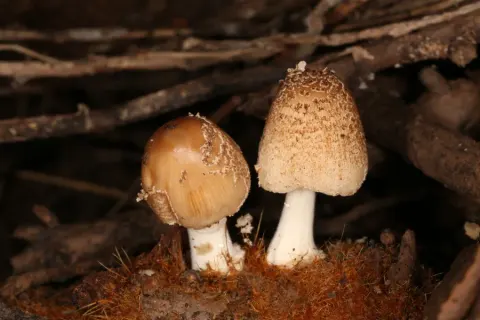
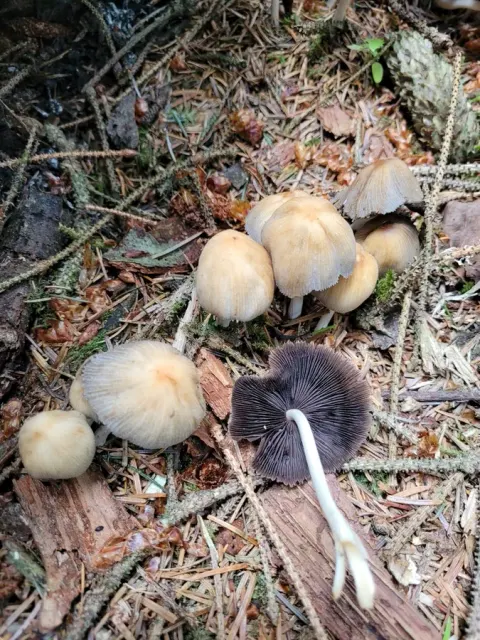
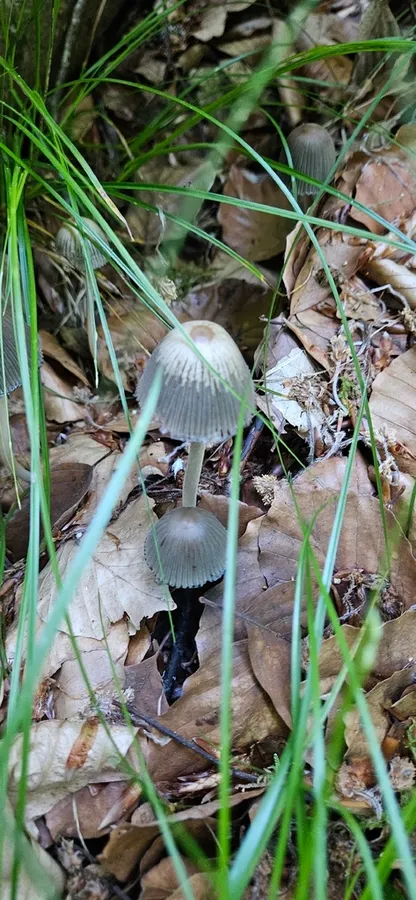
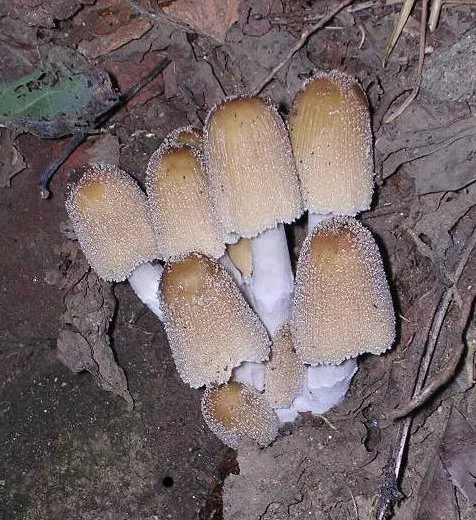
The cap is initially 1–2.5 cm in diameter, oval to cylindrical, but expands to become campanulate (bell-shaped), sometimes with an umbo (a central nipple-like protrusion); finally it flattens somewhat, becoming convex. When expanded, the cap diameter reaches 0.8–5 cm with the margin torn into rays and turned upwards slightly. The color is yellow-brown or tan often with a darker center, then pale yellow or buff from the margin inwards. The cap margin is prominently grooved almost all the way to the center; the grooves mark the positions of the longer gills on the underside of the cap. When young, the cap surface is covered with white or whitish shiny particles, remnants of the universal veil that covers immature specimens. Coprinellus micaceus is hygrophanous, meaning it assumes different colors depending on its state of hydration. The gills are crowded together closely, and have an adnexed (narrow) attachment to the stipe. Initially white, they change color to dark brown then eventually black as the spores mature. Expansion of the cap causes the gills to split open down their median planes, tearing the cap margin into rays. The process of spore discharge and autodigestion begin at the bottom of the gills before the upper parts of the gills have become completely blackened. The brittle stipe is hollow, and measures 3–10 cm long by 2–5 mm thick and is roughly the same diameter throughout the length of the stipe. It is generally white but may discolor to pale dirty cream from the base up. The stipe surface is at first velvety with a very fine whitish powder, but this eventually wears off, leaving it more or less smooth.
Habitat dan peran ekologis
Coprinellus micaceus is a saprotrophic species, deriving nutrients from dead and decomposing organic matter, and grows in and around stumps or logs of broad-leaved trees or attached to buried wood. It prefers feeding on bark, particularly the secondary phloem, rather than the wood. In the scheme of the succession of fungal species involved in the decomposition of wood, C. micaceus is a late stage colonizer, and prefers to feed on wood that has already decomposed sufficiently to have reached "a friable softened consistency". A 2010 study suggests that the fungus can also live as an endophyte, inhabiting the woody tissue of healthy trees without causing disease symptoms. The fungus is also associated with disturbed or developed ground, such as the sides of roads and paths, gardens, building sites and the edges of parking lots; it has also been noted for growing indoors on rotting wood in humid environments. In one instance it was discovered about 120 m (400 ft) underground in an abandoned coal mine, growing on wooden gangways and props used to support the roof. Fruit bodies are commonly found growing in dense clusters, but can also be found growing singly or in small clumps, especially in forested areas.
- Habitat atau konteks temuan
- Informasi belum tersedia pada sumber rilis ini.
- Substrat
- kayu; kulit kayu
- Peran atau konteks
- Pengurai
Reproduksi
The gills are crowded together closely, and have an adnexed (narrow) attachment to the stipe. Initially white, they change color to dark brown then eventually black as the spores mature. Expansion of the cap causes the gills to split open down their median planes, tearing the cap margin into rays. The process of spore discharge and autodigestion begin at the bottom of the gills before the upper parts of the gills have become completely blackened. The brittle stipe is hollow, and measures 3–10 cm long by 2–5 mm thick and is roughly the same diameter throughout the length of the stipe. It is generally white but may discolor to pale dirty cream from the base up. The stipe surface is at first velvety with a very fine whitish powder, but this eventually wears off, leaving it more or less smooth.
Catatan identitas dan cakupan
- Nama diterima mengikuti Catalogue of Life Base2026-09-11; uraian mempertahankan konsep dan nama sumber aslinya.
- Original geographic, specimen and life-cycle scope retained; source import awaits individual editorial review.
- Impor dan terjemahan otomatis belum diperiksa editorial per profil. Struktur reproduktif yang disebutkan tidak membuktikan seluruh siklus hidup diketahui.
- Pengukuran pada uraian mengikuti spesimen, kultur, dan metode sumber; angka tidak diperluas ke semua populasi.
Catatan distribusi dalam narasi mengikuti sumbernya. Dokumentasi spesimen atau foto mengikuti catatan sumber. Bukti wilayah Indonesia dan penilaian konservasi tidak disimpulkan dari gambar.
Melihat dengan konteks
Dokumentasi Coprinellus micaceus menurut asosiasi foto pada record takson iNaturalist. Kredit: Roberto Zanon. Identitas mengikuti sumber; bukan penentuan spesimen independen.
- Jenis
- Fotografi
- Kredit
- (c) Roberto Zanon, some rights reserved (CC BY-SA)
- Lisensi
- CC BY-SA 4.0
- Sumber media
- Buka entri sumber
Sumber profil
- [1] Coprinellus micaceus — Wikipedia (en)
- [2] Catalogue of Life Base2026-09-11 — Coprinellus micaceus
- [3] Dokumentasi visual — Coprinellus micaceus
Rujukan halaman ini
Fungi. Coprinellus micaceus. Rilis data fungi-2026-10-12-expansion-2. https://fungi-atlas.mgadib.chatgpt.site/jamur/coprinellus-micaceus/.
Status: impor sumber; pemeriksaan editorial per profil belum selesai. Untuk klaim biologis, gunakan rujukan pada bagian terkait dan periksa konteks sumber aslinya.