Ciri dan struktur
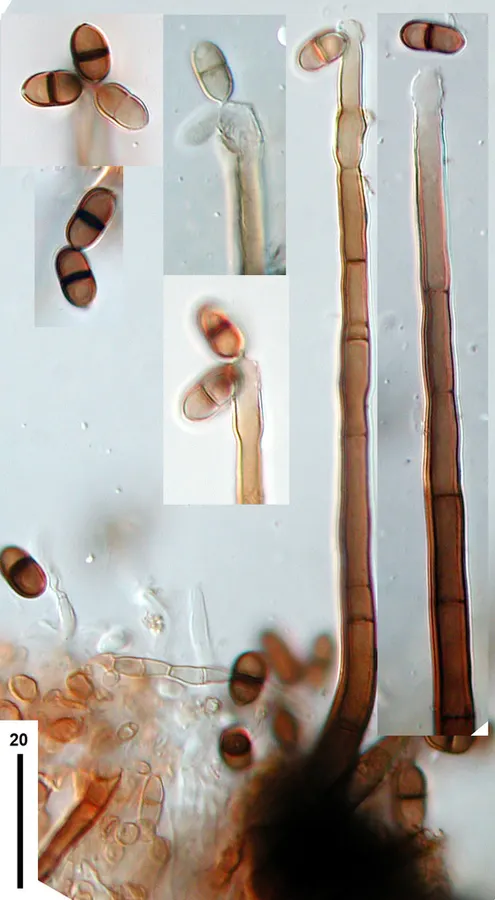
Colonies black, effuse, composed of erect conidiophores. Mycelium mostly immersed. composed of branched, septate, subhyaline to brown hyphae 1.5-3.5um wide. Conidiophores widely scattered or crowded, arising singly or in groups of up to 6, simple, finally up to 300µm long with the cells 12-22um Iong, usually bulbous and up to 9.5µm wide at the base. then 4.5-5.5um wide. and tapering to 3.5um toward the apex, brown to dark brown toward the base, paler toward the apex; the base characteristically bear, rooting hyphae. Some conidiophores are inconspi. cuously and transversely ridged toward the distal end. Conidia produced bIasticalIy on successive new growing points toward the apex of the conidiophore which becomes swollen, up to 9µm and denticulate with the scars of fallen conidia. Conidiophores can produce a terminal extension which produces a cluster of successive conidia on the apex which also becomes swollen; up to 5 such successive extensions of a single conidiophore have been seen. Conidia are dry, 1-septate, smooth, oblong to broadly ellipsoidal, sometimes somewhat narrowed medially, sIightIy denticuiate at the basal scar. pile brown to brown and uniformly pigmented or darker above the septum; they have a minute paler zone at the apex. Conidia measure 7- 1.5 x 4.5-5.7um. Conidia (? chlamydospores) produced on supeificial hyphae are sessile, broadiy ellipsoidal to obovoid. uiformly brown, continuous, and measure 7.2-10.8 x 4.5-5.4um. The collections cited above are in excellent agreement with the original illustrated account by de Hoog (op cit.). Examination of a derivative of the type isolation of C. oblongispora Matsushima (1975) indicates that this name is based on C. ellipsoidea.
Habitat dan peran ekologis
On dead wood and bark, (1-3) Auckland Prov., (1) Beilschmiedia tawa, Mamaku State Forest, 22.III.1963, J.M.D. DAOM 96094; (2) Leptospermum ericoides, Cornwallis, 31.XII.I962, J.M.D. POD 20401 (DAOM 93568); (3) Leptospermum scoparium Kauri Reserve, Coromandel-Whitianga Road, 6.IX.1963, PDD 21461 (DAOM 96090); (4) L.. scoparium North Canterbury, AshIey Gorge 14 V.1963, J.M.D. PDD 21050 (DAOM 96093); (Melicytus ramiflorus AuckIand Prov., Hunua Gorge, Hunua 12.11.1963, PDD 20565 (DAOM 96104); (6) Nothofagus fusca, WeIIington Prov., Tongariro NationaI Park, Ohakune Mountain Road (750m),7.111.1963, PDD 20642 (DAOM 96097); (7) is,. solandri var. cliffortioides, North Canterbury. Okuku VaIley, N of Oxford, 19.X.I963, J.M.D. PDD 21623 (DAOM 96092); (8) Pseudopanax crassifolius Au k_ land Prov., Upper Piha VaIley, Waitakere Range, 9.X.1963, J.M.D. DAOM 96091; (9-13) unidentified hosts, (9) AuckIand Prov., Scenic Drive, near Titirangi, 6.11.1963, DAOM 96105; (10) AuckIand Prov.. Orere, 20-11.1963, PDD 20569 (DAOM 96099); (11-13) WelIington Prov. - Tongariro National Park. Erua, 6. III.1963 PDD 20661 (DAOM 96078), DAOM 96098, 96095.
- Habitat atau konteks temuan
- hutan
- Substrat
- kayu
- Peran atau konteks
- Belum dikategorikan pada rilis ini.
Reproduksi
Colonies black, effuse, composed of erect conidiophores. Mycelium mostly immersed. composed of branched, septate, subhyaline to brown hyphae 1.5-3.5um wide. Conidiophores widely scattered or crowded, arising singly or in groups of up to 6, simple, finally up to 300µm long with the cells 12-22um Iong, usually bulbous and up to 9.5µm wide at the base. then 4.5-5.5um wide. and tapering to 3.5um toward the apex, brown to dark brown toward the base, paler toward the apex; the base characteristically bear, rooting hyphae. Some conidiophores are inconspi. cuously and transversely ridged toward the distal end. Conidia produced bIasticalIy on successive new growing points toward the apex of the conidiophore which becomes swollen, up to 9µm and denticulate with the scars of fallen conidia.
Catatan identitas dan cakupan
- Nama diterima mengikuti Catalogue of Life Base2026-09-11; uraian mempertahankan konsep dan nama sumber aslinya.
- Historical description as cited by BiotaNZ. Preserve explicit New Zealand/locality, host and specimen qualifiers. Distribution is the cited source scope, not a current global range.
- Impor dan terjemahan otomatis belum diperiksa editorial per profil. Struktur reproduktif yang disebutkan tidak membuktikan seluruh siklus hidup diketahui.
- Pengukuran pada uraian mengikuti spesimen, kultur, dan metode sumber; angka tidak diperluas ke semua populasi.
Catatan distribusi dalam narasi mengikuti sumbernya. Dokumentasi spesimen atau foto mengikuti catatan sumber. Bukti wilayah Indonesia dan penilaian konservasi tidak disimpulkan dari gambar.
Melihat dengan konteks
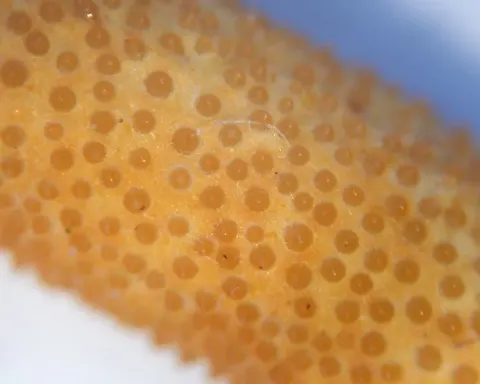
Dokumentasi Cordana ellipsoidea menurut asosiasi foto pada record takson iNaturalist. Kredit: Jerry Cooper. Identitas mengikuti sumber; bukan penentuan spesimen independen.
- Jenis
- Fotografi
- Kredit
- (c) Jerry Cooper, some rights reserved (CC BY), uploaded by Jerry Cooper
- Lisensi
- CC BY 4.0
- Sumber media
- Buka entri sumber
Sumber profil
- [1] Hughes, S.J. 1978: New Zealand fungi. 25. Miscellaneous species. New Zealand Journal of Botany 16(3): 311-370. — Cordana ellipsoidea
- [2] Catalogue of Life Base2026-09-11 — Cordana ellipsoidea
- [3] Dokumentasi visual — Cordana ellipsoidea
Rujukan halaman ini
Fungi. Cordana ellipsoidea. Rilis data fungi-2026-10-12-expansion-2. https://fungi-atlas.mgadib.chatgpt.site/jamur/cordana-ellipsoidea/.
Status: impor sumber; pemeriksaan editorial per profil belum selesai. Untuk klaim biologis, gunakan rujukan pada bagian terkait dan periksa konteks sumber aslinya.