Ciri dan struktur
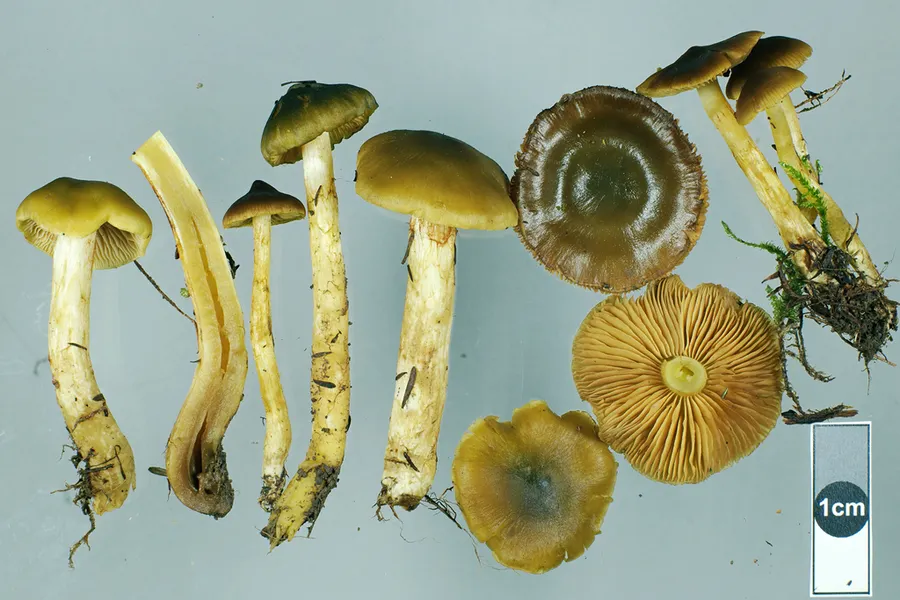
Pileus -60 mm, hemispherical or convex becoming broadly umbonate or obtusely campanulate finally depressed around umbo, margin distinctly inrolled in young specimens; centre black-olive, pale fuliginous-green or grey-green, fading towards margin to ochre-yellow or golden yellow; glutinous to viscid, remaining sticky, occasionally radially wrinkled, margin striate in aged carpophores, conspicuous veil remnants absent. - Lamellae 20-30, -7, adnate to broadly emarginate, subdecurrent with tooth, -7 mm wide; pale yellow to apricot (any green-olive tinge absent) turning yellow rust brown with age; edges concolorous, entire to serrulate. - Stipe -100 x-8 (-15 at base) mm, (sub)fusoid, subbulbous or clavate at base, rarely cylindrical, single or cespitose; pale yellow (occasionally with pale grey-olive shine); glutinous to viscid from base to subpersistent fibrillose or agglutinated cortina, apex dry, sometimes with yellow rhizoids at base; solid when young, becoming hollow. - Context pale yellow (turning brown upon bruising), distinctly olive-grey beneath cuticle of pileus. - Odour and taste acidulous to (weakly) raphanoid. - Chemical reactions on pileus (and stipe): KOH-red to red-brown. Spore print rust brown. - Spores 7-8.5-11 x (4-) 4.5-5.5 µm, oval to subelliptical, minutely verrucose but with coarse warts at apex (often embedded in perisporial remnants), rust brown. - Basidia 25-35 x 6-7 µm, 4-spored, often with purple-brown plasmatic pigment. - Cheilocystidia absent. - Pileipellis an ixocutis composed of cylindrical, strongly gelatinized, entangled hyphae (2-6 µm diam.), subcutis cellular, in KOH with brilliant red-purple both plasmatic, encrusting and intercellular pigment which scarcely dissolves in KOH, solvent stains pale olive brown, rarely with oleiferous hyphae. - Clamp connections present.
Habitat dan peran ekologis
On soil both in Nothofagus and Leptospermum forests. - New Zealand. In New Zealand D. alienata represents the most common species of the genus. It is found in mixed broadleaved forests but also occurs in pure stands of both Nothofagus spp. and Leptospermum spp. Due to the olive-green tinge on the yellow pileus D. alienata is readily confused with D. olivaceonigra or D. icterinoides. According to personal experience the definite identification and/or separation of the species belonging into this complex is often not possible in the field. A thorough microscopical examination should be supported by data obtained from thin-layer chromatography of the anthraquinonoid pigments (KELLER & al., 1988). Skyrin, hypericin and to a lesser degree dermolutein are the principal pigments which are responsible for the yellow colours of D. alienata. A similar pigment pattern is also found in D. icterinoides which, however, differs not only by the presence of additional pigment components but also several other distinctive macroscopical characters.
- Habitat atau konteks temuan
- hutan
- Substrat
- tanah
- Peran atau konteks
- Belum dikategorikan pada rilis ini.
Reproduksi
Pileus -60 mm, hemispherical or convex becoming broadly umbonate or obtusely campanulate finally depressed around umbo, margin distinctly inrolled in young specimens; centre black-olive, pale fuliginous-green or grey-green, fading towards margin to ochre-yellow or golden yellow; glutinous to viscid, remaining sticky, occasionally radially wrinkled, margin striate in aged carpophores, conspicuous veil remnants absent. - Lamellae 20-30, -7, adnate to broadly emarginate, subdecurrent with tooth, -7 mm wide; pale yellow to apricot (any green-olive tinge absent) turning yellow rust brown with age; edges concolorous, entire to serrulate. - Stipe -100 x-8 (-15 at base) mm, (sub)fusoid, subbulbous or clavate at base, rarely cylindrical, single or cespitose; pale yellow (occasionally with pale grey-olive shine); glutinous to viscid from base to subpersistent fibrillose or agglutinated cortina, apex dry, sometimes with yellow rhizoids at base; solid when young, becoming hollow. - Context pale yellow (turning brown upon bruising), distinctly olive-grey beneath cuticle of pileus. - Odour and taste acidulous to (weakly) raphanoid. - Chemical reactions on pileus (and stipe): KOH-red to red-brown.
Catatan identitas dan cakupan
- Nama diterima mengikuti Catalogue of Life Base2026-09-11; uraian mempertahankan konsep dan nama sumber aslinya.
- Historical description as cited by BiotaNZ. Preserve explicit New Zealand/locality, host and specimen qualifiers. Distribution is the cited source scope, not a current global range.
- Impor dan terjemahan otomatis belum diperiksa editorial per profil. Struktur reproduktif yang disebutkan tidak membuktikan seluruh siklus hidup diketahui.
- Pengukuran pada uraian mengikuti spesimen, kultur, dan metode sumber; angka tidak diperluas ke semua populasi.
Catatan distribusi dalam narasi mengikuti sumbernya. Dokumentasi spesimen atau foto mengikuti catatan sumber. Bukti wilayah Indonesia dan penilaian konservasi tidak disimpulkan dari gambar.
Melihat dengan konteks
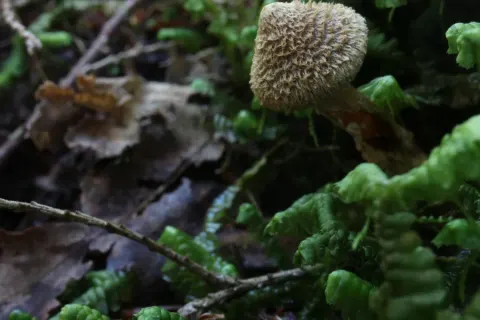
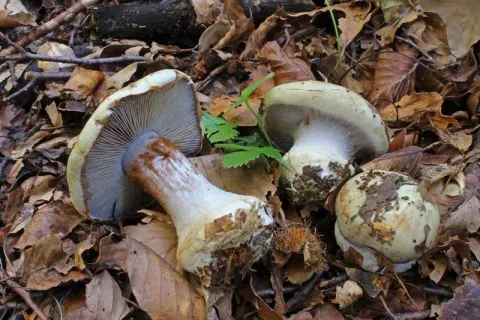
Dokumentasi Cortinarius alienatus menurut asosiasi foto pada record takson iNaturalist. Kredit: Jerry Cooper. Identitas mengikuti sumber; bukan penentuan spesimen independen.
- Jenis
- Fotografi
- Kredit
- (c) Jerry Cooper, some rights reserved (CC BY), uploaded by Jerry Cooper
- Lisensi
- CC BY 4.0
- Sumber media
- Buka entri sumber
Sumber profil
- [1] Horak, E. 1988: New species of Dermocybe (Agaricales) from New Zealand. Sydowia 40: 81-112. — Dermocybe alienata
- [2] Catalogue of Life Base2026-09-11 — Cortinarius alienatus
- [3] Dokumentasi visual — Cortinarius alienatus
Rujukan halaman ini
Fungi. Cortinarius alienatus. Rilis data fungi-2026-10-12-expansion-2. https://fungi-atlas.mgadib.chatgpt.site/jamur/cortinarius-alienatus/.
Status: impor sumber; pemeriksaan editorial per profil belum selesai. Untuk klaim biologis, gunakan rujukan pada bagian terkait dan periksa konteks sumber aslinya.